
A community benefits agreement is a legally binding contract between a developer and a community coalition that guarantees specific, measurable outcomes for residents affected by a development project. Unlike informal pledges or goodwill commitments, a true CBA carries legal recourse. It covers job quality, local hiring, affordable housing, environmental mitigation, and reporting requirements with penalties. For Georgia stakeholders, from Atlanta neighborhood groups to county officials evaluating data center proposals, understanding how these agreements work is the difference between a symbolic promise and a real community gain.
What makes a community benefits agreement enforceable?
A legally binding CBA includes three to five core elements: job quality standards, local hiring targets, affordable housing provisions, environmental mitigation measures, and clear reporting requirements with financial penalties for noncompliance. Each element must carry a measurable benchmark, not a vague aspiration. That specificity is what separates an enforceable contract from a developer's press release.

Effective agreements set performance metrics tracked over multiple years. A local hiring clause, for example, should state a specific percentage of construction jobs reserved for residents within a defined zip code, with quarterly reporting to an oversight committee. Without that structure, the clause is unenforceable in practice.
Oversight committees play a central role in sustained enforcement. These bodies, typically composed of community representatives, labor liaisons, and sometimes a neutral third party, review compliance reports and flag violations. Transparency in reporting builds public trust and creates political pressure for compliance even when legal remedies are slow.
- Job quality standards: Wage floors, benefits requirements, and union neutrality clauses
- Local hiring targets: Percentage thresholds for residents from affected zip codes or census tracts
- Affordable housing: Unit counts, income thresholds, and deed restriction timelines
- Environmental mitigation: Air quality monitoring, stormwater controls, and green space commitments
- Reporting and penalties: Quarterly or annual reports with defined fines for missed targets
Pro Tip: Avoid language like "best efforts" or "reasonable attempts" in any CBA clause. Courts consistently treat these phrases as unenforceable. Replace them with specific numbers, deadlines, and dollar penalties.
How does the negotiation and enforcement process work?
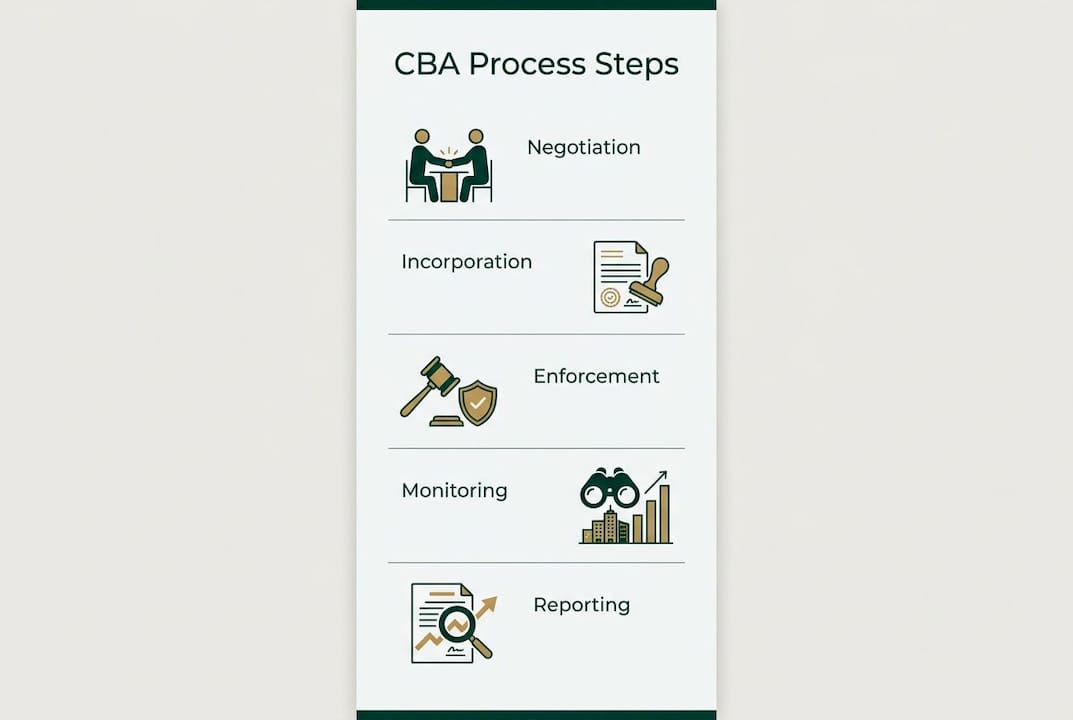
The negotiation process follows four distinct phases, and large projects can require continuous monitoring for 20 or more years. That timeline demands a structured process from the start.
- Public education. Community groups conduct surveys, host town halls, and partner with universities to identify priorities. Early collaboration strongly correlates with lasting agreement success. This phase builds the coalition's credibility and negotiating mandate.
- Formal negotiation. Representatives from labor, faith, environmental, and resident groups sit across the table from the developer's legal team. A broad-based coalition is not optional. Developers arrive with experienced attorneys. Communities that fragment into competing factions lose leverage immediately.
- Contract drafting and signing. Legal counsel for both sides drafts the final agreement. Every commitment gets a defined metric, a reporting schedule, and a penalty structure. The signed document becomes the enforcement baseline.
- Long-term implementation and enforcement. Enforcement provisions include remediation steps, judicial orders, and fines. Smaller communities, however, often lack resources for sustained legal action. That resource gap is the most common reason agreed benefits go partially delivered.
The most durable CBAs get embedded directly into municipal development agreements, not left as standalone private contracts. When a city or county formally incorporates the CBA into its approval conditions, the developer cannot walk away from obligations after the ribbon cutting.
Pro Tip: Request that your city or county attorney formally incorporate the CBA into the development approval ordinance. A private contract between a community group and a developer is harder to enforce than a condition of municipal approval.
How have community impact agreements been applied across project types?
CBAs are most common in projects that receive public subsidies, including tax abatements, land transfers at below-market value, or infrastructure investments paid by taxpayers. The public benefit rationale is straightforward: if taxpayers subsidize a project, the project should deliver measurable returns to those taxpayers.
The range of applications is wider than most stakeholders realize. Workforce development commitments for disadvantaged groups, affordable housing provisions tied to transit projects, and environmental oversight clauses in industrial rezoning cases all qualify as CBA examples. Data center projects represent a growing category, particularly relevant in Georgia given the state's rapid expansion of technology infrastructure.
Data center CBAs address a specific set of concerns. These facilities generate significant tax revenue and utility demand but create relatively few permanent jobs. A well-drafted neighborhood benefits agreement for a data center might include:
- Job creation targets: Commitments to hire locally for construction and a defined number of permanent technical positions
- Tax revenue sharing: Agreements on how property tax revenue flows to local schools or infrastructure funds
- Utility cost-sharing: Provisions addressing the strain large facilities place on local power and water systems
- Environmental safeguards: Cooling system standards, noise limits, and stormwater management plans
| Project type | Common CBA provisions |
|---|---|
| Data centers | Local hiring, tax revenue commitments, utility cost-sharing |
| Transit infrastructure | Affordable housing near stations, workforce development |
| Mixed-use redevelopment | Affordable unit percentages, small business set-asides |
| Industrial rezoning | Air quality monitoring, green buffers, community health funds |
| Mining and extraction | Land restoration bonds, royalty-sharing, environmental oversight |
CBAs also reduce project conflict. When communities shift from reactive opposition to proactive negotiation, project timelines often shorten. Developers gain predictability. Communities gain binding commitments. That mutual benefit is why CBAs generate local benefits that pure opposition rarely achieves.
What are best practices and common pitfalls for CBA stakeholders?
Most failed CBAs share the same defects: vague language, no measurable targets, unclear roles, weak enforcement mechanisms, and no penalties for noncompliance. These are not accidental omissions. Developers with experienced legal teams sometimes use framework-style language intentionally to create the appearance of commitment without the substance.
The distinction matters legally. A community benefits framework is a set of non-binding guidelines. A true CBA is legally enforceable with defined recourse. Communities that accept a framework when they negotiated for an agreement have no legal remedy when commitments go unmet.
Best practices for community groups and officials:
- Start community engagement before the developer files any permit application. Early involvement shapes the project, not just the agreement.
- Build a coalition that spans labor unions, faith communities, environmental organizations, and resident associations. A united front strengthens negotiating power.
- Require specific, measurable commitments in every clause. "30% of construction jobs to residents within zip codes 30310 and 30311" is enforceable. "Local hiring preference" is not.
- Establish a transparent reporting structure with public access to compliance data.
- Consult legal counsel experienced in community development contracts before signing anything.
Common pitfalls to avoid:
- Accepting a non-binding framework as a substitute for a legal agreement
- Allowing a developer to negotiate separately with individual community groups rather than a unified coalition
- Omitting dispute resolution procedures, including mediation and arbitration timelines
- Failing to define what happens when a developer sells the project to a new owner
Pro Tip: Embed the CBA into the official development agreement filed with your municipality. Without that step, a developer can satisfy the approval process and then treat the community contract as optional once construction begins.
Key Takeaways
A community benefits agreement delivers real outcomes only when it combines specific measurable commitments, broad coalition representation, and formal integration into municipal development approvals.
| Point | Details |
|---|---|
| Legal enforceability is non-negotiable | A framework without penalties is not a CBA. Require defined metrics and financial consequences. |
| Coalition breadth determines leverage | Labor, faith, environmental, and resident groups together outweigh fragmented advocacy. |
| Municipal integration extends compliance | Embedding the CBA in city or county approval conditions outlasts private contracts. |
| Vague language kills agreements | Replace "best efforts" with specific numbers, deadlines, and dollar penalties in every clause. |
| Early engagement shapes outcomes | Community input before permit filing produces stronger provisions than late-stage negotiation. |
What I've learned watching CBAs succeed and fail in Georgia
The most common mistake I see is communities celebrating a signed agreement as the finish line. The signature is the starting line. A CBA is only as strong as the enforcement infrastructure built around it. In Georgia, where development pressure in metro Atlanta and secondary markets like Savannah and Augusta is accelerating, that distinction is becoming urgent.
The agreements that actually deliver results share one characteristic: the community coalition stayed organized after signing. Groups that disbanded or lost funding within two years of signing consistently saw developers slow-walk or quietly abandon commitments. The developer's legal team does not forget the agreement. The community cannot afford to either.
I am also watching the data center CBA space closely. Georgia is one of the top data center markets in the Southeast. These projects bring real tax revenue but limited job creation. The communities that negotiate well are the ones that quantify the utility burden, demand specific permanent job numbers, and tie tax revenue commitments to school funding formulas. Generic "community investment" language in a data center CBA is worth almost nothing.
The other pattern worth naming: developers sometimes offer a community-focused planning process as a substitute for a binding agreement. Participation in a planning process feels meaningful. It is not a legal contract. Communities should accept both, not one instead of the other.
The future of CBAs in Georgia depends on whether local governments treat them as conditions of approval rather than optional add-ons. Municipalities that formally incorporate these agreements into development ordinances create a compliance environment that private contracts cannot replicate.
— Jeremy
How Urbanplanningpros supports community benefit projects
Urbanplanningpros works with landowners, developers, and local stakeholders across Georgia to assess project feasibility and align development plans with community priorities before negotiations begin.

A feasibility study from Urbanplanningpros identifies project impacts, infrastructure constraints, and community needs early, giving all parties a factual foundation for CBA negotiations. That groundwork reduces conflict, shortens timelines, and produces agreements grounded in what a project can actually deliver. Urbanplanningpros also provides expert project management to track CBA compliance milestones, coordinate reporting, and flag implementation gaps before they become legal disputes. If your project involves a community benefit component, contact Urbanplanningpros to build the planning foundation that makes those commitments stick.
FAQ
What is a community benefits agreement?
A community benefits agreement is a legally binding contract between a developer and a community coalition that requires specific, measurable benefits such as local hiring, affordable housing, and environmental protections in exchange for project support.
How is a CBA different from a community benefits framework?
A CBA is legally enforceable with defined penalties for noncompliance. A community benefits framework is a non-binding set of guidelines that carries no legal recourse if a developer fails to deliver.
Who negotiates a community benefits agreement?
A broad coalition of labor unions, faith organizations, environmental groups, and resident associations negotiates on the community side. Developers are typically represented by experienced legal counsel.
What makes a CBA enforceable long-term?
Embedding the CBA into the official municipal development agreement is the most reliable enforcement mechanism. Private contracts between community groups and developers are harder to enforce than formal conditions of government approval.
What provisions should a Georgia data center CBA include?
A data center CBA in Georgia should address local hiring targets for both construction and permanent positions, utility cost-sharing arrangements, property tax revenue allocation, and environmental standards for cooling systems and stormwater management.