A conditional use permit (CUP) is a discretionary land use approval that lets a use already listed as conditional in a zoning ordinance move forward, subject to site specific conditions. If your project sits in that category, your first move is checking the local zoning table for your district, then scheduling a pre-application meeting with planning staff before you draft anything else.
TL;DR:
- Most conditional use permits are granted if applicants demonstrate site-specific standards, with approval often running with the property and requiring ongoing compliance.
- The application process demands early studies, detailed site plans, and precise alignment with local decision criteria to avoid delays and continuances.
- Fees are driven by project complexity, with costs including environmental or traffic studies and consultant work, often amounting to several thousand dollars.
- Approval hinges on meeting standards for neighborhood compatibility, infrastructure adequacy, and adherence to comprehensive plans, with conditions imposed to mitigate impacts.
- Proper preparation and a solid factual record are more critical than community support or public opposition in securing a permit on the first attempt.
Table of Contents
- What a Conditional Use Permit Actually Is
- Why Cities Require CUPs and What Typically Needs One
- CUP vs. Variance vs. Special Exception
- How to Get a CUP: The Application Checklist
- Timeline and Cost Expectations
- How Approval Criteria and Conditions of Approval Work
- Public Hearings, Notice, and Appeals
- After Approval: Recording, Compliance, and Revocation
- How Urban Planning Pros Supports the CUP Process
- The Overlooked Part of Getting a CUP Approved
- Get Entitlement Support Without the Guesswork of DIY Filing
- Where to Verify Local CUP Requirements
- Sources
- FAQ
What a Conditional Use Permit Actually Is
A CUP is not a loophole and it is not a favor from city hall. It is a mechanism written directly into the zoning ordinance that lets certain uses operate in a district if the applicant can demonstrate they meet specific standards. If you satisfy those standards, the governing body generally has to approve the request, though it can attach conditions to manage impacts, according to King County's conditional use permit guidance.
Most CUP decisions are quasi-judicial. That means the planning commission, hearing examiner, or council is applying facts to fixed legal standards rather than voting on preference, which is why the record you build matters so much later.
Once granted, a CUP typically runs with the land rather than the applicant. A few things follow from that:
- The permit stays valid when the property changes hands, not just while the original owner holds title.
- New owners inherit both the approval and the obligation to comply with its conditions.
- Local jurisdictions can still record the CUP against the property, so future title searches and due diligence will surface it.
- Modifying or terminating an existing CUP usually requires its own separate process, not a unilateral decision by whoever owns the land at the time.
Why Cities Require CUPs and What Typically Needs One
Zoning codes treat some uses as fine everywhere in a district and others as fine only if the specific site and design can absorb the impact. A CUP exists to sort the second group without banning it outright. The policy goal is compatibility: letting a use exist while making sure it does not degrade the neighborhood around it.
Common examples that show up on conditional use lists across the country include:
- Houses of worship or schools proposed inside residential zones
- Drive-thru restaurants near residential boundaries or high-traffic corridors
- Cell towers and wireless communication facilities
- RV parks, campgrounds, or short-term lodging uses
- Expansions or changes to legally nonconforming structures
- Group homes, daycare centers, or other uses with specific occupancy or traffic profiles
Every jurisdiction publishes its own list, organized by zoning district, inside the local ordinance. There is no universal roster of conditional uses. A drive-thru might be outright permitted in one commercial zone and conditional two towns over. That variation is exactly why the zoning table check has to happen before you assume anything about your project.
CUP vs. Variance vs. Special Exception
These three terms get used interchangeably by people who should know better, and the confusion sends applicants down the wrong process more often than it should.
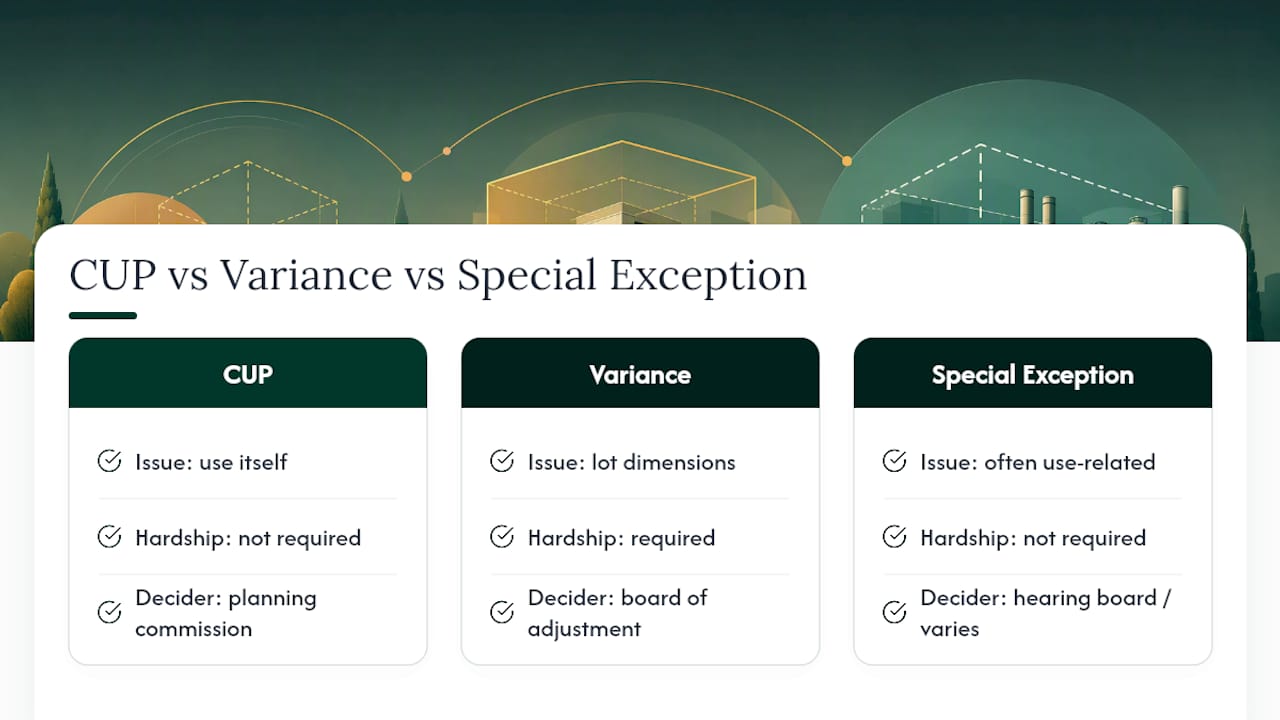
A variance addresses dimensional or physical hardship. It is for situations where strict application of the code, like a setback or height limit, creates a practical difficulty tied to something unique about the lot itself. The applicant has to prove hardship, not just inconvenience.
A special exception is largely a labeling difference from state to state. In many frameworks it functions almost identically to a CUP, but the deciding body can differ. A zoning hearing board or board of adjustment often decides special exceptions, while a planning commission or council typically decides CUPs, according to Pennsylvania's planning series on special exceptions, conditional uses, and variances.
If your use is not permitted outright and does not appear on any conditional list, and the problem is really about lot dimensions, you likely want a variance. If the use itself is the issue, you want a CUP or its local equivalent.
How to Get a CUP: The Application Checklist
Getting a conditional use permit approved on the first pass comes down to sequencing. Applicants who skip steps almost always end up with a continuance, which adds months, not days, to the calendar.
- Confirm the use is actually conditional. Pull your zoning district's table and verify the use is listed as conditional, not permitted outright or prohibited.
- Request a pre-application meeting. Most planning departments will meet with you before you file anything, and this is where you learn which studies you actually need instead of guessing.
- Scope required studies early. Traffic, noise, stormwater, and environmental checklists (including SEPA review in states that require it) can take weeks to commission, so start them the day you leave the pre-application meeting.
- Assemble the narrative and legal documents. A project narrative explaining the use, a legal description of the parcel, and proof of ownership or authorization are baseline requirements almost everywhere.
- Prepare scaled drawings. A scaled site plan, a vicinity map, architectural elevations, and civil or grading plans need to match the level of detail your jurisdiction's checklist specifies, per King County's application requirements.
- Run parking and circulation numbers. Parking calculations tied to the proposed use are one of the most common reasons for an incomplete application.
- Submit for completeness review. Staff will check your package against the checklist and issue a completeness determination, sometimes routing it to other agencies for referral comments.
- Respond to referral comments quickly. Slow turnaround on staff comments is one of the most preventable causes of a continued hearing date.
Pro Tip: Build your studies around the ordinance's exact decision criteria, not around what you assume the reviewer wants to see. The burden of proof sits with the applicant, so an application organized section by section against the code's own standards reads faster and gets fewer follow-up requests.
Every application checklist looks slightly different by jurisdiction, but the shape is remarkably consistent once you've built one. If your project involves a mixed-use concept with multiple entitlement layers, coordinating site plans and public-hearing prep early prevents the studies from arriving out of order.
Timeline and Cost Expectations
Administrative CUP reviews, the ones decided by staff without a public hearing, often move in a matter of weeks. Once your application requires a planning commission or council hearing, expect months rather than weeks, and complex projects with contested hearings can run past six months.
Fees vary by jurisdiction and by project scope, but they scale with complexity rather than staying flat. Some borough-level examples show application fees starting around $1,600 with processing times that can be several weeks for certain permit types, according to the Matanuska-Susitna Borough's conditional use permit page.
Budget beyond the application fee itself. The real cost driver for most CUP applicants isn't the filing fee, it's the consultant work behind it.
Line items worth planning for:
- Traffic, noise, or environmental study fees, which can run into the thousands depending on scope
- Legal or planning consultant time to prepare the narrative and manage referrals
- Costs tied to implementing conditions once approved, like landscaping buffers or signal upgrades
- Resubmission fees if the application is deemed incomplete on first review
Municipal filing systems and deadlines also vary. Some cities, like Chesapeake, Virginia, run submissions through dedicated online portals with hard cutoff dates for each hearing cycle, so missing a filing window can push your timeline out an entire cycle.
How Approval Criteria and Conditions of Approval Work
Every jurisdiction's ordinance spells out the standards a CUP application has to meet, and reviewers score the application against those standards, not against general goodwill toward the project. Recurring criteria across most codes include:
- Compatibility with surrounding land uses and neighborhood character
- Adequate traffic circulation and parking for the proposed use
- Sufficient public facilities and utility capacity to support the use
- Consistency with the jurisdiction's comprehensive plan
When a proposal creates impacts that a straight denial would otherwise trigger, many jurisdictions favor conditioning the approval over rejecting it outright, as long as the conditions can realistically mitigate the anticipated effect, per land use practice guidance on conditional use permits. Typical conditions include hour-of-operation limits, landscaping buffers, lighting restrictions, or capped occupancy.
Conditions have to be tied to an actual impact the project creates, not arbitrary. Watch for one wrinkle: some state statutes limit how much a jurisdiction can condition off-site transportation improvements, so a demand for a traffic signal miles away may exceed what the code allows, per the Pennsylvania planning series.
Approved CUPs aren't necessarily permanent without oversight. Many include monitoring provisions, periodic compliance review, or revocation triggers if conditions go unmet, according to University of Wisconsin Extension's training materials on conditional uses.
Public Hearings, Notice, and Appeals
Notice requirements typically combine published notice in a local paper with mailed notice to property owners within a set radius, often 300 to 1,000 feet depending on the jurisdiction. The hearing body itself varies: some CUPs go to a planning commission, others to a full council, and some jurisdictions route them to a hearing examiner instead.
- Build your factual record before the hearing, not during it, with written findings and expert reports ready to submit.
- Coach anyone testifying on your behalf to speak to the ordinance criteria specifically, not general project enthusiasm.
- Remember that neighborhood opposition alone is not a lawful basis for denial. Decisions need to rest on substantial evidence tied to the ordinance's standards, per legal analysis on administrative land-use decision making.
- Appeal windows are generally short, and appeals typically go to a local board of adjustment or directly to court depending on the jurisdiction.
After Approval: Recording, Compliance, and Revocation
Once granted, most jurisdictions record the CUP against the property, which is what allows it to transfer with ownership rather than expiring at the sale. You'll usually still need separate building or operational permits before construction or use begins, since the CUP addresses land use eligibility, not construction code compliance.
- Keep dated evidence of ongoing compliance, photos, inspection reports, operational logs, in one place.
- Review your conditions annually against what's actually happening on site, not just what was proposed.
- Know your jurisdiction's revocation triggers before you need to worry about them; noncompliance is the most common one.
- If your operation needs to change, apply for a modification rather than assuming minor drift is acceptable.
Pro Tip: Keep a compliance binder from day one. A simple folder with dated photos and logs turns a future modification request from a fight into paperwork.
How Urban Planning Pros Supports the CUP Process
Consulting teams can work alongside landowners and developers through feasibility studies, entitlement strategy, and application preparation, the exact stages where CUP applications go sideways. Coordinated submittals across multiple agencies and a factual record built before the hearing date tend to mean fewer continuances and a shorter path from filing to approval. The firm's portfolio includes coordination on mixed-use entitlement projects that required exactly this kind of multi-agency sequencing.
The Overlooked Part of Getting a CUP Approved
Most guidance on conditional use permits treats the hearing as the finish line. It isn't. The application package you submit weeks earlier decides the outcome far more than anything said at the podium, because a quasi-judicial body is legally required to weigh evidence, not enthusiasm or opposition volume.

The conventional advice tells applicants to "build community support." That's not wrong, but it's incomplete, and it can even backfire if it substitutes for the ordinance-based record you actually need. A packed room of supporters doesn't satisfy a traffic circulation standard. A stormwater study does.
What gets underestimated is timeline risk from incomplete submittals. A single missing study or an underscoped traffic count doesn't just delay your file, it pushes you into the next hearing cycle, which on a council-level review can mean another two or three months gone. Prioritize the studies and the narrative's alignment with your jurisdiction's specific decision criteria before you spend a single dollar on public outreach. Get the record right first. The politics matter less than people think once the record is solid.
— Jeremy Wenger
Get Entitlement Support Without the Guesswork of DIY Filing
Some applicants handle a straightforward CUP themselves, especially when the use is well-precedented and the jurisdiction's checklist is short. But once a project involves multiple studies, agency referrals, or a contested public hearing, the margin for a costly continuance grows fast. A consulting team that scopes your required studies, drafts the narrative against your jurisdiction's exact approval criteria, and coordinates submittals across agencies can help ensure your file lands complete the first time.

If you're still deciding whether your project even needs a CUP or a different entitlement path, a feasibility study answers that before you spend money on the wrong application. For projects already headed toward a hearing, the land planning services team can prepare the site plans, studies, and hearing record together. Reach out for a project snapshot and find out what your site can realistically support before your next planning department meeting.
Where to Verify Local CUP Requirements
Start with your jurisdiction's own checklist, like King County's conditional use permit information and checklist or the Matanuska-Susitna Borough's CUP page. Local code and your planning department's application packet always control over any general guide.
Sources
- Conditional Use Permit information and checklist (King County)
- MSB - Conditional Use Permit
- Law/legal analysis on administrative land-use decision making and public hearing evidence
- Special Exceptions, Conditional Uses and Variances (Pennsylvania planning series)
FAQ
What is an example of a conditional use?
A house of worship or school proposed inside a residential zone is a common example, along with drive-thru restaurants, cell towers, and RV parks in districts where those uses aren't permitted outright.
What is a conditional use permit in Kentucky?
Kentucky follows the same general framework as most states: a use listed as conditional in the local zoning ordinance can proceed if the applicant meets the ordinance's specific standards, with the local board of adjustment or planning commission deciding the request.
How long does a conditional use permit take?
Administrative reviews without a public hearing often take a matter of weeks, while applications requiring a planning commission or council hearing typically take months, and complex or contested projects can run past six months.
What is a conditional use permit in California?
California cities apply the same conditional use structure found nationally: a use is listed as conditional in the zoning code, and the applicant must demonstrate compliance with locally adopted findings, such as compatibility and public facility adequacy, before a planning commission or hearing officer.