Conditions of approval are legally binding entitlement terms, not suggestions, and ignoring them can freeze a permit or trigger revocation. The single move that protects your project today is building a conditions matrix: pull every condition from the resolution, map it to a milestone, assign a responsible party, and log the clearance date. Do this before your next submittal, not after a plan check rejection forces the issue.
TL;DR:
- Building a conditions matrix before submittal helps track each requirement, responsible party, and deadline, preventing project stalls caused by unfulfilled conditions.
- Most conditions are tied to specific milestones like grading, improvement plans, or building permits, with "prior to" triggers determining the next step; missing these delays approvals.
- Cost impacts primarily involve infrastructure improvements, mitigation fees, and bonds, which should be estimated early to avoid financial surprises during construction.
- Non-negotiable standard conditions usually require compliance; project-specific conditions may have room for negotiation if supported by technical justification.
- Regularly reviewing and updating the conditions matrix ensures ongoing compliance, especially for long-term monitoring and during ownership transitions.
Table of Contents
- What Is Conditions of Approval Compliance?
- What Do the Milestone Acronyms GP, IP, BP, PCC, and UO Mean?
- How Do You Read COAs for Cost and Schedule Impact?
- Can You Negotiate or Amend a Condition of Approval?
- How Do You Build a Conditions Matrix That Actually Works?
- Which Departments Sign Off on Your Conditions?
- What Happens if You Don't Comply with a Condition?
- A Copyable COA Checklist and Sample Matrix Row
- How Often Should You Review Compliance Status?
- What Tools Help You Manage COA Compliance?
- What Do Successful and Failed COA Compliance Look Like?
- Who Needs to Stay in the Loop During Compliance?
- How Should You Plan for Compliance Before You Even Submit?
- The Recurring Mistakes That Cost Developers Months
- How Urban Planning Pros Helps You Stay Ahead of Every Condition
- Where to Verify Jurisdiction-Specific COA Rules
- Sources
- FAQ
What Is Conditions of Approval Compliance?
Conditions of approval compliance means satisfying every requirement attached to a land use entitlement, in the order and format the jurisdiction specifies, before you can move to the next permit stage. A typical COA resolution is not one undifferentiated list. It's organized by department, and each department's conditions carry their own intent, format, and clearance path.
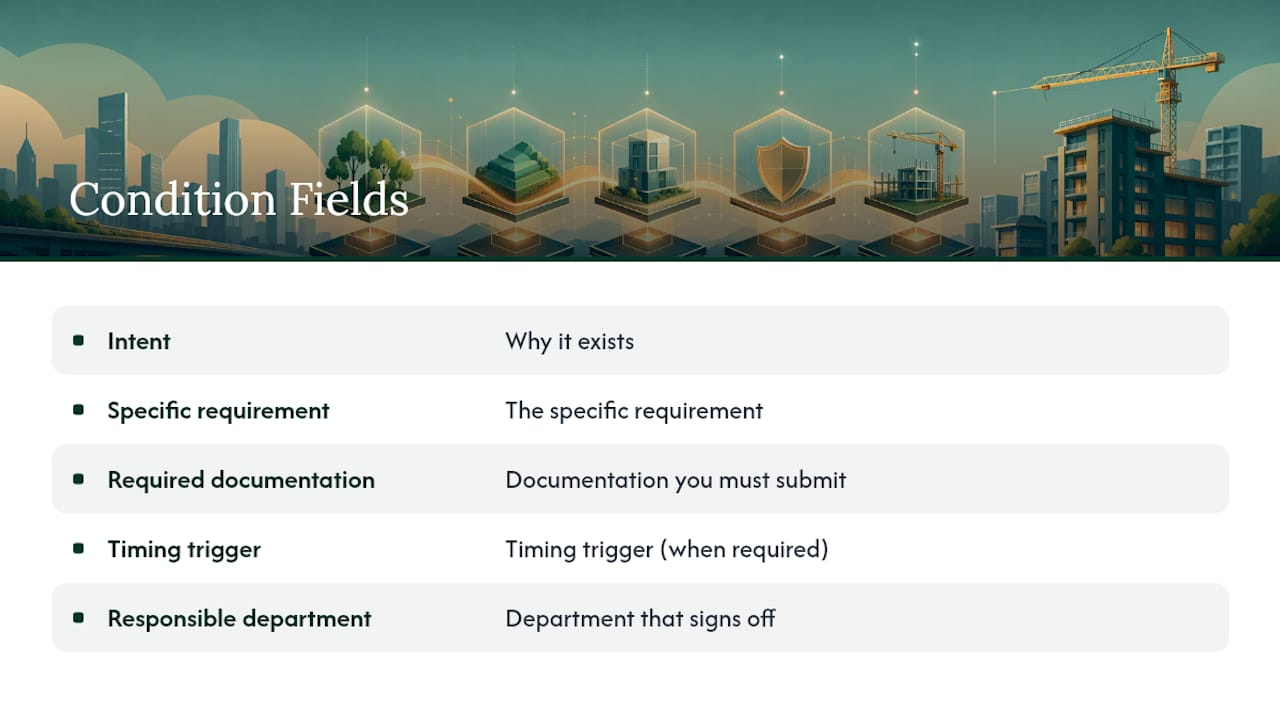
Most resolutions group conditions into planning, public works or engineering, environmental, fire, and utilities sections, with special studies (traffic, geotechnical, biological) sometimes broken out separately. Each individual condition, according to the San Diego County Conditions of Approval Manual, should state its intent (why it exists), the specific requirement, the documentation you must submit, the timing trigger, and the department that signs off.
Condition coding is your shortcut. A prefix like "PW" or "ENV" usually points you straight to the reviewing division, saving you a phone call. Learn to read that code on day one, because it tells you who owns the clearance before you've read a single sentence of the requirement itself.
What Do the Milestone Acronyms GP, IP, BP, PCC, and UO Mean?
Every COA ties to a point in your project timeline, and jurisdictions abbreviate those points instead of spelling them out. Missing one of these codes is how developers end up with a bond application stuck for months.
- GP — Grading Permit, often the first construction-adjacent milestone
- IP — Improvement Plans, engineering design submittal for public infrastructure
- BP — Building Permit, the trigger for most building and life-safety conditions
- PCC — Prior to Certificate of Compliance (or Prior to Commencement of Construction, depending on jurisdiction), a common early gate
- UO — Use of Occupancy, tied to final inspections and operational conditions
- RP — Recordation of the (Final) Map, which locks in the subdivision itself
The phrase "prior to" is the operative language in almost every condition, and it's the most reliable indicator of what blocks your next step. A condition that reads "Prior to issuance of Building Permit" means the county will not stamp your building plans until that requirement clears, full stop. Rank every "prior to" condition against your own construction schedule before you rank anything else. The conditions with no explicit timing trigger are usually lower priority, but never assume; verify with the reviewing department.
How Do You Read COAs for Cost and Schedule Impact?
Look for verbs and nouns that signal capital spending versus paperwork. "Construct," "install," "dedicate," or "improve" almost always mean a contractor and a budget line. "Submit," "provide evidence," or "record a covenant" usually mean staff time and a modest fee, not a construction contract.
Four cost categories show up in nearly every resolution: physical improvements (curbs, sidewalks, utility extensions), mitigation program costs (biological monitoring, cultural resource surveys), monitoring or condition review fees charged directly by the jurisdiction, and security deposits or performance bonds held until work is verified complete.
Add an estimated cost column to your conditions matrix and flag anything touching infrastructure or mitigation for an early vendor quote. Bonds and deposits in particular tie up capital for the life of the entitlement, so knowing the number in month one beats discovering it in month eleven when your construction loan is already drawn.
Can You Negotiate or Amend a Condition of Approval?
Some conditions are negotiable; most aren't, and knowing the difference saves you a wasted hearing. Standard conditions, the boilerplate language applied to every project of a given type, are rarely open for discussion. Project-specific conditions, drafted for your site's particular constraints, sometimes have room to move.
A variance or amendment request that actually succeeds contains three things: a technical justification (an engineering or environmental report showing the alternative meets the same intent), an alternatives analysis showing you considered the standard requirement first, and evidence of stakeholder outreach to neighbors or affected agencies. Large federal approval processes follow the same logic. BOEM's Construction and Operations Plan conditions require formal notification and documented review before a variance is granted, a useful analog for how seriously local jurisdictions treat the same request.
File the request before the submittal it would block, not after. A variance filed the week your grading permit application is due almost never gets fair consideration.
How Do You Build a Conditions Matrix That Actually Works?
A spreadsheet beats a PDF binder every time, because a resolution document tells you nothing about status. Your matrix needs these columns, at minimum:
- Condition ID (matching the resolution's numbering)
- Intent (one sentence, in plain language)
- Requirement description
- Milestone or timing trigger
- Responsible party
- Required submittals or documentation
- Clearance contact (name, department, phone or email)
- Status (open, in progress, submitted, cleared)
- Date cleared
Assignment matters as much as the list itself. Your civil engineer typically owns grading, drainage, and utility conditions. Your architect owns building code and accessibility items. Your contractor owns construction-phase conditions like erosion control and noise limits. You, as owner or developer, own everything involving payment, dedication, or a signature on a covenant. Leaving a condition unassigned is the single most common reason a project stalls at plan check.
Pro Tip: Keep a live "conditions register" inside your project's document management system rather than a static file. When your surveyor or a new contractor joins mid-project, they should be able to check the register and know instantly whether a condition is cleared, pending, or deferred, without a phone call to you.
Review the matrix at every project team meeting, not just before a submittal deadline, and archive every signed clearance letter in one folder tied to the condition ID.
Which Departments Sign Off on Your Conditions?
Clearance authority almost always splits along the same lines: planning handles land use and design conditions, public works or engineering handles grading and infrastructure, building handles life-safety and code items, environmental health or a separate environmental division handles mitigation monitoring, fire handles access and suppression systems, and the utility provider handles service extensions and easements.
Condition coding usually flags which division owns a given item, so read the prefix before you call the county switchboard. Once you've identified the reviewer, add their name, direct line, and email into your matrix immediately. A generic "Planning Department" entry is useless six months later when you need a signature and the original reviewer has moved to a different desk.
What Happens if You Don't Comply with a Condition?
Jurisdictions don't jump straight to the harshest penalty, but they do escalate predictably. A sample Notice to Permittee from Ventura County's Mitigation Monitoring and Reporting Program lists the standard enforcement ladder: reporting the violation to the planning commission, suspending permit operations, denying recordation of the final map, modifying or revoking the underlying permit, and forfeiting any bond or security deposit posted against the condition.
Remediation, where you're given a defined window to cure the deficiency, is the jurisdiction's default first move. Revocation is reserved for repeated or willful noncompliance. What surprises many owners is that conditions don't expire when you sell. Recordation notices attach many conditions to the property itself, meaning a successor owner inherits obligations you never finished, which is exactly the kind of liability a title company will flag during due diligence.
A Copyable COA Checklist and Sample Matrix Row
Building your own tracking system doesn't require software on day one. A five-step checklist gets you moving:
- Extract every condition from the resolution into a single list, in the order they appear
- Map each one to its milestone (GP, IP, BP, PCC, UO, RP)
- Assign a responsible party and a clearance contact
- Estimate the cost or fee tied to each condition
- Set a target clearance date and track it against your schedule
A sample row might read: Condition 14, Public Works, "Dedicate 10-foot public utility easement along frontage," Prior to Improvement Plan approval, Civil Engineer, Recorded easement document plus title report, Contact: PW Land Development Division, Status: In Progress, Target Date: March 2026.
Pro Tip: Site plan checklists in jurisdictions like Prince George's County explicitly require you to document conditions from prior approvals, not just the current one. Carry every open condition forward into each new submittal, or plan reviewers will bounce your application back for a status letter.
This is exactly the audit work a feasibility study performs before you close on land or break ground, cross-referencing every condition against zoning, infrastructure capacity, and market timing so nothing surfaces as a surprise mid-construction.
How Often Should You Review Compliance Status?
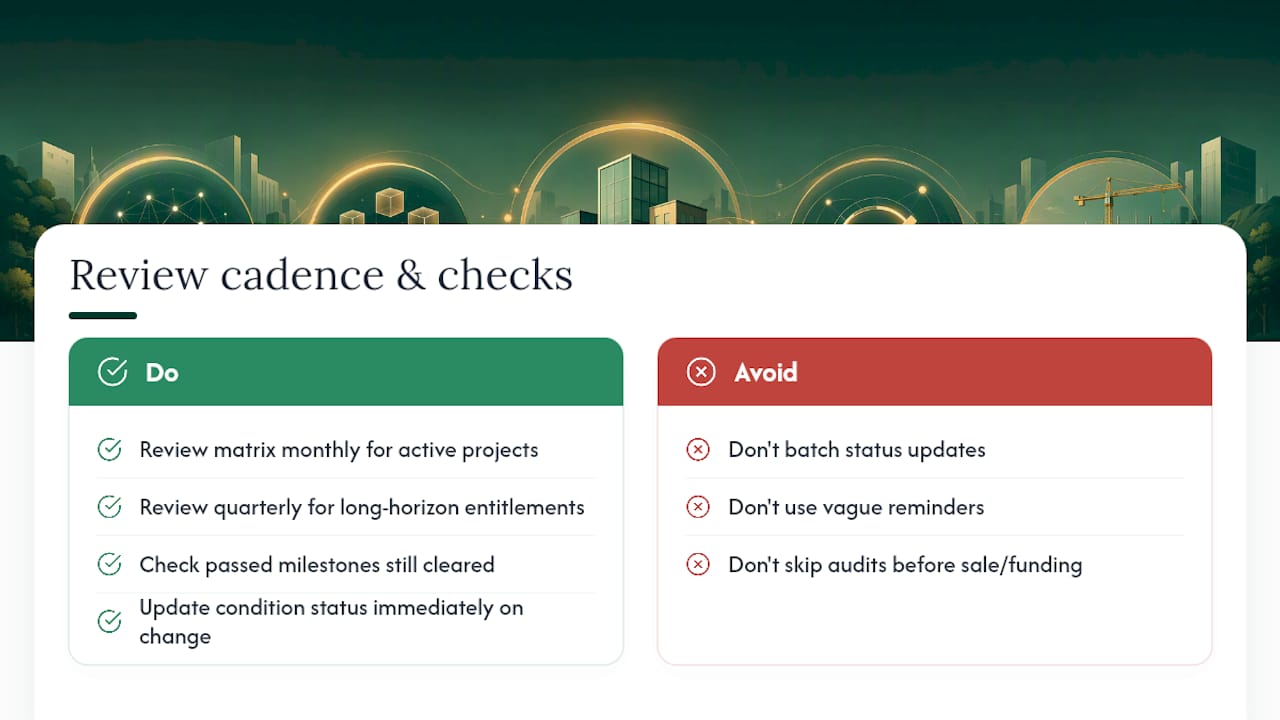
Treat your conditions matrix as a living document, reviewed on a fixed cadence rather than only when a deadline forces your hand. Monthly is a reasonable default for an active construction project; quarterly works for a longer-horizon entitlement sitting between approval and groundbreaking.
A periodic review should check three things every time. First, has a milestone passed without its associated condition being cleared? That's the fastest way to spot a coming plan check rejection before it happens. Second, have any conditions changed status, from open to submitted, or submitted to cleared, since the last review? Update the matrix immediately rather than batching updates, because a stale matrix creates false confidence. Third, are there conditions tied to ongoing monitoring, like a Mitigation Monitoring and Reporting Program for biological or noise impacts, that require periodic reporting rather than a one-time clearance?
That third category catches developers off guard most often. Mitigation monitoring conditions frequently extend years past your certificate of occupancy, requiring annual reports or site inspections long after you've mentally closed the file on the project. Build a recurring calendar reminder for each ongoing monitoring obligation, tied to the specific report due date, not a vague "check in periodically" note.
Audits become critical at ownership transitions. Before selling a partially entitled property, or before a lender releases construction funds, pull the full matrix and produce a status letter showing exactly which conditions are cleared, which are pending, and which remain outstanding with a completion date. Title companies and lenders will ask for this, and having it ready shortens escrow by weeks.
What Tools Help You Manage COA Compliance?
Most small to midsize developers start with a shared spreadsheet, and that's a legitimate choice as long as someone owns updating it. A spreadsheet with columns for condition ID, milestone, responsible party, and status, hosted on Google Sheets or Microsoft Excel with version history turned on, covers the basics for a single-phase project.
Larger or multi-phase developments tend to outgrow spreadsheets fast. Construction and entitlement management platforms, along with general project management tools like Procore, Smartsheet, or Asana, let you attach documents directly to each condition, assign due dates that trigger automatic reminders, and give your engineer, architect, and contractor simultaneous visibility without a shared email thread. The advantage isn't the software itself, it's that a condition can't quietly slip through the cracks when three people are watching the same live record instead of three separate inboxes.
Document management matters as much as task tracking. Whatever system you choose, keep signed clearance letters, recorded easements, and monitoring reports attached directly to their condition ID rather than filed separately by date. When a lender, buyer, or your own successor project manager needs proof a condition cleared, they should find it in one click, not a folder search.
For teams managing several entitlements at once, The Intent Ledger publishes practical guidance on the documentation fields planning teams should capture, worth a look if you're designing your matrix from scratch and want a second opinion on structure.
Whatever tool you pick, the discipline matters more than the platform. A $12 monthly spreadsheet tool used consistently beats an enterprise platform nobody updates.
What Do Successful and Failed COA Compliance Look Like?
Federal-scale approvals illustrate the pattern at its most formal. The FDA's postapproval requirements for medical devices mandate continuing evaluation, recordkeeping, and periodic reporting, and missing those obligations can lead to withdrawal of the approval itself. Land use entitlements work on the same underlying principle at a local scale: approval is conditional, not permanent, until every requirement clears.
Failed compliance usually traces back to one of three root causes. A developer misses a "prior to" trigger buried in a 40-page resolution because nobody built a matrix at intake. A responsibility gap opens because a condition never got assigned to a specific person, so it sits untouched until a plan checker flags it. Or a prior condition gets dropped entirely during a later submittal, an omission that site plan checklists in jurisdictions like Prince George's County are specifically designed to catch by requiring proof that earlier conditions were addressed.
Successful compliance looks unglamorous by comparison. The project team extracted conditions the week the resolution was signed, assigned each one to a named person, and tracked status against the construction schedule rather than against the resolution's page order. Redevelopment projects illustrate this well. A constraint review on a historic rehabilitation project surfaces prior-approval conditions early enough to fold them into new design decisions instead of discovering them after construction drawings are already finalized. The pattern holds across project types: early extraction and clear ownership prevent the resubmittal cycles that eat months off a schedule.
Who Needs to Stay in the Loop During Compliance?
Compliance breaks down as often from a communication gap as from a missed deadline. Your civil engineer needs visibility into planning conditions that affect site design. Your contractor needs to know about environmental monitoring conditions before they mobilize equipment, not after a stop-work order arrives. Your lender needs periodic status updates, particularly for conditions tied to bond releases or draw schedules.
Set a standing cadence, even if it's brief. A biweekly quick check with your project team on open conditions catches drift long before it becomes a crisis. Route every status change through the same matrix so nobody is working from an outdated version emailed three weeks ago.
External stakeholders matter too. If a variance request or amendment involves neighboring property owners, document the outreach you did, dates, names, and what was communicated. That record becomes part of your justification if the request goes to a hearing. And keep a single point of contact on the jurisdiction side for each department, because conditions cleared by one reviewer sometimes get questioned by a successor reviewer who wants to see the original documentation again.
How Should You Plan for Compliance Before You Even Submit?
The best time to assess conditions risk is before you own the property, not after your grading permit application gets rejected. Pull COAs from comparable recent approvals in the same jurisdiction during due diligence, if they're publicly available, to get a realistic sense of what the county typically demands for a project like yours.
Once you have an actual resolution in hand, triage conditions by risk, not by number order. High-risk conditions are the ones with capital costs attached, an uncertain clearance timeline, or dependency on a third party like a utility company or adjacent landowner. Low-risk conditions are administrative, a form, a fee, a signature, and can wait.
Build your matrix and cost estimate before you finalize your construction loan or your investor pro forma. A mitigation monitoring program or an unexpected easement dedication discovered mid-construction doesn't just cost money, it can push your schedule past a financing deadline. Treat that initial read of the resolution as a risk assessment exercise, not a formality to file away.
The Recurring Mistakes That Cost Developers Months
The pattern I see most often isn't a hard condition, it's a dropped one: teams forget to carry prior-approval conditions into new submittals, leave items unassigned, or misjudge which milestone a condition actually blocks. Early coordination between your engineer and surveyor catches most of this before it triggers a resubmittal cycle. Treat every condition as a live project risk, not paperwork to file and forget.
— Jeremy Wenger
How Urban Planning Pros Helps You Stay Ahead of Every Condition
Reading a 40-page resolution correctly, on your own, while also managing a construction schedule, is where most compliance gaps start. Urban Planning Pros builds the conditions matrix as part of a formal feasibility study, so the cost, timing, and responsibility questions get answered before you're locked into a closing date or a construction loan draw schedule.

For projects with multiple entitlement phases, master land planning coordination keeps conditions from earlier approvals from getting dropped in later submittals, the exact failure mode that stalls resubmittals for months. If you'd rather not chase down department contacts and clearance letters yourself, owner representation puts someone in that seat on your behalf, coordinating survey and engineering sign-offs directly with the reviewing agencies.
Handle it in-house if you have one project and a team member with bandwidth to own the matrix full time. Bring in a consultant when you're juggling multiple entitlements, tight financing deadlines, or a resolution dense enough that a missed "prior to" trigger would be expensive. Reach out through the services page to scope what your specific project needs.
Where to Verify Jurisdiction-Specific COA Rules
Check your county planning department's own manual before relying on general guidance. Useful starting points include the San Diego County COA Manual and Oakland's standard conditions resource.
Sources
- Conditions of Approval Manual — San Diego County
- Conditions and Mitigation Monitoring and Reporting Program example — Ventura County
- Conditions of Construction and Operations Plan Approval — BOEM (example)
FAQ
What Are the 5 Key Areas of a Conditions of Approval Resolution?
Most COA resolutions organize conditions into planning, public works or engineering, environmental, fire, and utilities sections, sometimes with special studies broken out separately. Each condition within those sections carries an intent statement, a requirement, documentation, a timing trigger, and a named clearance authority per the San Diego County COA Manual.
What Are the Regulatory Requirements for COA Compliance?
The core requirement is satisfying each condition's documentation and timing trigger before the milestone it's tied to, whether that's a grading permit, building permit, or final map recordation. Jurisdictions treat conditions as legally binding, and the City of Oakland's standard conditions guidance confirms noncompliance leads directly to enforcement action.
What Are the Three Types of Conditions of Approval?
Conditions generally fall into standard conditions applied broadly to a project type, project-specific conditions tailored to your site's constraints, and ongoing monitoring conditions tied to a mitigation program that extends past initial construction. Standard conditions are rarely negotiable; project-specific conditions sometimes are.
What Happens if I Don't Comply with a Condition of Approval?
Enforcement typically escalates from reporting the violation to the planning commission, to permit suspension, to denial of final map recordation, and in serious cases to permit revocation or bond forfeiture, as outlined in Ventura County's sample enforcement language. Many conditions also attach to the property itself, so a future buyer can inherit unresolved obligations.
How Much Does a Feasibility Study for COA Compliance Cost?
Pricing for a feasibility study through Urban Planning Pros is available on request, since costs vary by project scope and jurisdiction complexity. Visit the services page for details on scoping a study for your property.