Most land development projects run 9 to 36 months from first feasibility check to occupancy, and entitlements decide which end of that range you land on. The core sequence is feasibility, entitlements, design and permits, construction, and occupancy. Environmental review and discretionary approvals are the biggest wildcard in the schedule, which is why a feasibility study before you file anything is the cheapest insurance you can buy.
TL;DR:
- A feasibility study before filing can identify buildability, utility capacity, and environmental issues, preventing costly redesigns and schedule slips.
- Discretionary approvals tied to rezoning or environmental review can extend timelines beyond a year, especially if applications are incomplete or trigger multiple review cycles.
- Concurrent submission of civil, architectural, and structural plans during plan check can reduce total project duration by weeks or months.
- Environmental constraints such as wetlands or floodplains often cause significant delays if discovered late, making early environmental assessment crucial.
- Project timelines range from 18 months to over 36 months, with early planning and streamlined approval paths reducing overall duration.
Table of Contents
- What Are the Typical Phases in a Development Timeline?
- Why Does a Feasibility Study Matter Before You File Anything?
- How Do Entitlements Actually Get Approved, and Why Do Timelines Vary So Much?
- How Do Plan Check and Construction Sequencing Affect Your Schedule?
- What Are the Biggest Risks to Your Development Timeline?
- What Do Fast and Typical Development Timelines Look Like in Practice?
- Why Timeline-First Planning Protects Your Project's Value
- How Urban Planning Pros Keeps Your Schedule on Track
- Where Can You Find More on Entitlement Procedures and Fees?
- Sources
- FAQ
What Are the Typical Phases in a Development Timeline?
Every land development project moves through the same skeleton of phases, but the duration of each one swings wildly based on jurisdiction, entitlement type, and site conditions. Here's the phase-by-phase breakdown, with short, typical, and long ranges for each stage of the project development schedule.
- Feasibility and due diligence: 2 to 16 weeks. A clean parcel with no red flags moves fast; a site with title issues or unclear utility capacity stretches toward the long end.
- Entitlements and approvals: 3 months to 36+ months. Ministerial approvals (permitted-use projects that don't need discretionary review) sit at the low end. Discretionary approvals tied to rezoning, general plan amendments, or CEQA/NEPA review push well past a year.
- Design and engineering, including plan check: 8 to 24 weeks typical, though concurrent review cycles with the building department can compress this.
- Financing and bidding: 4 to 12 weeks, usually run in parallel with the tail end of design.
- Site work and infrastructure: 2 to 12 months, driven by grading complexity, utility extensions, and off-site improvement requirements.
- Vertical construction: 4 to 24+ months depending on building type, from a single retail pad to a mid-rise residential structure.
Dependencies compound quickly. A utility extension that requires a franchise utility's own capital plan, an off-site road improvement tied to a traffic study, or a hearing that gets continued a month, each of these can quietly add weeks to a schedule that looked tight on paper. That's the nature of a software development schedule comparison breaks down. Land timelines depend on external approval bodies that do not operate on your calendar.
Why Does a Feasibility Study Matter Before You File Anything?
A feasibility study exists to answer one question before you spend real money: can this site actually deliver the project you're imagining, and what will it cost in time and dollars to get there? Done right, it gives you a buildability opinion, a utility capacity check, an environmental flag list, and a preliminary schedule map, all before you've paid an engineer to draft a single sheet.
Typical deliverables include a zoning and title review, a Phase I environmental site assessment, a survey scope, utility availability letters, concept sketches, and a preliminary timeline. A focused feasibility study on a typical parcel can wrap in 2 to 3 weeks. Complex sites, ones with wetlands, floodplain exposure, or contested zoning, often need 4 to 12 weeks to run down every issue properly.
- Confirms buildability and highlights critical issues before engineering spend begins
- Maps utility capacity and flags environmental constraints early
- Produces a cost and schedule outline that shapes entitlement strategy and funding decisions
Pro Tip: Treat the feasibility study as your go/no-go gate. Skipping it to save two weeks upfront is the single most common reason land deals blow their budget six months later.
How Do Entitlements Actually Get Approved, and Why Do Timelines Vary So Much?
The entitlement process follows a fairly consistent sequence across jurisdictions, but the duration attached to each step depends entirely on whether your project needs discretionary review. A typical municipal entitlement flow runs like this:
- Application preparation and submission. You assemble site plans, technical studies, and supporting documents for a complete filing.
- Planning staff review for completeness. Staff check the application against code requirements, often within 2 to 5 weeks for a well-prepared submittal.
- Environmental review determination. Staff decide whether the project qualifies for a categorical exemption or needs a full CEQA or NEPA analysis.
- Public hearings. Planning commission hearings are commonly scheduled within roughly 60 days of a complete application, per Long Beach's entitlement guidance.
- Appeal period. Most jurisdictions allow a window, often 10 to 15 days, for third parties to appeal the decision.
- Notice of Final Action. This clears the way for plan check to begin.
Ministerial approvals for permitted uses can clear in weeks to a few months. Discretionary approvals tied to rezoning or environmental review stretch to a year or more, and large master-planned communities routinely take 18 to 24+ months once you factor in CEQA or NEPA review. The most common cause of extended timelines isn't the process itself. It's an incomplete application that triggers a second or third round of staff comments, each one adding another full review cycle to the clock.
How Do Plan Check and Construction Sequencing Affect Your Schedule?
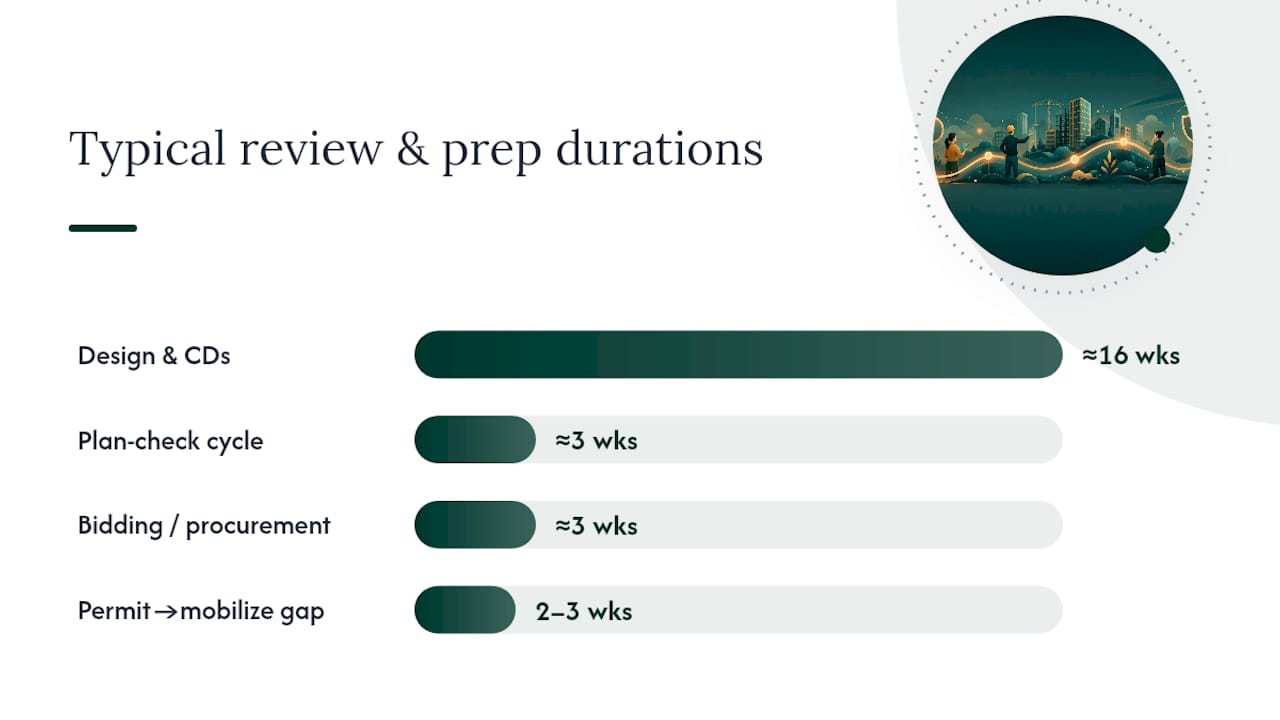
Once entitlements clear, plan check and permitting take over, and this is where a lot of otherwise well-run projects lose momentum they don't need to lose. Plan check typically takes several weeks per cycle after final approvals, and jurisdictions with heavy workloads routinely require multiple rounds of comments before issuing a permit.
The fix isn't complicated. Submitting concurrent packages instead of sequential ones, and having your civil, architectural, and structural documents ready at the same time, shortens the total review window meaningfully. A zoning and building-rights verification check run early in design catches code conflicts before they surface as plan-check comments.
- Design and construction documents typically take a few to several months to produce, depending on project complexity.
- Concurrent plan-check submittals (civil, architectural, structural reviewed together) can trim weeks off a sequential review process.
- Bidding and contractor procurement, run several weeks in parallel with the final plan-check cycle, lets mobilization start soon after permit issuance.
- A gap between permit issuance and contractor mobilization of more than two or three weeks usually signals a scheduling or budgeting problem worth fixing before it repeats on the next phase.
What Are the Biggest Risks to Your Development Timeline?
Five factors account for most of the schedule damage on land projects: incomplete applications, environmental constraints discovered late, insufficient utility capacity, political or neighborhood opposition, and financing delays that stall a project mid-entitlement. Environmental issues like protected species habitat, wetlands, or floodplain designation are especially costly when they surface after you've already filed, because they force a redesign under a deadline instead of a redesign during feasibility.
The countermeasures are straightforward and cheap relative to the delays they prevent.
- Hold a pre-application meeting with planning staff before filing. It's a low-cost step that frequently surfaces fatal constraints early.
- Consider phased entitlements or an as-of-right build where the code allows it. Streamlined approval paths have cut comparable project timelines from roughly seven months to under three in some jurisdictions.
- Confirm utility capacity in writing during feasibility, not during design.
- Build schedule and budget contingency into every entitlement milestone, and consider owner representation to manage the approval process on your behalf.
Pro Tip: Watch your entitlement expiration date as closely as your budget. Most approvals expire in 2 to 5 years, and a financing delay that pushes construction past that window can force a full re-entitlement.
What Do Fast and Typical Development Timelines Look Like in Practice?
- 18-month lean path: Feasibility (1 month) → ministerial or streamlined entitlement (3 to 4 months) → design and plan check (4 months, concurrent) → site work and construction (9 to 10 months, overlapping).
- 36-month typical path: Feasibility (2 months) → discretionary entitlement with environmental review and hearings (12 to 18 months) → design and permitting (5 months) → site work and vertical construction (12 to 15 months).
- Contingency belongs at the entitlement milestone, not at the end of construction. If a project is tracking toward 30+ months before you've even filed, it's worth re-scoping or phasing rather than pushing forward on the original plan.
Why Timeline-First Planning Protects Your Project's Value
Most schedule damage on land projects traces back to one decision: skipping the upfront work that would have surfaced a constraint before money was spent chasing a design that couldn't get approved. The feasibility and master planning process builds around that principle, mapping zoning, utility capacity, and environmental flags before committing to engineering or entitlement filings.
One recurring pattern from projects we've reviewed: a site that looked straightforward on paper carried a utility capacity constraint that only surfaced during a feasibility check, well before it could derail a submitted application. Catching that kind of issue early is the difference between a schedule that slips by weeks and one that slips by a year.
— Jeremy Wenger
How Urban Planning Pros Keeps Your Schedule on Track
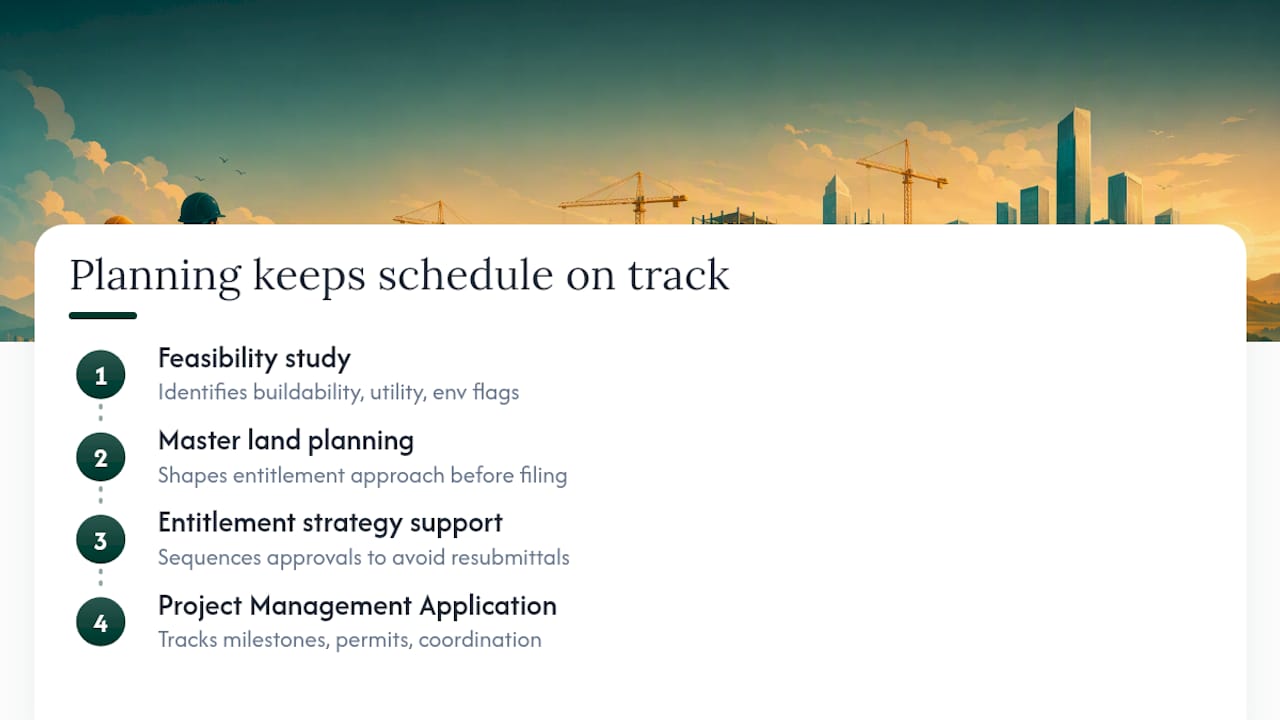
This approach is an alternative to guessing your way through entitlements. Every phase of the process gets mapped before money is spent on engineering or filing fees. A feasibility study identifies buildability, utility capacity, and environmental flags upfront, which is the single fastest way to avoid a six-month detour mid-entitlement.

Beyond feasibility, master land planning shapes your entitlement strategy before you file, and entitlement strategy support helps you sequence discretionary approvals to avoid unnecessary resubmittal cycles. Once you're past entitlements, the Project Management Application tracks milestones, permit status, and contractor coordination in one place, so nothing slips through a communication gap between your team and the jurisdiction.
If your site is still in the concept stage, consider scheduling a feasibility study to obtain a real schedule map before incurring expenses on speculative design work.
Where Can You Find More on Entitlement Procedures and Fees?
For readers who want the primary source material behind the figures in this guide, Long Beach Development Services publishes a full municipal entitlement flow with staff review and hearing timing. The NAHB land development checklist covers due diligence and approval steps industry-wide, and Bailey Engineers details typical feasibility study scope and turnaround.
Sources
FAQ
How Long Does a Typical Development Timeline Take Start to Finish?
Most projects run from several months to a few years total, with entitlement complexity, ministerial versus discretionary review, and environmental study requirements determining where a specific project falls in the timeline.
What Is the Fastest Way to Shorten an Entitlement Timeline?
A pre-application meeting with planning staff and pursuing an as-of-right or streamlined approval path where the code allows it are the two most reliable ways to cut months off discretionary review.
How Long Does a Feasibility Study Take?
A focused feasibility study on a typical parcel takes 2 to 3 weeks, while complex sites with environmental or title issues can take 4 to 12 weeks.
What Causes the Most Delay in a Land Development Schedule?
Incomplete applications that trigger repeat review cycles, late-discovered environmental constraints, and insufficient utility capacity are the three most common causes of extended timelines.
Should I Budget Contingency for Every Phase or Just Entitlements?
Entitlements carry the most schedule risk and deserve the largest contingency, but plan check and utility coordination also warrant buffer time since both routinely require multiple review rounds.