
A feasibility study cost is the upfront investment required to determine whether a land development project is financially and physically viable. For most projects, that cost ranges from $5,000 to $500,000+, with the industry rule of thumb placing fees at 0.75% to 1.5% of total project investment. Florida developers face an especially wide range due to the state's mix of coastal constraints, wetland regulations, and fast-moving municipal zoning changes. Understanding what drives that number before you commission a study protects your budget and your project timeline. Urbanplanningpros works with property owners across Florida to scope studies that match both the project's complexity and the lender's requirements.
What factors affect the cost of a feasibility study?
Feasibility study pricing is not arbitrary. Every line item in a proposal reflects a real variable that affects how much work the study requires.
The most significant cost drivers include:
- Project size and total investment value. Fees scale with the capital at risk. A $2 million residential infill project and a $40 million mixed-use development require fundamentally different levels of analysis.
- Site complexity. Wetlands, flood zones, hillside topography, and contaminated soils each trigger additional investigations. Florida's abundance of wetland parcels means site-specific investigations frequently add cost beyond the base study fee.
- Regulatory environment. Projects requiring USDA program compliance, environmental impact assessments, or special exception zoning reviews carry higher documentation burdens. USDA-compliant studies, for example, are priced by asset class: REAP program studies run $5,250 to $11,250, Business and Industry loans require $7,500 to $18,750, and Community Facilities studies range from $11,250 to $22,500.
- Depth of market analysis. A study that includes primary demand surveys, absorption modeling, and competitive supply analysis costs more than one relying on secondary data alone.
- Consultant expertise and team size. A solo practitioner and a multi-discipline firm charge differently. Lender-grade studies typically require licensed professionals across planning, engineering, and finance.
- Timeframe and secondary investigations. Rush delivery and additional geotechnical or environmental reports add cost. Complex residential studies typically deliver in 3–4 weeks at $15,000 to $25,000, or 6–8 weeks when extensive investigations are required.
Pro Tip: Request an itemized scope of work before signing any engagement letter. A transparent proposal separates legitimate cost drivers from padding.
The regulatory complexity in Florida adds a layer most national cost guides understate. Stormwater management requirements, coastal construction setback lines, and county-specific concurrency rules all affect how deep a study must go to satisfy both the jurisdiction and the lender.
How do different feasibility study approaches compare in cost?
Not every project needs the same level of analysis. The right approach depends on project scale, financing requirements, and how much primary research the site demands.

| Approach | Typical cost range | Best suited for | Key limitation |
|---|---|---|---|
| AI-assisted tools | $200–$2,000 | Initial scoping, pre-acquisition screening | Cannot replace site-specific primary research |
| Boutique or freelance consultants | $2,000–$10,000 | Small residential, early-stage planning | May lack lender-accepted credentials |
| Traditional consulting firms | $5,000–$50,000+ | Bank-financed projects, complex sites | Higher cost, longer timeline |
| DIY feasibility analysis | Minimal cash, high time | Budget-constrained owners with planning knowledge | High error risk, rarely lender-accepted |
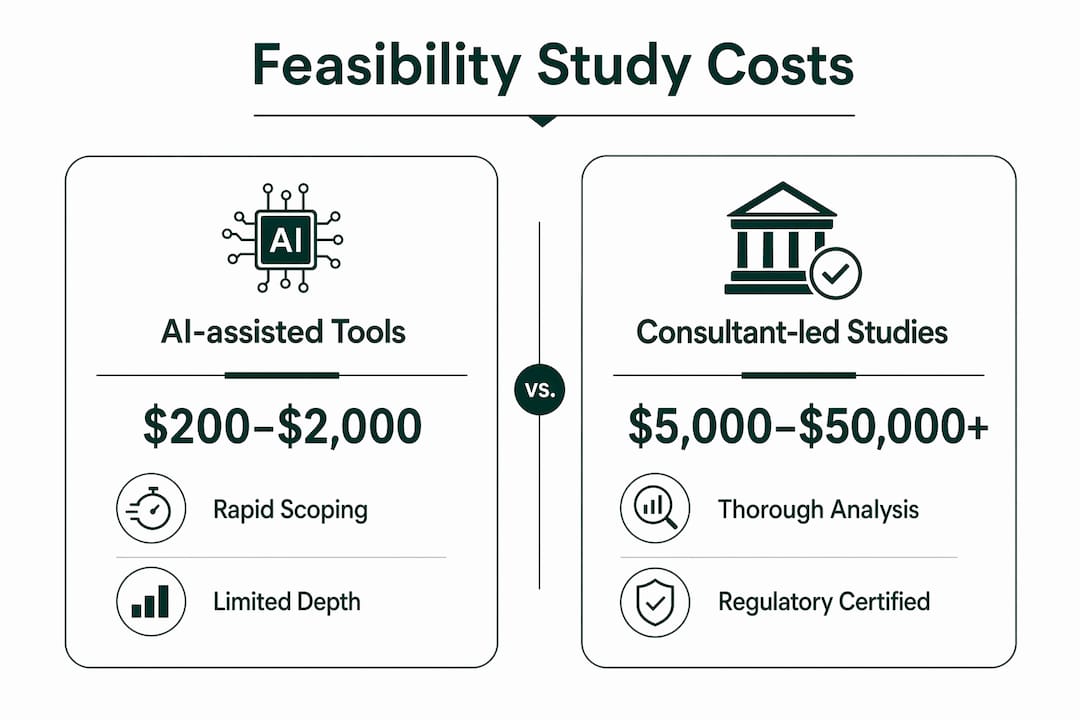
AI-assisted tools costing $200 to $2,000 are effective for rapid initial scoping but cannot fully replace consultant-led studies required for bank financing or complex developments. They work well as a first filter before committing to a full engagement.
Traditional consulting firms deliver the most thorough product. Their studies meet the documentation standards that lenders treat as credit documents. For any project seeking SBA, USDA, or conventional construction financing, a firm-led study is not optional.
Pro Tip: Use an AI tool or desktop review to stress-test your concept before spending on a full study. If the numbers look weak at the screening stage, they rarely improve with more research.
Boutique consultants fill the middle ground well for smaller Florida projects, such as a 12-unit townhome development or a rural commercial conversion. They offer custom analysis at a price point that fits a tighter feasibility study budget without sacrificing the local market knowledge that generic platforms miss.
How to budget and evaluate feasibility study pricing for your project
Budgeting for a land feasibility study cost requires more than picking a number from a range. Follow these steps to build a realistic figure before you solicit proposals.
-
Apply the 0.75% to 1.5% guideline. Multiply your projected total project cost by 0.75% for a baseline estimate. A $10 million project should budget $75,000 to $150,000 for a thorough feasibility analysis. This range accounts for the full scope of work lenders expect.
-
Identify your regulatory triggers early. Florida projects near wetlands, within coastal high-hazard areas, or subject to DRI (Development of Regional Impact) review will need additional studies. Budget for these separately from the base feasibility fee.
-
Account for phased cost refinement. Feasibility cost estimates produce Rough Order of Magnitude figures with a ±20–30% variance. That range narrows through design phases until you reach a Guaranteed Maximum Price. Plan your cash flow around this reality, not a single fixed number.
-
Engage your consultant before the lender. Engaging a consultant before lender involvement avoids costly rework from rejected studies and supports lender-approved documentation. Waiting until after a term sheet arrives is the most expensive sequencing mistake developers make.
-
Evaluate proposals on scope, not price. A $3,500 "brochure-style" report and a $15,000 lender-grade study are not the same product. Compare what each proposal includes: primary market research, financial modeling, site constraint analysis, and the consultant's credentials with your target lender type.
-
Reserve for additional investigations. Geotechnical reports, environmental Phase I or Phase II assessments, and traffic studies each carry separate fees. A complete feasibility study budget includes these line items, not just the consultant's base fee.
Florida's development pipeline moves fast, particularly in high-growth corridors like the I-4 corridor, Southwest Florida, and the Treasure Coast. Developers who budget accurately at the feasibility stage avoid the capital timing problems that stall projects mid-entitlement.
What are the consequences of underinvesting in a feasibility study?
Cutting the feasibility study expense is one of the most expensive decisions a developer can make. The savings at the front end rarely survive contact with the problems a thorough study would have caught.
"Lenders treat feasibility studies as essential credit documents. Inadequate studies lead to greater financial risk and loan delays. The most costly error is commissioning a study post-term sheet that lenders reject, resulting in a second, expensive engagement under time pressure."
Source: Loan Analytics, The Feasibility Study Consultant in 2026
Lenders view feasibility studies as critical credit documents and reject cheap studies that fail examiner review. That rejection costs far more than the initial savings on the study fee. A developer who saves $8,000 on a cut-rate report and then faces a 90-day loan delay loses far more in carrying costs, rate lock extensions, and contractor remobilization fees.
Site-specific surprises are the other major risk. Hillside construction in Florida's panhandle, for example, can reveal foundation conditions that add six figures to a project budget. A study that skips geotechnical investigation leaves that risk entirely unpriced. Feasibility fees function as risk mitigation investments that surface hidden site constraints, regulatory hurdles, and non-viable project assumptions before capital is committed.
Project cancellations after significant pre-development spending represent the worst outcome. Developers who skip or underinvest in feasibility analysis routinely discover fatal flaws after spending on design, permitting, and legal fees. The feasibility study is the checkpoint that prevents that sequence.
Key Takeaways
Feasibility study cost is a direct function of project complexity, regulatory requirements, and study depth, and investing appropriately at this stage protects every dollar committed afterward.
| Point | Details |
|---|---|
| Core cost range | Most projects fall between $5,000 and $50,000; large or complex projects exceed $500,000. |
| Budget guideline | Use 0.75%–1.5% of total project cost to set a realistic feasibility study budget. |
| Engage consultants early | Hire your consultant before lender involvement to avoid rejected studies and costly rework. |
| Match approach to project scale | AI tools suit initial scoping; lender-grade consulting firms are required for financed projects. |
| Underinvestment carries real risk | Cheap studies get rejected by lenders, triggering delays and second engagements under deadline pressure. |
The real cost of treating feasibility as a formality
I have reviewed enough failed projects to say this plainly: the developers who treat feasibility as a box to check are the ones who call me after the lender rejects their report. They spent $4,000 on a desktop summary, and now they need a full study in three weeks with a term sheet expiring. That second engagement costs more than the first one would have, and it happens under the worst possible conditions.
The studies that actually protect a project are the ones scoped to the site, not to a price point. A thorough land planning analysis surfaces the zoning constraints, infrastructure gaps, and market demand questions that determine whether a project pencils out. That work cannot be templated.
What I find most underappreciated is the value of an independent study. Developers sometimes use internal projections or a seller's feasibility report to support their acquisition decision. Lenders see through that immediately. An independent, credentialed study carries weight precisely because it has no stake in the outcome.
Modern AI tools have a legitimate role in the pre-acquisition phase. They are fast, inexpensive, and good at flagging obvious problems. But they do not replace the site visit, the primary market interviews, or the regulatory review that a qualified consultant brings. Use them to screen, not to decide.
The developers who get the most value from feasibility work are the ones who engage early, scope thoroughly, and treat the study as the foundation of their project documentation. That approach does not cost more over the life of a project. It costs less.
— Jeremy
Urbanplanningpros feasibility study services for Florida developers
Florida development projects carry regulatory complexity that generic feasibility reports consistently underestimate. Urbanplanningpros delivers professional feasibility studies tailored to residential, commercial, and USDA-compliant projects across the state, with analysis grounded in local zoning, infrastructure constraints, and market conditions.

Every engagement includes a detailed review of property documents, zoning constraints, and market direction. The team at Urbanplanningpros works with property owners and developers from initial scoping through final documentation, producing studies that meet lender standards and support informed acquisition and development decisions. Contact Urbanplanningpros to discuss your project and receive a scoped proposal built around your specific site and financing requirements.
FAQ
How much does a feasibility study cost on average?
Most mid-sized projects fall between $5,000 and $50,000, with complex large-scale developments exceeding $500,000. The standard industry guideline places fees at 0.75% to 1.5% of total project investment.
What is included in a land feasibility study cost?
A land feasibility study typically includes site constraint analysis, zoning review, market demand research, financial modeling, and infrastructure assessment. Additional investigations such as geotechnical reports or environmental assessments carry separate fees.
Can I use an AI tool instead of hiring a consultant?
AI-assisted tools costing $200 to $2,000 work well for initial scoping and pre-acquisition screening. They cannot replace consultant-led studies required for bank financing, USDA programs, or complex site conditions.
Why do lenders reject cheap feasibility studies?
Lenders treat feasibility studies as credit documents and apply examiner-level scrutiny. Studies that lack primary research, licensed credentials, or required program documentation fail that review and delay or block loan approval.
When should I commission a feasibility study in Florida?
Commission the study before approaching a lender and before committing significant pre-development capital. Engaging a qualified consultant at the pre-acquisition stage prevents the costly rework that follows a rejected post-term-sheet submission.