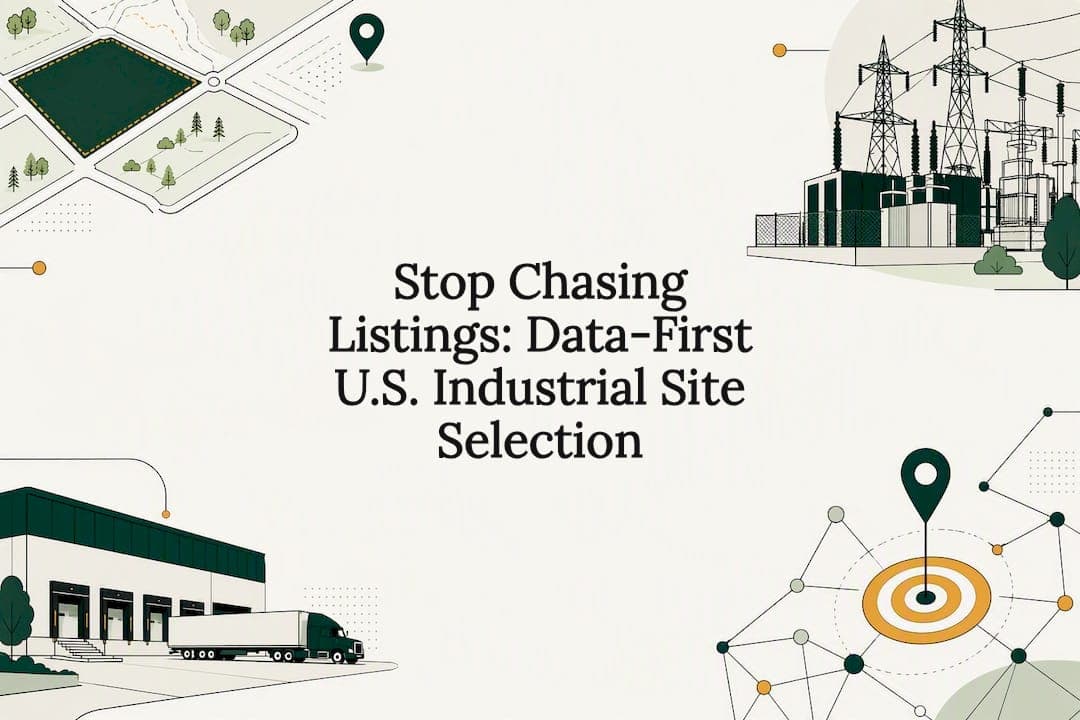
Use a structured, weighted, data-driven process that starts with clear business objectives and ends with discounted cash flow (DCF) comparisons across finalist sites. Two moves come first: define your operational requirements before you look at a single property listing, and build a weighted criteria scorecard with agreement from every stakeholder who has to live with the decision. A feasibility study can turn these steps into a documented, defensible plan.
TL;DR:
- Utility upgrade timelines can disqualify a site if capacity confirmation exceeds project schedule requirements, making construction delays costly.
- Commuter-shed analysis often reveals recruiting risks hidden by county-level labor statistics and can eliminate otherwise suitable sites.
- Rail, port access, and freight costs must be modeled in dollars and included in the financial forecast, as mode disadvantages can significantly inflate expenses.
- Environmental and permitting risks, such as floodplain or wetlands restrictions, should be assessed early, with costs and timelines incorporated into DCF models.
- Expansion potential should be evaluated from the start, including parcel size, utility capacity, zoning flexibility, and future cost implications, to avoid selecting a site that cannot scale.
Table of Contents
- What Is the Right Industrial Site Selection Process?
- How Do You Score Workforce Availability for a Site?
- What Logistics Factors Determine Site Viability?
- Why Do Utility Timelines Eliminate More Sites Than Cost Does?
- How Should Incentives Factor Into Site Selection?
- What Environmental and Permitting Risks Should You Screen Early?
- Greenfield, Brownfield, or Existing Building: Which Fits Your Project?
- What Should You Verify During a Site Tour?
- How Feasibility Studies Turn This Process Into an Executable Project
- Risk Assessment: Accounting for Natural Disaster Vulnerability
- Scalability: Does the Site Support Future Expansion?
- Does the Site Comply With Zoning and Land Use Rules?
- Why Community Impact Assessment Belongs in Your Scorecard
- A Planner's Warning on Common Site-Selection Mistakes
- How Urban Planning Pros Supports Your Site Selection Process
- Sources
- FAQ
What Is the Right Industrial Site Selection Process?
Industrial site selection works best as an eight-step sequence, not a property search. Skipping steps to chase a listing that "looks right" is the single most common way projects end up locked into a site that can't support their labor plan, utility load, or expansion timeline.
- Define business objectives — production volume, staffing plan, utility loads, and growth horizon, documented before viewing any property.
- Set weighted evaluation criteria with cross-functional sign-off from operations, finance, and real estate.
- Screen regions and states using customer and supplier mapping to build a rational shortlist.
- Narrow to communities using workforce and utility indices.
- Score candidate sites against the weighted scorecard.
- Run technical due diligence — Phase I/II environmental, geotechnical, utility confirmation.
- Build a cross-state DCF model incorporating incentives, operating costs, and taxes.
- Select and negotiate the finalist, using model outputs as leverage.
Weighting matters because it forces disagreements about priorities into the open before scoring starts, not after someone has already fallen in love with a parcel. A structured decision framework using MCDM and GIS analysis exists precisely because site selection involves too many competing constraints, labor, logistics, utilities, incentives, and risk, to compare informally. Once sites are scored, DCF modeling, scenario planning, and sensitivity analysis translate the winning location into an actual financial forecast, showing how upfront capital, operating costs, and incentive cash flows play out over a 10 to 20 year horizon rather than a single-year comparison.
How Do You Score Workforce Availability for a Site?
Labor availability is measured, not guessed. The essential metrics are employment by occupation, unemployment rate, prevailing wages, location quotient (a measure of how concentrated a specific occupation is in a region relative to the nation), and the strength of local training pipelines through community colleges or workforce boards.
- Employment by occupation and industry, pulled at the county or metro level.
- Unemployment rate trends over the past 24 to 36 months, not a single snapshot.
- Prevailing wage data for the specific occupations the facility needs.
- Location quotient for target occupations, showing whether the labor pool is genuinely concentrated or thin.
- Training pipeline capacity through community colleges, technical schools, and workforce development boards.
Statistic Callout: Public sources like the Census Bureau, BLS, and EIA are free but often lag 24 to 48 months behind current conditions, while private data providers cost more but deliver current, analysis-ready numbers.
The most underused tool here is commuter-shed analysis: mapping the actual 30-minute drive-time catchment around a site using journey-to-work Census data, then overlaying occupational concentration inside that ring. A commuter-shed study frequently exposes recruiting risk that headline county-level labor statistics hide entirely, and it's often the single factor that eliminates a site late in the process.
What Logistics Factors Determine Site Viability?
Freight access shapes operating cost more than almost any other variable, and it needs to be modeled in dollars, not just described in adjectives like "close to the highway."
- Highway geometry and truck circulation, including turning radius for tractor trailers and weight restrictions on approach roads.
- Rail access, whether the site has an existing spur or requires new track construction.
- Intermodal terminal proximity and port access for import/export-dependent operations.
- Estimated freight cost per unit and lead time impact across candidate sites.
Run the freight math before you fall for a site: estimate cost per mile by mode, multiply by expected annual volume, and fold the result into your DCF or annual operating-cost model alongside labor and utility costs. For manufacturers moving heavy or bulk freight, rail or port access often becomes the deciding factor over labor cost or even incentive value, since a single mode disadvantage can add millions in annual freight expense that no incentive package fully offsets.
Why Do Utility Timelines Eliminate More Sites Than Cost Does?
Utility capacity confirmation is a pass/fail screen, not a scoring criterion you weight against everything else. Ask each utility provider directly about current capacity, planned upgrades, and the estimated timeline for any required infrastructure work.
A concrete red flag: if a substation upgrade is quoted at 18 months and your project needs power in 12, that site should be eliminated regardless of how attractive the labor pool or incentive package looks, making generator rental for construction sites a practical temporary power solution during utility upgrades. Utility upgrades can also sit queued behind other projects with higher priority, so confirmed capacity on paper means little if your upgrade is fifth in line. Build utility risk directly into your schedule and DCF assumptions, treating any uncertain timeline as a cost of delayed production, not a footnote.
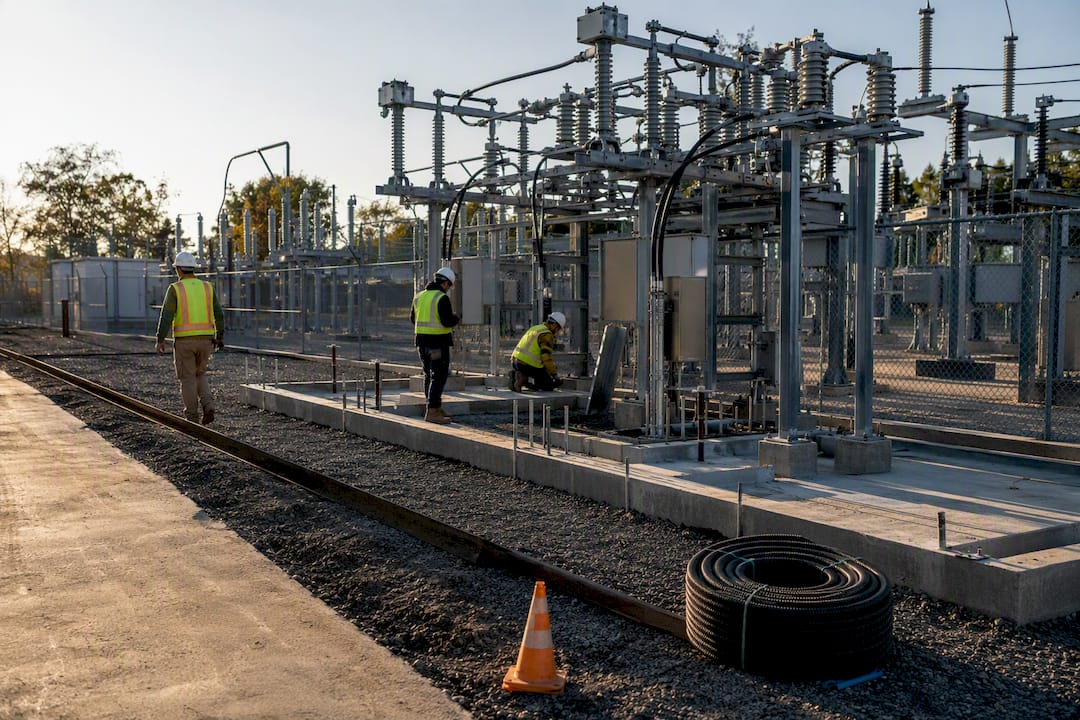
Pro Tip: Ask the utility for their project queue position in writing, not just a capacity number. A verbal "we can handle that" from a utility rep means nothing if three other developments are ahead of you for the same substation.
How Should Incentives Factor Into Site Selection?
Incentives refine a decision; they should never drive one. Statutory incentives (tax abatements set by formula) are predictable and low-risk. Discretionary incentives (negotiated grants, training funds) come with strings, job count commitments, clawback provisions, minimum investment thresholds, that need scrutiny before you count on the value.
- Separate statutory incentives from discretionary ones in your model, since only the latter carries negotiation risk.
- Build a cross-state cost model with upfront capital, annual operating costs, taxes, transportation costs, and incentive cash flows, all discounted to present value.
- Confirm job count and investment commitments tied to any discretionary package before finalizing.
- Time incentive negotiations after your shortlist is technically validated, not before.
Statistic Callout: Companies frequently lack the internal expertise to identify the full range of available programs. Engaging incentive and negotiation specialists early improves outcomes because complex multi-jurisdiction negotiations rarely go well as a side project for an already-stretched real estate team.
What Environmental and Permitting Risks Should You Screen Early?
Environmental exposure and permitting timelines can turn a promising site into a money pit if they surface after you've already committed capital.
- Phase I environmental assessment first; Phase II soil and groundwater testing if Phase I flags any history of industrial use.
- Brownfield sites carry real remediation exposure. Get a cost estimate before remediation costs quietly outweigh the incentive value that made the site attractive.
- Confirm the permitting pathway for your specific use, some industrial classifications trigger conditional use hearings that add months to a timeline you assumed was fixed.
- Screen for floodplain designation, wetlands, and endangered species habitat, all of which can restrict buildable area or add mitigation costs.
Feed every one of these into your scorecard as a weighted risk factor, not an afterthought discussed only after you've picked a favorite.
Greenfield, Brownfield, or Existing Building: Which Fits Your Project?
Site type should follow your priority, not the other way around.
- Greenfield sites carry the highest upfront cost and longest lead time but offer maximum configuration flexibility for purpose-built layouts.
- Existing buildings get you into production fastest but constrain ceiling height, column spacing, and dock configuration.
- Brownfield sites can come with remediation risk, offset in some cases by incentive value, but require careful cost modeling before commitment.
Certified "shovel-ready" sites, pre-permitted parcels with confirmed utility capacity and completed environmental review, matter because states and site selectors increasingly favor development-ready parcels over untested ground, especially since mid-sized projects can otherwise lose incentive priority to larger megaprojects.
What Should You Verify During a Site Tour?
A site tour exists to confirm your model's assumptions, not to fall in love with a parking lot.
- Title report and easements, confirm nothing restricts your planned building footprint.
- Truck circulation on the actual approach roads, not just the highway exit.
- Visible utility infrastructure, transformers, substations, water mains, and their apparent condition.
- Surrounding land uses and any signs of community sentiment toward industrial development.
- Local economic development organization (EDO) engagement level and responsiveness.
Photograph everything, request the most recent utility confirmation letter and any zoning correspondence on the spot, and get timeline commitments in writing before you leave. Every finding either confirms a DCF input or triggers a risk adjustment to the model you built earlier in the process.
How Feasibility Studies Turn This Process Into an Executable Project
A feasibility study maps directly onto the eight-step process: it verifies zoning and entitlement pathways, coordinates utility confirmations, and produces defensible cost estimates before capital moves. Urban Planning Pros built this approach around addressing property constraints, approvals, and stakeholder alignment at the earliest possible stage, before they become expensive surprises mid-project. That earlier alignment is what keeps a scorecard and a DCF model connected to what a site can actually deliver. Review completed project snapshots to see how the process plays out on real parcels.
Risk Assessment: Accounting for Natural Disaster Vulnerability
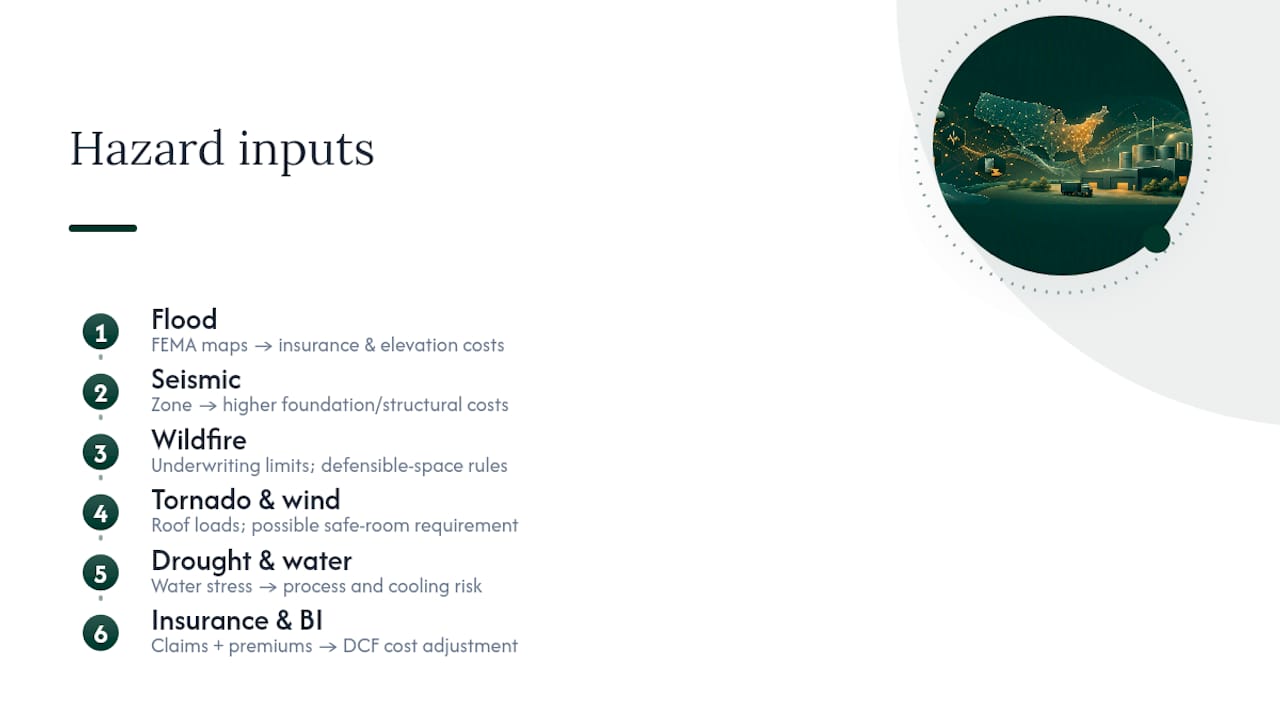
Hazard exposure belongs in the weighted scorecard as its own line item, not folded into a general "risk" category that gets glossed over. Flood zone designation is the most consequential single factor, since FEMA flood maps determine both insurance cost and whether certain floor elevations or flood-proofing measures become mandatory design requirements. A site sitting in a 100-year floodplain isn't automatically disqualified, but it needs a cost adjustment for elevated construction and higher insurance premiums baked into your DCF model, not discovered after groundbreaking.
Seismic risk matters most for facilities with heavy equipment or tall racking, where foundation and structural costs scale directly with seismic zone classification. Wildfire exposure has become a bigger underwriting factor in the West, affecting both insurance availability and, in some counties, defensible-space requirements around structures. Tornado and severe wind exposure across the central and southeastern US affects roof design loads and, for some tenants, whether a hardened safe room becomes a practical necessity for worker safety compliance.
Drought and water stress deserve a look too, particularly for any process that depends on significant water volume for cooling or manufacturing. A site with attractive labor and utility scores can still carry a real cost penalty once you price in insurance premiums, resilient design requirements, and business interruption exposure tied to its specific hazard profile. Pull historical claims data and current FEMA and state hazard maps for every finalist site, and assign each a numeric risk score inside your weighted criteria rather than treating hazard exposure as a qualitative gut check.
Scalability: Does the Site Support Future Expansion?
A site that fits today's footprint but leaves no room to grow often costs more over a 10-year horizon than a slightly more expensive site with expansion capacity built in. Evaluate the total parcel size against your current building footprint, and ask specifically what percentage of the site would remain available after your initial phase.
Utility capacity needs the same forward look you gave it during initial screening. Confirming power and water capacity for your day-one load means little if a Phase Two expansion would require another multi-year utility upgrade cycle. Ask the utility directly what headroom exists beyond your initial requested capacity, not just whether today's ask can be met.
Zoning and entitlement flexibility matters just as much as physical acreage. A parcel zoned for exactly your current use but requiring a new conditional use permit for expanded operations effectively resets your permitting timeline the moment you need to grow. Check whether the surrounding parcels are held by the same landowner or under compatible zoning, since expansion sites that require assembling adjacent parcels from multiple owners rarely close on a timeline that matches business needs.
Build expansion scenarios into your DCF model as a probability-weighted future cash flow, not a separate afterthought. A site that costs 10% more upfront but avoids a second full site-selection cycle in five years is very often the better financial decision once you run the full comparison, and that comparison only surfaces when scalability gets its own line in the scorecard from the start.
Does the Site Comply With Zoning and Land Use Rules?
Zoning compatibility is a binary screen before it's anything else: either the parcel is zoned for your intended industrial use, or it requires a rezoning or conditional use permit that adds real time and real risk to your schedule. Pull the current zoning designation and the jurisdiction's comprehensive land use plan for every finalist site, since a comprehensive plan that shows the area transitioning toward residential or mixed use signals future friction even where current zoning technically allows industrial development.
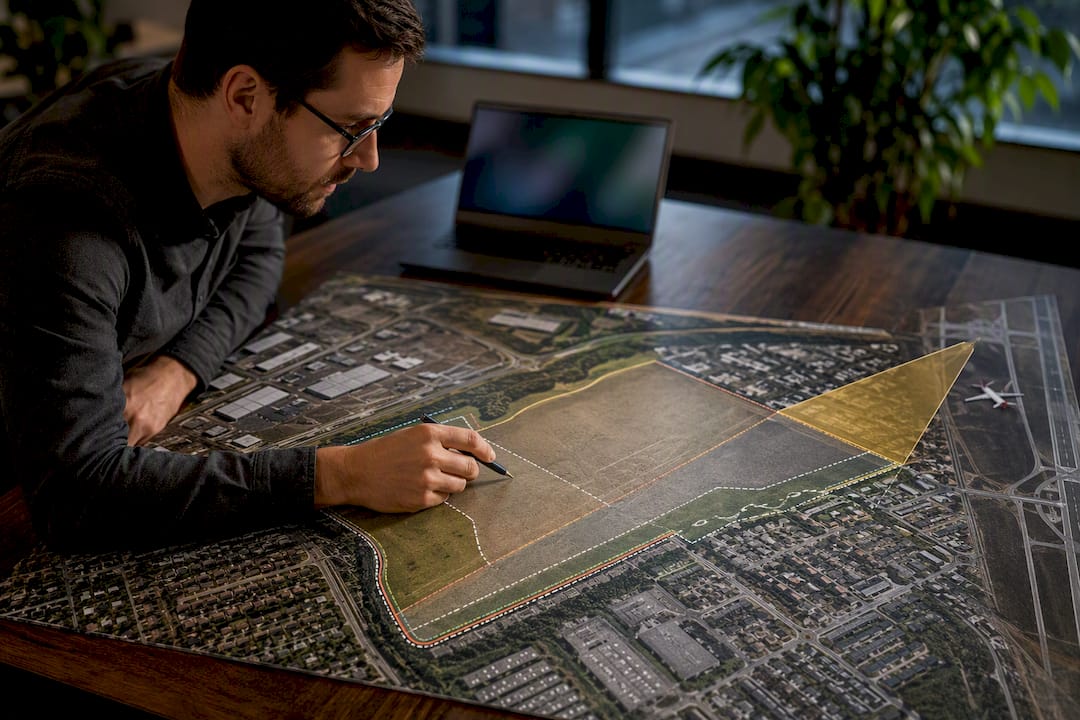
Overlay districts deserve specific attention. Airport approach zones, historic districts, and environmental overlay districts can restrict building height, operating hours, or even the specific processes allowed on a site, restrictions that a base zoning designation alone won't reveal. Setback requirements, buffer zone mandates near residential boundaries, and noise ordinances all affect how much of a parcel's advertised acreage is actually usable for your building footprint and outdoor storage or loading needs.
If rezoning is required, get a realistic timeline from the local planning department rather than accepting a general estimate from the property listing. Rezoning processes that include public hearings can run anywhere from a few months to over a year depending on the jurisdiction and the level of community opposition, and that timeline needs to sit inside your DCF model as a real cost of delayed production, not a rounding error. A parcel with slightly worse logistics but by-right zoning for your use case frequently beats a "perfect" parcel that requires a contested rezoning.
Why Community Impact Assessment Belongs in Your Scorecard
Community sentiment toward a proposed industrial facility shapes permitting timelines, hearing outcomes, and even future expansion approvals, which makes it a scoring criterion rather than a public relations afterthought. Public hearings for conditional use permits or rezonings give organized opposition a formal venue, and a facility perceived as adding traffic, noise, or environmental burden without local benefit can face delays that no amount of technical due diligence prevents.
Start by identifying who actually has standing to object: adjacent residential neighborhoods, environmental justice communities where prior industrial siting decisions have created historical grievances, and local advocacy groups active on land use issues in that jurisdiction. A quick review of recent planning commission minutes for the jurisdiction often reveals whether industrial proposals have drawn organized opposition in the past, and how the commission typically responds.
Engagement works better started early than defensive. Meeting with the local EDO, neighborhood associations, and relevant elected officials before filing formal applications lets you address traffic routing, buffer landscaping, or hiring commitments proactively rather than reactively during a contentious hearing. Facilities that commit to local hiring targets or community investment as part of their proposal tend to move through approval processes with less friction, and that goodwill often pays forward into future expansion approvals on the same site. Build community risk into your weighted scorecard using a simple scale, prior industrial approvals with no opposition score low risk, sites in jurisdictions with recent contested industrial hearings score higher, and let that number inform your finalist ranking alongside labor, logistics, and cost.
A Planner's Warning on Common Site-Selection Mistakes
Too many site searches start with a property listing and work backward into justifying it, letting an attractive incentive package or a broker's favorite parcel quietly override the weighted criteria that should be driving the decision. Set up a steering committee with operations, finance, and real estate represented, and bring in outside expertise, incentive negotiators, feasibility consultants, environmental specialists, once the shortlist narrows to finalists. Set your criteria, run the cross-state model, and commission a feasibility study before you sign anything.
— Jeremy Wenger
How Urban Planning Pros Supports Your Site Selection Process
Urban Planning Pros gives developers and landowners a way to validate a site before capital is committed, not after. A feasibility study covers zoning verification, entitlement strategy, utility coordination, and cost estimates, the exact inputs your DCF model and weighted scorecard depend on.

For teams that need extra bandwidth during a shortlist crunch, the Fractional Team Options service adds planning and coordination capacity without a permanent hire. Master land planning translates a validated site into a buildable layout, and owner representation keeps your interests protected through negotiation and permitting. The typical outcome clients report is reduced timeline risk and cleaner, better-supported financial assumptions heading into a final decision. If you're evaluating finalist sites and want the zoning, utility, and cost picture confirmed before you commit, explore Urban Planning Pros's services or request a feasibility study to get started.
Sources
- Trade
- Applied Sciences — MCDM-GIS-AI technology convergence roadmap for industrial site selection
- UNC SOG — Perspectives on the business location and site selection process
FAQ
What Are Some Examples of Site Selection Criteria?
Common criteria include labor availability and cost, highway and rail access, utility capacity, zoning compatibility, environmental risk, and incentive value. Each gets weighted and scored on a structured scorecard rather than judged individually.
What Are Examples of Industrial Sites?
Industrial sites range from raw greenfield land to remediated brownfield parcels and existing warehouse or manufacturing buildings available for lease or purchase. The right type depends on whether your priority is speed, cost, or configuration flexibility.
What Is Meant by Site Selection?
Site selection is the structured process of evaluating and choosing a location for a facility based on labor, logistics, utilities, cost, and regulatory factors. It typically runs from defining business objectives through a final DCF-backed comparison of finalist sites.
How Does Site Selection Work?
It works as an eight-step sequence: define objectives, set weighted criteria, screen regions, narrow to communities, score sites, run due diligence, build a cross-state cost model, then select and negotiate. A feasibility study from Urban Planning Pros can operationalize several of these steps, including zoning verification and utility coordination.