
A land development pro forma is a financial forecasting model that projects all costs, revenues, and returns for a land development project before a single dollar is committed. Developers and investors in Tennessee use this model to test whether a site can generate acceptable profits given local market conditions, zoning constraints, and construction costs. The model answers three questions upfront: What can you pay for the land? What will it cost to build? What will you earn at the end? Metrics like residual land value, internal rate of return (IRR), and net present value (NPV) sit at the core of every credible development financial model.
What are the key phases of a land development pro forma?
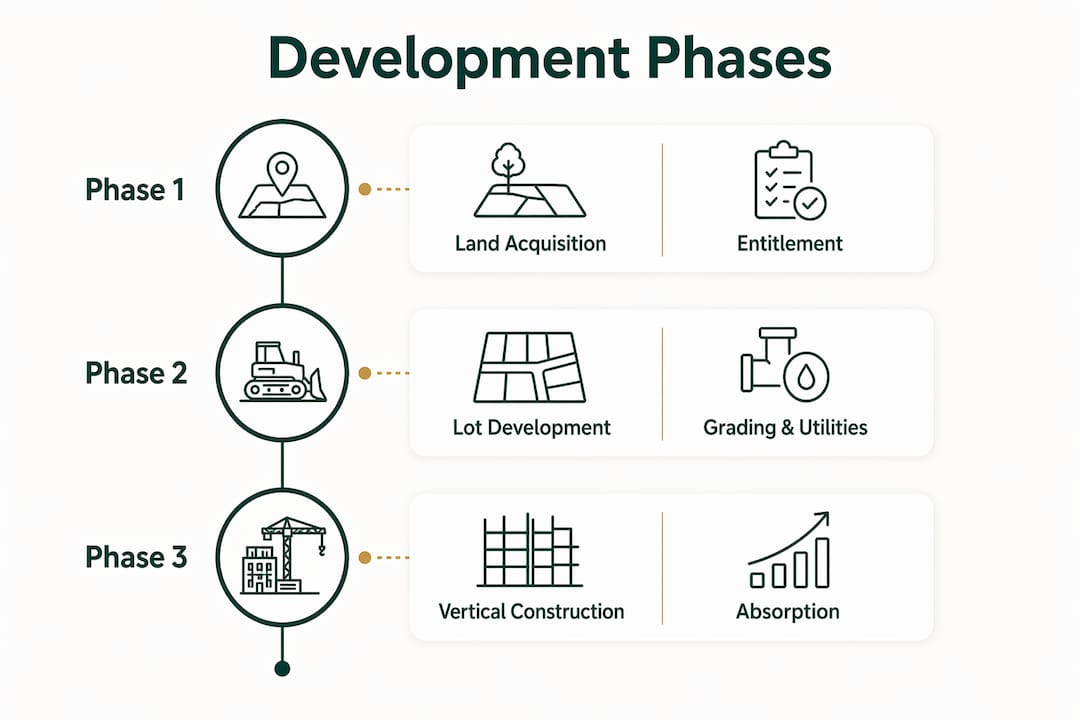
A well-structured development financial model separates the project into three distinct phases. Experienced developers model land acquisition and entitlement, lot development, and vertical construction as separate sections. Each phase carries a different risk profile, financing structure, and timeline. Mixing them into a single sheet creates confusion and hides cost overruns.
Phase 1: Land acquisition and entitlement
Phase 1 covers the purchase price, closing costs, and all carrying costs during the entitlement period. Entitlement is the process of obtaining government approvals to develop the land. By-right projects typically require 4–8 months to obtain entitlements, while projects needing variances or conditional use permits require 12–18 months. That timeline difference has a direct dollar impact on your budget.
Entitlement periods are active cost centers where property taxes, insurance, and acquisition financing interest accrue before construction begins. Developers who underestimate this period routinely face shortfalls in their interest reserve. In Tennessee markets like Nashville or Knoxville, where zoning reviews can extend timelines, this phase deserves conservative budgeting.
Phase 2: Lot development
Phase 2 covers the physical work of preparing raw land for construction. This includes grading, utilities, roads, stormwater infrastructure, and all site improvements. These costs are substantial and must be modeled with current contractor pricing, not estimates from prior projects.

Phase 3: Vertical construction and absorption
Phase 3 covers the cost of building structures on the prepared lots. The absorption schedule, meaning how many units sell per month, directly affects how long financing stays outstanding. A slower absorption rate increases interest costs and delays your return.
Pro Tip: Model each phase on a separate worksheet or clearly labeled section. This preserves distinct financing terms and risk profiles, making it far easier to communicate with lenders and equity partners.
| Phase | Primary Costs | Key Risk |
|---|---|---|
| Land acquisition and entitlement | Purchase price, closing costs, carrying costs | Entitlement timeline overrun |
| Lot development | Grading, utilities, roads, infrastructure | Construction cost escalation |
| Vertical construction | Building costs, absorption schedule | Market absorption slowdown |
How is financing structured within a land development pro forma?
Financing structure is where many first-time developers make costly errors. Construction loans for lot development generally cover 65% of the appraised finished lot value, with developers funding the remaining equity portion. That 35% equity requirement must be accounted for in your property development budgeting from day one.
The numbered steps below reflect how a sound financing model is built:
- Calculate total lot development costs. Include all hard costs, soft costs, and contingency.
- Apply the 65% loan-to-cost ratio to determine the maximum construction loan amount.
- Identify the equity gap. The difference between total costs and loan proceeds is your required equity contribution.
- Budget third-party costs separately. Appraisals, title insurance, and loan fees typically equal 3–4% of the total lot development budget. These fees are real cash outflows that reduce your net return.
- Model construction interest using a 50% draw factor. A 50% draw factor estimates the average outstanding loan balance during construction, providing a reasonable interest accrual figure without daily compounding complexity.
- Build an interest reserve into the budget. This reserve covers loan payments during the construction and entitlement periods before revenue arrives.
Pro Tip: Never rely on a lender's term sheet to set your interest reserve. Model it yourself using your actual draw schedule and a conservative interest rate assumption. Tennessee construction loan rates have moved significantly in recent cycles.
The most common financing mistake is treating third-party fees as minor line items. On a $5 million lot development budget, a 3% fee load equals $150,000. That figure affects your residual land value calculation directly. For additional context on cash flow timing in development finance, the relationship between draw schedules and interest reserves follows the same logic applied in broader capital planning.
What critical financial metrics does a land development pro forma provide?
The development financial model produces several metrics that drive investment decisions. Each one answers a specific question about project viability.
Residual land value is the single most critical output. Residual land value is the maximum price a developer can pay for land while still achieving a target profit margin. The calculation works backward: start with completed property value, subtract total development costs and your required profit, and the remainder is what you can afford to pay for the land. Urban Planning Pros uses this metric as the foundation of every feasibility study it conducts for clients across Tennessee.
IRR (Internal Rate of Return) measures the annualized return of the entire project, accounting for the timing of cash flows. A project with a high IRR but a long timeline may be less attractive than a shorter project with a slightly lower IRR. Time is a real cost in development.
NPV (Net Present Value) measures value creation relative to total investment. A positive NPV confirms the project generates returns above your required rate. A negative NPV signals the land is priced too high or costs are too elevated for the market.
Development yield and development spread are two metrics that reveal whether a project creates real value:
- Development yield is the project's stabilized NOI divided by total development cost.
- Market cap rate is the yield investors apply to similar stabilized assets in the market.
- Development spread is the difference between development yield and market cap rate, sometimes called profit-on-cost.
- Developers typically target a development spread of 15–25% to justify the risk of ground-up construction.
Valuation accuracy depends on what you discount. Discounting Pre-Tax Before-CapEx Cash Flow (PBTCF, which equals NOI minus capital expenditures) produces a more accurate investment value than discounting raw NOI. Raw NOI ignores recurring capital expenditures, which overstates the asset's true value. This distinction matters most for income-producing properties but applies to any land use analysis that includes a hold-and-lease component.
How should you structure a pro forma for lender and investor communication?
A pro forma serves as a communication tool first and a calculation engine second. A pro forma model must be linear and transparent to facilitate communication with lenders and sellers, avoiding data or assumption confusion. Lenders and equity partners should be able to follow your logic without asking where numbers come from.
The recommended structure follows this progression:
- Acquisition costs: Land price, closing costs, entitlement fees, carrying costs
- Revenue projections: Lot sales price, absorption schedule, total gross revenue
- Development expenses: Hard costs, soft costs, third-party fees, contingency
- Financing costs: Loan proceeds, interest reserve, equity contributions
- Cash flow summary: Net cash flow by period, cumulative position
- Disposition analysis: Sale proceeds, profit, IRR, NPV, residual land value
Each section should reference clearly labeled assumptions. Sensitivity analysis, which tests how changes in lot price or construction cost affect returns, belongs in a dedicated section rather than embedded in the main model. This keeps the primary model clean and the stress-testing visible.
Pro Tip: If a lender has to call you to understand where a number came from, your model is not ready. Build it so a third party can audit every assumption without your help.
Common mistakes in model presentation include combining all three development phases into a single sheet, using unlabeled formulas that reference distant cells, and omitting a summary page. A one-page executive summary showing total costs, total revenue, profit, and IRR is the first thing a lender reads. Make it count.
Key Takeaways
A land development pro forma is only as reliable as the assumptions behind it, and separating development phases is the single most effective way to improve both accuracy and stakeholder trust.
| Point | Details |
|---|---|
| Separate development phases | Model acquisition, lot development, and vertical construction on distinct sections to preserve accuracy. |
| Residual land value drives decisions | Calculate maximum land price by subtracting all costs and profit targets from completed property value. |
| Budget third-party fees precisely | Appraisals, title insurance, and loan fees typically equal 3–4% of the total lot development budget. |
| Use a 50% draw factor for interest | This estimate approximates average outstanding loan balance without requiring daily compounding calculations. |
| Build for lender readability | A linear, clearly labeled model reduces lender questions and speeds up financing approvals. |
Why most pro formas fail before the deal closes
The most common failure I see is not a math error. It is a structural one. Developers build a single spreadsheet that blends acquisition costs, lot development, and homebuilding into one undifferentiated block of numbers. When a lender asks a question about entitlement carry costs, the developer cannot answer cleanly because the data is buried. That single structural flaw kills deals.
Residual land value is the question every pro forma must answer first. Not IRR. Not NPV. What can you pay for this land and still hit your profit target? If you cannot answer that in 30 seconds from your model, the model is not working for you.
Entitlement costs are the second most underestimated line item I encounter. Developers in Tennessee markets often assume a 4-month entitlement period and budget accordingly. When the jurisdiction requires a variance and the timeline extends to 14 months, the interest reserve is gone and the equity partners are unhappy. Budget for the worst-case timeline, then work to beat it.
Transparency with lenders and equity partners is not optional. A model that requires explanation is a model that creates doubt. Every assumption should be visible, labeled, and defensible. When you update market data or construction pricing, update the model and share the revised version. Lenders notice when developers treat the pro forma as a static document rather than a living analysis.
For developers working through complex entitlement timelines, understanding how multi-year planning affects capital commitments provides useful context on structuring long-horizon financial models.
— Jeremy
How Urban Planning Pros supports your pro forma process
Accurate pro forma modeling depends on accurate site data. Without confirmed zoning classifications, infrastructure constraints, and entitlement timelines, even a well-structured financial model produces unreliable outputs.

Urban Planning Pros provides feasibility studies that deliver the site-specific data your pro forma requires, including zoning analysis, entitlement risk assessment, and infrastructure cost estimates. The team also offers master land planning services that align your development concept with what the market and jurisdiction will actually support. For developers managing multiple phases simultaneously, the expert project management service tracks milestones, costs, and approvals across the full development timeline. Contact Urban Planning Pros to schedule a feasibility consultation before your next land acquisition.
FAQ
What is a land development pro forma?
A land development pro forma is a financial model that projects all costs, revenues, and returns for a development project across its full lifecycle. It guides investment decisions by calculating residual land value, IRR, and NPV before any capital is committed.
What does residual land value mean in a pro forma?
Residual land value is the maximum price a developer can pay for land while still meeting a target profit margin. It is calculated by subtracting total development costs and required profit from the completed property's market value.
How long does entitlement take in Tennessee?
By-right subdivision projects typically require 4–8 months for entitlement, while projects requiring variances or conditional use permits take 12–18 months. Budgeting for the longer timeline protects your interest reserve and equity position.
What loan-to-cost ratio applies to lot development loans?
Construction loans for lot development generally cover 65% of the appraised finished lot value. Developers fund the remaining equity portion, which must be accounted for in the project's total capital structure.
Why should development phases be modeled separately?
Separating phases preserves distinct financing terms, risk profiles, and timelines for each stage of the project. This structure makes the model easier to audit, reduces lender questions, and improves the accuracy of cost and return projections.