
Phase 1 ESA requirements are defined by ASTM E1527-21 and the EPA's All Appropriate Inquiries (AAI) rule, establishing a non-invasive environmental due diligence process that developers and consultants must complete before acquiring or developing property. Compliance with ASTM E1527-21 is mandatory under 40 CFR Part 312 to obtain CERCLA liability protection. That protection is the legal shield that keeps a buyer from inheriting cleanup costs tied to contamination they did not cause. In Louisiana, where industrial corridors, former agricultural land, and petrochemical sites frequently appear in development pipelines, getting this process right is not optional.
What are the core Phase 1 ESA requirements?
A Phase 1 Environmental Site Assessment is a standardized, non-invasive investigation designed to identify recognized environmental conditions (RECs) on or near a subject property. The governing standard is ASTM E1527-21, updated in 2021 to replace the prior E1527-13 version. Any assessment conducted under the older standard no longer satisfies AAI compliance for federal liability protection. Developers and lenders in Louisiana who accept outdated reports expose themselves to significant legal and financial risk.
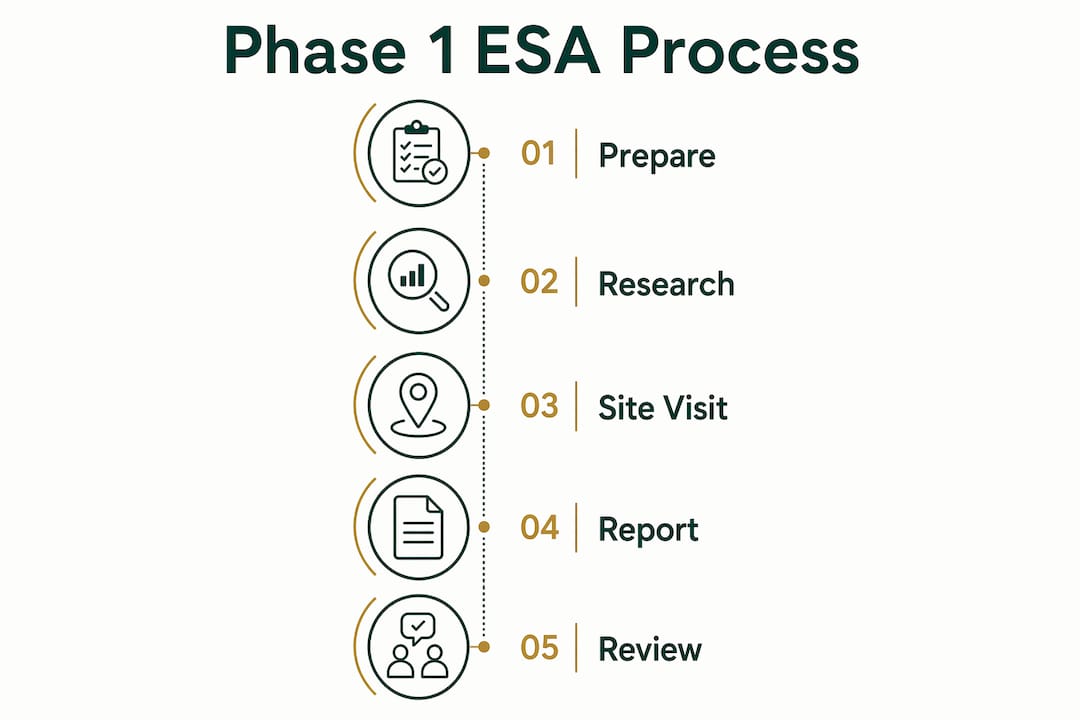
The ESA phase 1 process follows four defined components, each with specific deliverables:
-
Records review. The Environmental Professional (EP) reviews federal and state regulatory databases, historical aerial photographs, Sanborn fire insurance maps, topographic maps, and prior environmental reports. This step establishes the site's historical use and identifies any regulatory listings that signal past contamination.
-
Site reconnaissance. The EP conducts a physical walkthrough of the property and adjoining areas. The goal is to observe current conditions, including storage tanks, staining, distressed vegetation, drums, or any physical evidence of hazardous materials use.
-
Interviews. The EP interviews current and past owners, occupants, and local government officials. These conversations surface risks that do not appear in public records, such as informal dumping or unreported spills.
-
Report preparation. The EP compiles findings into a written report that documents RECs, data gaps, and professional judgment on environmental risk.
No soil, groundwater, or building material sampling occurs during a Phase 1 assessment. That distinction separates it from Phase 2 and keeps costs and timelines manageable for most transactions.
Pro Tip: Request copies of all database search reports as appendices to the Phase 1 report. In Louisiana, LDEQ records and EPA ECHO database entries for nearby industrial facilities can reveal off-site contamination sources that a site walkthrough alone will not detect.

Who qualifies as an Environmental Professional to conduct a Phase 1 ESA?
The EP designation is not a generic title. EPA defines three qualification pathways for professionals authorized to sign an AAI-compliant Phase 1 report:
- A licensed Professional Engineer (PE) or Professional Geologist (PG) with at least 3 years of relevant experience in environmental site assessments.
- A holder of a science or engineering degree plus at least 5 years of full-time relevant experience.
- A professional with 10 years of full-time relevant experience in environmental site assessments, without a required degree.
Each pathway requires demonstrated competence in environmental due diligence, not just general engineering or science credentials. Using an unqualified consultant invalidates CERCLA protections and can cause lender rejection of the report. That outcome is particularly costly when a deal is under contract and a closing deadline is approaching.
Many developers assume any licensed engineer can sign a Phase 1 report. That assumption is wrong and expensive to correct after the fact. The EP must specifically meet EPA criteria, and the report must state their qualifications explicitly.
Pro Tip: Before hiring a consultant, ask them to provide their CV and confirm in writing which of the three EPA qualification pathways they satisfy. Verify their license status through the Louisiana Professional Engineering and Land Surveying Board if they claim PE credentials.
You can also review engineering services qualifications to understand the professional standards that apply to compliant Phase 1 ESA work.
What are the timing requirements and report validity periods?
Phase 1 ESA reports do not have a single universal expiration date. The validity rules are component-specific, and this is one of the most misunderstood aspects of the esa requirements checklist.
| Component | Validity Period | Implication |
|---|---|---|
| Interviews, site visits, database searches | 180 days | Must be refreshed if acquisition extends beyond this window |
| Government records and historical review | 1 year | Longer shelf life but still subject to update if conditions change |
| Full assessment (all components current) | 1 year maximum | All components must fall within their respective windows |
Interviews, site inspections, and database searches must be completed within 180 days before the acquisition date to satisfy AAI compliance. Government and historical records reviews carry a 1-year validity limit. This distinction matters because many developers treat the Phase 1 report as a one-year document across the board. That misreading can leave the 180-day components expired while the report still appears current on its face.
Most Phase 1 ESAs complete within 2–4 weeks, but complex sites, large acreage, or limited data availability can extend that timeline. In Louisiana, sites near the Mississippi River industrial corridor or former sugar cane operations may require additional records research, adding time before the clock even starts on the 180-day window.
If a sale or development cycle extends beyond 180 days, the EP must update the time-sensitive components before closing. Failing to do so voids the AAI compliance and strips the buyer of innocent landowner protection under CERCLA.
How does Phase 1 ESA differ from Phase 2 ESA?
The Phase 1 vs Phase 2 ESA distinction comes down to one word: sampling. Phase 1 is observational and records-based. Phase 2 is intrusive and laboratory-driven.
Phase 2 ESA involves soil, groundwater, or vapor sampling to confirm and characterize contamination that Phase 1 identified as a recognized environmental condition. Phase 2 costs significantly more than Phase 1 and takes longer to complete. The decision to proceed to Phase 2 is not a failure of the Phase 1 process. It is the system working as designed.
Common triggers for a Phase 2 investigation after a Phase 1 site assessment include:
- Identification of a REC linked to a known or suspected release of hazardous substances.
- Historical use of the property as a gas station, dry cleaner, industrial facility, or agricultural operation with pesticide or fertilizer storage.
- Proximity to a listed Superfund site or LDEQ-regulated facility with documented releases.
- Data gaps that cannot be resolved through additional records research or interviews.
For developers in Louisiana, Phase 2 wetland delineations may also be required when Phase 1 findings overlap with jurisdictional wetland areas, adding another layer of due diligence before permits can proceed.
The real estate implications of a Phase 2 trigger are significant. Lenders may require remediation or risk pricing before funding. Buyers may renegotiate purchase price. Sellers may need to disclose findings to future buyers regardless of whether a deal closes. Understanding this dynamic before entering contract protects all parties.
What are RECs, data gaps, and how should consultants communicate findings?
Recognized environmental conditions are the central output of a Phase 1 environmental assessment. The three categories are:
- REC (Recognized Environmental Condition): A current or past release of hazardous substances or petroleum products that has or may have impacted the property. This is the highest-concern finding and typically triggers Phase 2 consideration.
- HREC (Historical Recognized Environmental Condition): A past release that has been remediated to regulatory standards with no ongoing concern. The site has a documented history but no current risk.
- CREC (Controlled Recognized Environmental Condition): A past release that has been addressed but with residual contamination remaining under regulatory controls, such as land use restrictions or monitoring requirements.
Data gaps are not assessment failures. They signal areas of uncertainty where records were unavailable, access was denied, or historical information was incomplete. A well-written Phase 1 report explains each data gap, its potential significance, and whether it affects the overall risk conclusion.
Consultants must communicate these findings in plain terms. Clients who receive a report full of technical qualifications without clear interpretation cannot make sound decisions about acquisition, pricing, or remediation budgeting. Transparent communication about data gaps is a professional obligation, not a courtesy.
Pro Tip: When presenting Phase 1 findings to a developer client, prepare a one-page executive summary that separates RECs by category, lists each data gap with a plain-language explanation, and states a clear recommendation. This prevents misinterpretation and speeds up the client's decision-making process.
Real estate transactions in Louisiana often involve properties with layered histories. Consulting resources that address environmental risks in real estate can help developers and their legal teams frame Phase 1 findings within the broader context of deal risk and lender requirements.
Key Takeaways
A Phase 1 Environmental Site Assessment conducted under ASTM E1527-21 and EPA AAI rules is the only path to CERCLA liability protection for property buyers, and its validity depends on meeting component-specific timing requirements, not a single expiration date.
| Point | Details |
|---|---|
| ASTM E1527-21 is mandatory | Only reports compliant with this standard satisfy EPA AAI and qualify for CERCLA protection. |
| Four non-invasive components | Records review, site reconnaissance, interviews, and report preparation define the Phase 1 process. |
| EP qualifications are non-negotiable | Only professionals meeting one of three EPA criteria can sign a valid, lender-accepted report. |
| Timing rules are component-specific | Interviews and site visits expire in 180 days; government records and the full assessment expire in 1 year. |
| RECs and data gaps guide next steps | RECs trigger Phase 2 consideration; data gaps signal uncertainty that clients must understand before closing. |
What I've learned from watching developers skip the details
After working through dozens of land planning and feasibility projects, the pattern I see most often is not outright negligence. It is overconfidence in a report that was never fully scrutinized. A developer receives a Phase 1 report, sees no RECs listed, and assumes the property is clean. What they missed is that the EP's qualifications were never verified, or that three of the 180-day components had already expired by closing day.
Louisiana adds its own complexity. The state's industrial history, coastal hydrology, and agricultural land conversions mean that properties with no obvious red flags can still carry legacy contamination from decades-old operations. A Phase 1 report that does not account for LDEQ records, historical aerial photography going back to the 1940s, or proximity to former oil field service yards is not a thorough report. It is a liability waiting to surface.
My strongest advice: integrate the Phase 1 site assessment into the earliest stage of project planning, not as a closing requirement but as a feasibility input. When you know the environmental risk profile of a site before you negotiate price or design infrastructure, you make better decisions. You budget for Phase 2 if needed. You price remediation into your pro forma. You avoid the worst outcome, which is discovering contamination after you own the property and have no legal recourse.
The innocent landowner defense under CERCLA exists for a reason. Protect it by treating Phase 1 compliance as a non-negotiable standard, not a checkbox.
— Jeremy
How Urban Planning Pros supports environmental due diligence
Environmental due diligence does not exist in isolation from the broader development process. Phase 1 findings directly affect zoning strategy, infrastructure planning, and capital timing. Urban Planning Pros integrates environmental risk assessment into its feasibility studies services so that developers understand site constraints before committing capital.

Urban Planning Pros works with landowners and developers across Louisiana to evaluate property documents, identify regulatory constraints, and build development strategies that account for environmental findings from the start. Whether a Phase 1 report flags a REC that needs Phase 2 follow-up or reveals a clean site ready for entitlement, the team at Urban Planning Pros helps clients translate those findings into a clear path forward. Reach out to discuss how land planning services can be structured around your site's environmental profile.
FAQ
What is a Phase 1 ESA and when is it required?
A Phase 1 Environmental Site Assessment is a non-invasive investigation conducted under ASTM E1527-21 to identify environmental risks before property acquisition or development. Lenders, federal programs, and CERCLA liability protections all require a compliant Phase 1 report.
How long does a Phase 1 ESA take to complete?
Most Phase 1 assessments complete within 2–4 weeks, though complex sites or limited data availability can extend that timeline. Developers should order the assessment early in the due diligence period to avoid closing delays.
What happens if a Phase 1 ESA identifies a REC?
A recognized environmental condition triggers consideration of a Phase 2 ESA, which involves soil, groundwater, or vapor sampling to confirm and characterize contamination. Finding a REC does not automatically kill a deal but does require further investigation before lenders will fund.
Can any licensed engineer sign a Phase 1 ESA report?
No. Only Environmental Professionals meeting one of three specific EPA qualification criteria can sign an AAI-compliant Phase 1 report. Using an unqualified consultant invalidates CERCLA protections and may cause lender rejection.
How often does a Phase 1 ESA need to be updated?
Interviews, site visits, and database searches expire after 180 days. Government records and the full assessment carry a 1-year validity limit. If a transaction extends beyond these windows, the relevant components must be refreshed before closing.