Find the agenda for your local planning commission, confirm how to join, and submit any written testimony or exhibits by your jurisdiction's deadline. Most agencies post agendas about six days before the meeting and release staff reports separately, sometimes not until the Friday beforehand. Check your jurisdiction's rules on remote testimony before you count on joining by video, and treat the written submission deadline, often 48 hours out or by close of business the Wednesday before, as firm.
TL;DR:
- Most agendas appear six days before the hearing, but staff reports may be released only a few days prior, making early review essential.
- Submitting written testimony at least 48 hours in advance is critical, with clear labelling of exhibits and direct responses to staff recommendations.
- Public hearings are quasi-judicial and focus on applying specific code criteria, so testimony referencing staff findings carries more influence than general objections.
- Hybrid attendance is common, but verify remote participation rules, including ADA accommodations and backup plans, to ensure your testimony is recorded.
- Local notice and appeal deadlines vary, so confirm the specific window for appeals promptly after decisions and understand submission and fee requirements.
Table of Contents
- Where to Find Planning Commission Meeting Agendas and Staff Reports
- What Happens During a Planning Commission Hearing
- How to Prepare and Submit Written Testimony
- Joining Remotely and Requesting Accommodations
- Timeline, Notice Requirements, and Appeal Windows
- A Practitioner's Checklist Before Any Hearing
- How Urban Planning Pros Prepares Clients for a Hearing
- Sources
- FAQ
Where to Find Planning Commission Meeting Agendas and Staff Reports
Every case starts with the same question: when is the hearing, and what will commissioners actually read before they vote? The answer lives on your city or county planning department's website, usually under a tab labeled "agendas," "meeting packets," or "hearings." Larger jurisdictions post a full calendar; smaller ones may bury it under the commission's own page.
San Francisco's planning department, for example, posts agendas roughly six calendar days before a hearing, with staff reports sometimes trailing behind, occasionally landing only the Friday before a midweek session. That gap matters. The agenda tells you a project is being heard. The staff report tells you what the planner actually recommends and why, including the code sections and findings that will drive the vote.
Before you assume your written comment will land on time, build a short habit around three things:
- Bookmark the commission's agenda or packet page and check it weekly during active project review.
- Subscribe to email, text, or calendar feed alerts if your jurisdiction offers them, most planning departments do.
- Download the full staff report and any linked exhibits, not just the agenda summary, since the technical analysis and recommendation live there.
- Call or check the site the morning of the hearing to confirm your item hasn't been continued or pulled from the docket.
That last step avoids wasted trips. Items get bumped constantly, and a canceled agenda item after you've cleared your schedule is one of the most common frustrations for first time attendees.
What Happens During a Planning Commission Hearing
A planning commission hearing runs in a predictable sequence: staff presents their report and recommendation, the applicant responds, the floor opens for public comment, commissioners ask questions, and then the board deliberates and votes. That order rarely changes, but the timing within it does.
What surprises a lot of first time speakers is how legal the process actually feels. Planning commission hearings are frequently quasi-judicial, meaning commissioners are bound to apply specific zoning code criteria and legal findings to the facts in front of them, not just weigh public opinion. That single fact changes how you should talk when you get the microphone.
A few practical realities to keep in mind:
- Commissioners lean heavily on the staff report's findings, so testimony that cites specific code sections tends to carry more weight than general objections.
- The agenda order can shift the night of the meeting. Items get reordered or continued at the commission's discretion.
- Deliberation and the vote usually happen immediately after public comment closes, so once testimony ends, the decision often follows within minutes.
Pro Tip: Read the staff recommendation before you write a single word of testimony. If staff already recommends denial or approval with conditions, your comment is far more persuasive when it responds directly to their stated findings instead of repeating points they've already addressed.
Arrive with the expectation that your item might be called early, late, or continued to another date entirely. Local land use meeting procedures and packet examples routinely note that commissions retain discretion to reorder or continue items without much advance warning.
How to Prepare and Submit Written Testimony
Most jurisdictions want written comments and exhibits in hand well before the gavel drops, and the deadline is not a suggestion; understanding how planning conditions affect building costs in the UK can help prepare for similar impacts on your project. Douglas County's land use meeting procedures request written comments at least 48 hours in advance, warning explicitly that late submissions may technically reach commissioners but arrive too close to the hearing for anyone to actually review them. If your jurisdiction meets midweek, that often translates to a Wednesday close-of-business cutoff for a Thursday hearing.
Follow this sequence to keep your submission usable, not just technically on time:
- Read the staff report first. Identify the specific code sections, zoning criteria, or findings the staff recommendation relies on.
- Draft a written comment that answers those criteria directly, summarizing any technical evidence (traffic studies, engineering reports, environmental data) in plain language up front.
- Label every exhibit clearly with a title, page count, and reference back to the point it supports. Practitioners who work with technical exhibits, engineer reports, and traffic studies almost always attach a short summary page, because commissioners rarely have time to read a 40-page appendix during the hearing itself.
- Submit as a properly named PDF well before the deadline, not right at the wire, in case of upload issues or email delays.
- Plan your oral remarks for two to three minutes. State your name, your relationship to the project (neighbor, applicant, affected property owner), and tie your points back to the staff report and specific criteria rather than general concerns.
If you need more time to gather technical evidence, ask the commission for a continuance early. Waiting until the hearing itself to request one rarely goes well.
Joining Remotely and Requesting Accommodations
Hybrid participation has become standard across most U.S. jurisdictions: you can watch in person or stream the hearing, and many commissions let you testify by video through platforms like Zoom or Microsoft Teams. That said, some agencies still require in-person attendance for formal witness testimony even when a remote viewing link exists, so verify your jurisdiction's specific rules before building your whole plan around remote access.
Streaming and accommodation requests both run on their own clocks:
- Confirm the streaming link a day or two ahead. If it appears late or fails on hearing day, most agencies list a backup phone number or contact for the commission secretary.
- Request ADA accommodations or language translation early. County pages commonly require 72 hours' notice to arrange interpreters or accessibility support.
- If you're relying on remote testimony for a contested case, have a backup plan to appear in person in case your jurisdiction restricts video testimony for the record.
Timeline, Notice Requirements, and Appeal Windows
A land use case typically moves through submission, staff review, public notice, the hearing itself, and then a decision that may still face an appeal. Notice usually goes out through a mix of mailed letters to nearby property owners, posted signs on the site, and an online agenda posting, each with its own lead time set by local code.
Fee schedules and appeal windows vary by jurisdiction, so check your local planning department's fee page rather than assuming a statewide number. A few patterns hold across most jurisdictions:
- Application fees, public notice fees, and record reproduction fees are usually itemized separately on a published fee schedule.
- Appeal periods commonly run a set number of calendar days after the written decision is issued, and either the applicant or an affected party can typically file.
- If you disagree with a decision, contacting the commission secretary directly is often the fastest way to confirm the exact appeal deadline for your case.
A Practitioner's Checklist Before Any Hearing
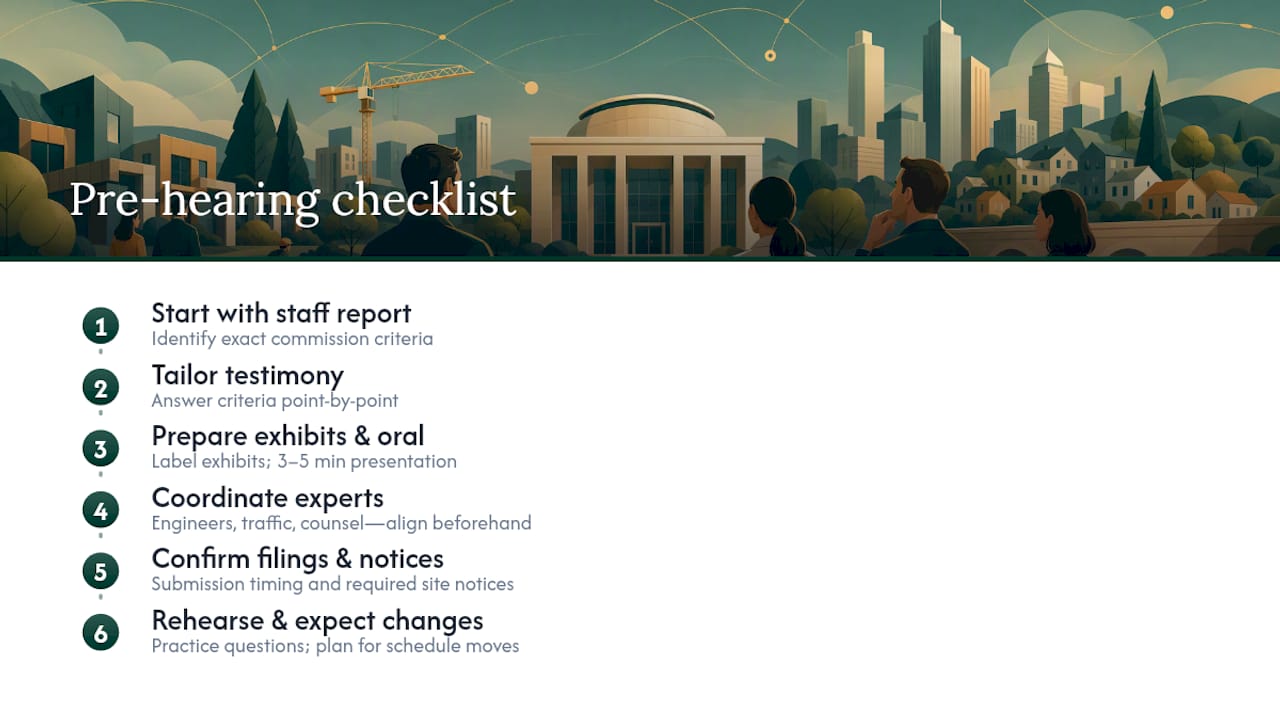
Every hearing preparation starts in the same place: the staff report, not the agenda. Identify the exact criteria the commission has to apply, then build testimony that answers those criteria point by point instead of arguing feelings about the project. Labeled exhibits and a tight three to five minute oral presentation do more work than a stack of unmarked paper. Coordinating with the technical team, engineers, traffic consultants, legal counsel, ahead of time means nobody is scrambling the morning of the hearing. Confirm submission timing, arrange any required site notices, and rehearse likely commissioner questions. Plan for scheduling uncertainty too, since agenda items get pulled forward or continued without much warning.
How Urban Planning Pros Prepares Clients for a Hearing
Preparing for a planning commission hearing is technical work disguised as a public meeting, and most of the risk shows up long before anyone steps up to the microphone. Urban Planning Pros works through the staff report with clients line by line, builds exhibits that speak directly to zoning criteria instead of general narrative, and coordinates the engineers, surveyors, and legal contacts who need to weigh in before submission deadlines hit.

That early technical review is where most of the risk gets removed. A feasibility study done before entitlement even starts flags the zoning constraints and infrastructure issues that would otherwise surface as staff objections at the hearing. For landowners and developers who want someone in the room who knows the code criteria as well as the commission does, Urban Planning Pros offers owner representation and land planning services built around exactly this kind of preparation. If your project has a hearing date on the calendar, schedule a consultation now, not the week your submission deadline hits.
Sources
- Calendar | SF Planning
- Town of Poughkeepsie — meetings and hearing notices
- Types of decisions — Land use training (extension.wisc.edu)
- Douglas County — land use meeting procedures
- San Diego County — Planning Commission hearing streaming and accommodations
FAQ
What is the purpose of a planning commission?
A planning commission reviews land use applications, such as rezonings, subdivisions, and development proposals, against local zoning code and general plan criteria, then makes recommendations or final decisions depending on the jurisdiction's structure.
Who sits on a local planning commission?
Membership varies by jurisdiction, but most commissions are made up of appointed citizen volunteers, often with backgrounds in real estate, architecture, law, or community advocacy, appointed by the mayor, city council, or county board.
How does a planning commission make its decisions?
Commissioners weigh the staff report's findings and recommendation against specific zoning or code criteria, then factor in public testimony before deliberating and voting; because many hearings are quasi-judicial, the vote has to be grounded in those legal criteria rather than general preference.
What is a planning commission hearing, exactly?
It's a public meeting where a commission reviews a specific development or land use proposal, hears from staff and the applicant, takes public comment, and then votes on approval, denial, or continuance based on code criteria.
Why would a planning commission deny or delay a project?
Common reasons include unresolved staff findings, missing technical studies, testimony that raises unaddressed code conflicts, or incomplete submissions, any of which can push commissioners toward a continuance rather than a final vote.
What should I do after the hearing if I disagree with the outcome?
Contact the commission secretary to confirm your jurisdiction's appeal window and filing requirements, since appeal periods and eligible parties vary by local code and are typically listed on the decision notice itself.