
PUD zoning is a site-specific rezoning tool that trades away standard lot and use restrictions for a unified development plan tied to public benefits. It gives developers design flexibility in exchange for binding commitments on open space, density, and infrastructure. Municipalities grant it selectively, and landowners, developers, and buyers all need to understand what they are agreeing to before signing on.
TL;DR:
- PUD zoning offers design flexibility and public benefits but involves longer approval timelines and binding commitments that affect resale and financing.
- It enables mixed-use developments with broader land use options, scaled to site size, and often requires detailed concept plans and public outreach.
- Reviewers evaluate whether deviations from standard zoning result in genuine improvements for the area, demanding measurable public benefits.
- Post-approval, PUDs come with recorded obligations, and any significant changes usually require a formal amendment through the review process.
- Engaging a qualified planning team early can identify conflicts and improve the chances of approval, especially for complex or large sites.
Table of Contents
- What Is PUD Zoning, and How Does It Differ From Traditional Zoning?
- What Can You Build Under PUD Zoning?
- Is PUD Zoning Worth Pursuing? Weighing the Benefits and Drawbacks
- How Do You Apply for PUD Zoning? Steps and Timeline
- What Do Cities Look for When Reviewing a PUD?
- What Happens After PUD Approval? Governance and Amendments
- When Should You Pursue a PUD, and When Should You Hire a Consultant?
- A Practitioner's View on Building a Winning PUD Strategy
- How Urban Planning Pros Can Help With Your PUD Application
- Sources
What Is PUD Zoning, and How Does It Differ From Traditional Zoning?
Traditional zoning, often called Euclidean zoning, sorts land into fixed categories: residential here, commercial there, industrial somewhere else, each governed by rigid setback and density rules. A planned unit development works differently. It's a legislative rezoning action that creates a custom rulebook for one site, built around a unitary site plan rather than a generic use table.
That flexibility doesn't come free. Municipalities negotiate standards like setbacks, parking ratios, and use mixes against what the applicant offers in return. A few terms show up in nearly every PUD conversation:
- Concept plan: the early, big-picture layout submitted for initial review and public feedback.
- Final development plan: the detailed, engineered version submitted after concept approval.
- Unified control: proof that one entity controls the entire site, so the plan can be enforced as a whole.
- Development narrative: the written case explaining what's being built, why, and what the public gets in exchange.
Get these fundamentals wrong early, and the rest of the entitlement process gets harder.
What Can You Build Under PUD Zoning?
PUDs typically support a wider mix of uses than a single Euclidean district would allow on its own. That's the point of pursuing one.
Common project types include:
- Mixed-use centers combining ground-floor retail with residential or office space above.
- Clustered residential development mixing single-family lots, townhomes, and apartments on one master-planned tract.
- Neighborhood retail serving the immediate development rather than regional traffic.
- Institutional uses like schools, clinics, or civic buildings integrated into a larger plan.
- Dedicated parks and open space woven through the site rather than left as leftover parcels.
Municipal plans express these allocations in specific terms: percentage of land by use, maximum floor area ratio, or units per acre. A five-acre infill parcel might only support a modest PUD with neighborhood retail and clustered housing. A 200-acre tract near a highway interchange can justify a full mixed-use center with its own internal street grid. Scale drives what a reviewing body will consider "planned unit development" versus a stretch of the term.
Is PUD Zoning Worth Pursuing? Weighing the Benefits and Drawbacks
A PUD can raise a project's value, but it also raises its risk profile. Landowners and developers need to weigh both sides before committing time and money to the process.
The benefits tend to show up first in underwriting:
- Design flexibility lets a site respond to its actual topography, views, and access points instead of forcing a generic grid onto irregular land.
- Higher achievable value often follows from blending uses and amenities that command a premium over a single-use subdivision.
- Lower infrastructure cost per unit results from clustering buildings and sharing streets, utilities, and stormwater systems.
The drawbacks show up later, usually during entitlement or after closing:
- Longer timelines compared to a permitted-use project, since a PUD requires legislative approval rather than a staff-level review.
- Political exposure, because council and commission approvals are discretionary and can hinge on public hearing turnout as much as technical merit.
- Binding, recorded obligations that follow the land through resale, financing, and long-term maintenance.
Lenders and buyers should read the approved plan closely. A PUD's conditions affect appraisal assumptions and future flexibility just as much as the entitlement itself.
How Do You Apply for PUD Zoning? Steps and Timeline
Every jurisdiction runs its own version of the process, but the sequence is fairly consistent across the country.
- Pre-application meeting: staff review the concept informally and flag obvious conflicts before formal submission.
- Neighborhood outreach: many cities expect or require applicant-led meetings with nearby property owners before the first hearing.
- Concept plan submission: the rezoning request goes in, typically with a development narrative, land-use schedule, and preliminary plan drawings.
- Public hearings: the planning commission reviews first, followed by a council vote, both open to public comment.
- Final development plan: once the rezoning is approved, engineered site plans go through a more technical, staff-level review.
Standard submittal packages include traffic and utility studies, a development standards table covering density and setbacks, and documentation proving unified control of the property. Some cities, including Wichita, allow applicants to combine concept and final plan review when the initial submission is detailed enough, which can shave months off the schedule.
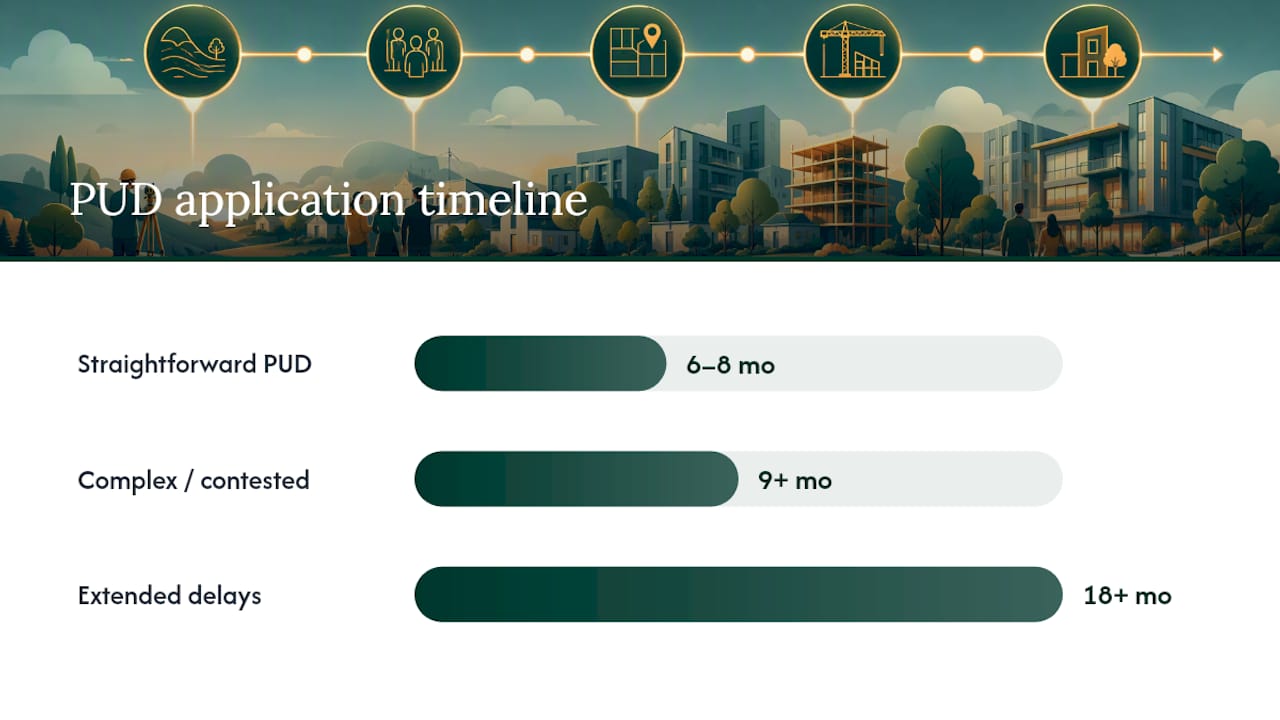
Timing varies widely. A straightforward PUD on an uncontested site can move through in six to eight months, matching the range cities like Phoenix cite as typical. Complex or contested projects routinely stretch past nine months and sometimes past a year and a half, usually because of neighborhood opposition, incomplete traffic studies, or redesigns requested mid-review.
Pro Tip: Submit a concept package with real renderings and a landscape plan instead of a bare-bones sketch. It costs more upfront, but a detailed package builds staff and council confidence faster than a vague one they have to interrogate at the hearing.
What Do Cities Look for When Reviewing a PUD?

Reviewers aren't just checking boxes. They're deciding whether the proposed deviations from standard zoning produce something genuinely better for the surrounding area.
Design expectations typically include:
- Usable open space, sized and placed where residents will actually use it, not just leftover corners.
- Pedestrian connectivity between buildings, streets, and adjacent neighborhoods.
- Architectural articulation that breaks up long facades and repetitive massing.
- Stormwater and sustainability measures, from green roofs to shaded parking areas.
In exchange for flexibility, applicants usually need to offer something measurable back to the public. That might mean extra open space beyond the minimum, a share of affordable units, habitat protection on sensitive portions of the site, or infrastructure upgrades the city wouldn't otherwise fund. Planning offices, including DC's zoning office, frame this explicitly as an exchange: the applicant gets relief from standard rules, and the public gets a documented benefit in return. Reviewers judge "superiority" against what conventional zoning would have produced on the same site, not against some abstract ideal.
What Happens After PUD Approval? Governance and Amendments
Approval isn't the finish line. It's the start of a set of obligations that run with the land.
An approved PUD plan is legally binding, not aspirational. Recorded covenants and easements typically lock in the open space, setbacks, and use mix the plan describes. Private streets, shared amenities, and common landscaping usually fall to a homeowners' association or similar management entity, since someone has to maintain what the city won't take over.
Not every future change requires a public hearing. Minor adjustments, like shifting a building footprint a few feet, often qualify for administrative approval. Changes to density, use mix, or public benefit commitments usually require a formal amendment, which means going back through commission and council review.
This matters for resale and financing. Lenders and buyers should confirm what's recorded against the property, since an outdated or violated PUD condition can complicate a sale years after the original approval.
When Should You Pursue a PUD, and When Should You Hire a Consultant?
A PUD makes sense when a site has real constraints that conventional zoning can't accommodate, when the plan depends on mixing uses that standard districts keep separate, or when the developer can offer public benefits substantial enough to justify the deviations requested.
The financial case comes down to a straightforward comparison: does the value lift from added density, use flexibility, or premium positioning outweigh the added entitlement time and cost? For many mid-size and larger sites, it does. For a small, straightforward parcel, a standard rezoning or variance may get there faster and cheaper.
This is where a consultant earns their fee. A qualified planning team builds the feasibility study, drafts the development narrative, runs community outreach, and manages the entitlement calendar so nothing stalls in staff review.
Pro Tip: Get a feasibility read on your site before writing a single page of the development narrative. It's far cheaper to learn a PUD won't work in month one than in month nine.
A Practitioner's View on Building a Winning PUD Strategy
Most PUD applications don't fail because the design is bad. They fail because the applicant didn't spot a fatal conflict early enough, or the development narrative reads like a legal formality instead of a genuine case for why the public benefits.
The strongest applications Urban Planning Pros has structured over the years share a pattern: a feasibility study that surfaces zoning and site conflicts before money gets spent on engineering, a master plan detailed enough to answer staff questions before they're asked, and outreach materials that treat neighbors as stakeholders rather than obstacles to manage. Councils grant PUD flexibility as a negotiated exchange, and the applicants who understand that going in tend to move faster through hearings than the ones who treat the public benefit requirement as an afterthought.
The technical plan gets a project to the hearing room. The narrative and the outreach are what get it approved.
— Jeremy Wenger
How Urban Planning Pros Can Help With Your PUD Application
Getting a PUD approved means building a case, not just a site plan, and that's exactly where Urban Planning Pros focuses its work. The firm runs feasibility studies that pressure-test a site against zoning constraints and market conditions before you commit capital to design or engineering, then carries that analysis into master land planning that produces the concept plans and development standards reviewers actually want to see.

A first meeting typically covers your site's constraints, what a realistic use mix looks like, and whether the value lift justifies the entitlement timeline. For readers weighing a specific development approach, resources like this breakdown of specific plan zoning show how similar negotiated-flexibility tools work in practice. If you're holding land and unsure whether a PUD, a standard rezoning, or something else fits your parcel, request a project snapshot from Urban Planning Pros and get a clear read on your options before you file anything with the city.
Sources
- Planned Unit Development (PUD) Procedures — City of Phoenix
- Planned Unit Development (PUD) — Austin municipal code excerpt
- Planned Unit Development | dcoz - DC.gov
- Planned unit development — Wikipedia