A restrictive covenant can legally block or materially limit a proposed development, regardless of what zoning allows. If the property has any recorded history, treat covenant risk as a feasibility item today: pull the full chain of title, flag any recorded restrictions, and price remediation into your schedule before you go further with design or financing.
TL;DR:
- Title searches must include the full chain of ownership, as covenants can be buried in deeds, plats, or CC&Rs recorded decades earlier, and might still be enforceable.
- Resolving covenant conflicts can involve negotiating a release, purchasing insurance, relying on statutory overrides, or litigating, with each option differing significantly in cost and speed.
- Engaging a real estate attorney, insurance broker, and land planner early in the process helps confirm enforceability, identify beneficiaries, and develop effective mitigation strategies.
- Lenders treat undisclosed covenants as a security risk, and their counsel often will not close until the covenant is addressed, insured, or legally removed.
- Including covenant review and mitigation options in a feasibility study is essential for accurate project assessment, especially in historic or complex title situations.
Table of Contents
- What Restrictive Covenants Development Plans Must Account For
- How Covenants Affect Feasibility, Design, and Financing
- How to Find and Interpret Covenants During Due Diligence
- Options for Resolving a Restrictive Covenant Conflict
- A Practical Workflow When a Covenant Issue Surfaces
- How a Feasibility Study Treats Covenant Risk in Practice
- When Covenants Protect Value and When They Block It
- Get a Covenant Risk Assessment Before You Commit Capital
- Sources
- FAQ
What Restrictive Covenants Development Plans Must Account For
A restrictive covenant is a private, recorded promise attached to a specific parcel that limits how the land can be used or built on. Unlike a handshake agreement between neighbors, it "runs with the land," meaning it binds every future owner automatically, whether or not that owner ever read the deed or knew the restriction existed, according to the Texas Real Estate Research Center.
That single feature is what makes covenants so dangerous to a project timeline. You can close on a parcel with clean zoning and full entitlements, and still discover a covenant recorded decades earlier that caps unit count, bans commercial use, or requires architectural review by a defunct committee. Covenants that commonly surface in development due diligence include:
- Use restrictions limiting a parcel to single-family residential or agricultural purposes
- Density or unit caps written into an original subdivision plat
- Height and setback limits stricter than current zoning code
- Architectural approval clauses requiring sign-off from a homeowners association or original developer
- Anti-subdivision clauses barring further parcel splits
Covenants and zoning are not the same instrument, and they don't cancel each other out. Zoning is public law set by a municipality and can be changed through variance or rezoning. A covenant is a private contract, and courts generally apply whichever restriction is stricter. Getting a zoning variance does nothing to remove a covenant that still sits on the title.
How Covenants Affect Feasibility, Design, and Financing
The gap between what zoning permits and what a covenant allows is where projects get expensive. A parcel zoned for multifamily can still carry a 1960s covenant limiting it to single-family homes. A site cleared for four stories under current code might carry a deed restriction capping height at two. These aren't theoretical conflicts. They show up in title searches on infill and redevelopment sites more often than most acquisition teams expect.
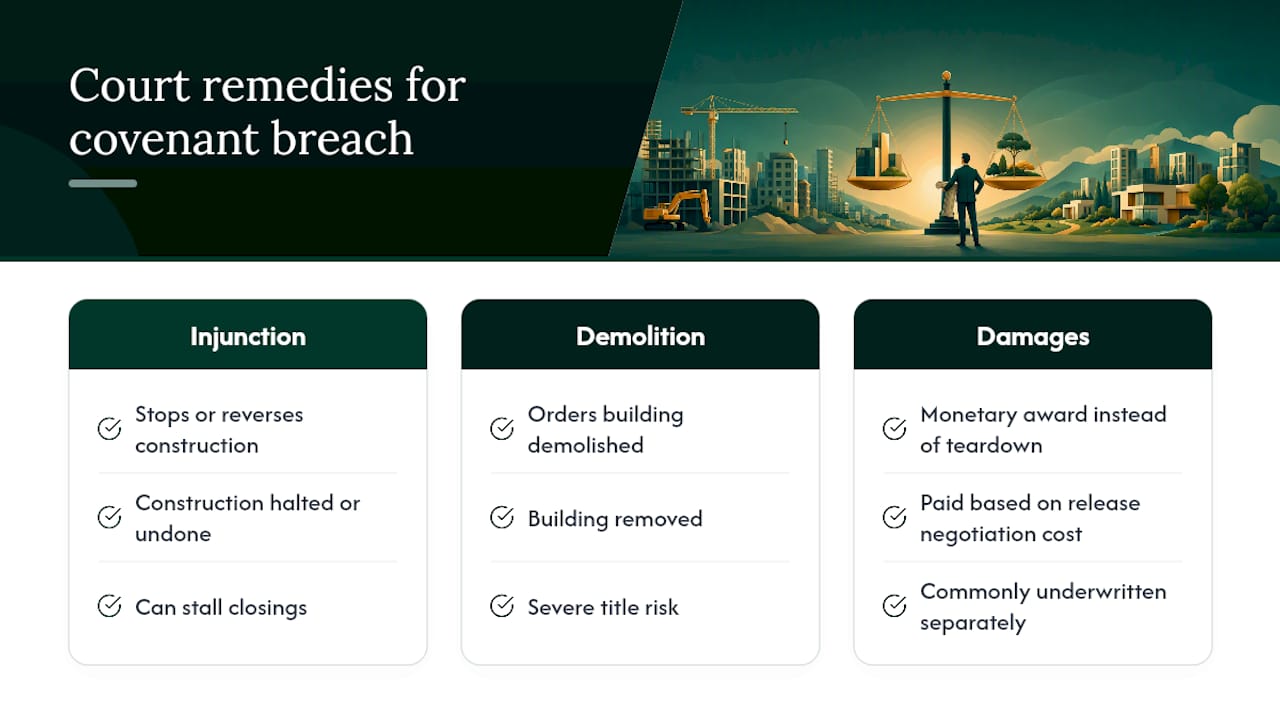
When a covenant is violated and a beneficiary sues, courts have three basic remedies available: an injunction stopping or reversing construction, a demolition order, or damages in lieu of demolition. Courts sometimes award substantial monetary damages instead of ordering a building torn down, calculated on what the developer would have reasonably paid to negotiate a release upfront, according to B P Collins Solicitors. Modeling only the demolition scenario understates real exposure; the damages route is common enough to underwrite separately.
Lenders treat this as a title problem, not a legal footnote. An undisclosed covenant is a security risk to the loan itself, and lender's counsel often will not clear to close until the covenant is resolved, insured, or expressly carved out of the title commitment, per guidance from Construction Capital. A covenant surfacing late in underwriting has stalled more closings than most developers admit publicly.
How to Find and Interpret Covenants During Due Diligence
Covenants don't always live where you expect. They can be buried in an original subdivision plat, a standalone declaration of covenants, conditions, and restrictions (CC&Rs), or a deed from three owners back that never got re-recorded in a way title software flags automatically.
- Pull the full chain of title, not just the current deed. County recording offices, plat maps, and prior deeds all carry independent covenant language.
- Identify the beneficiary. Some covenants name a specific party (a prior developer, an HOA, adjoining lot owners). Others are enforceable by any lot owner in the subdivision, which multiplies your negotiation counterparties.
- Check duration and renewal terms. Many covenants include automatic renewal periods; some expire on a fixed date that may have already passed.
- Look for required approvals. Architectural review clauses, subdivision consent requirements, and use-change approvals all need separate tracking.
- Check state statute before assuming enforceability. Some states void covenants that ban solar installations, and others provide statutory removal procedures for discriminatory language, per Snohomish County's guidance. Many states also have marketable-title acts that extinguish sufficiently old encumbrances after a set statutory period, according to LegalClarity.
Pro Tip: Don't assume a covenant applies to your build just because the language sounds close. Legal review sometimes finds that a proposed use falls technically outside a covenant's prohibited activity, which can eliminate the issue without negotiation, insurance, or litigation entirely.
Options for Resolving a Restrictive Covenant Conflict
Once a covenant is confirmed and material, four remediation paths exist, and they differ enormously in cost, speed, and certainty.
- Negotiate a release or variation directly with the beneficiary. This is the fastest and cheapest route when the beneficiary is identifiable and cooperative, but it can also be the most expensive if that party recognizes leverage and prices it accordingly.
- Purchase restrictive-covenant indemnity insurance. Insurers underwrite the risk of enforcement rather than removing the covenant itself, which works well for older, low-enforcement-risk restrictions with no obvious motivated beneficiary.
- Rely on a statutory override where one applies. Solar-access laws, anti-discrimination statutes, and marketable-title acts can void or extinguish certain covenants automatically, but this only works when the specific statute matches your specific fact pattern.
- Litigate through quiet title, declaratory judgment, or a changed-conditions argument. This is the slowest and most expensive path, and courts remain reluctant to invalidate private deed restrictions absent a clear showing that the original purpose is obsolete or that enforcement would be inequitable, per Cornell Law School's Legal Information Institute.
The insurance route has a trap that catches developers who move too fast:
Once you approach a beneficiary about a covenant, you may have closed off the insurance market for that same risk. Underwriters typically require that no approach has been made to the beneficiary before they'll quote cover, because contact itself increases the odds of a claim.
Sequence matters here as much as strategy. Talk to an insurance broker before you talk to the HOA, not after.
A Practical Workflow When a Covenant Issue Surfaces
Finding a covenant mid due diligence doesn't have to derail a deal, but it does require a defined sequence rather than ad hoc problem solving.
- Pause at the right point. Don't close on a parcel with an unresolved material covenant unless the purchase contract includes a contingency tied to covenant resolution.
- Engage the right people in order. Title company first to confirm the recorded language, then real estate counsel to assess enforceability, then an insurance broker if indemnity cover looks viable, then lender's counsel once a mitigation path is chosen.
- Involve your land planner early, since covenant limits on density, height, or use directly change what a feasibility study should even test.
- Build a documentation package for lenders and investors: a written risk memo, an insurance quote if applicable, evidence of any beneficiary negotiations, and a realistic timeline for resolution.
Pro Tip: Lenders respond far better to a documented mitigation plan than to a covenant that simply doesn't appear in your submission. Surfacing the issue yourself, with a plan attached, reads as competence. Having it surface during their own title review reads as a red flag.
Planning permission or entitlement approval does not erase this risk. Private covenants survive municipal approval, and beneficiaries can still enforce them after a project is permitted, according to B P Collins Solicitors. A stack of approved permits means nothing to a covenant holder with standing to sue.
How a Feasibility Study Treats Covenant Risk in Practice
A well-built feasibility study doesn't treat covenants as a legal afterthought bolted onto the zoning report. The feasibility study folds covenant review into the same phase as constraint mapping: a targeted title review, identification of likely beneficiaries, and a constraint map showing exactly where covenant limits intersect with the intended program.
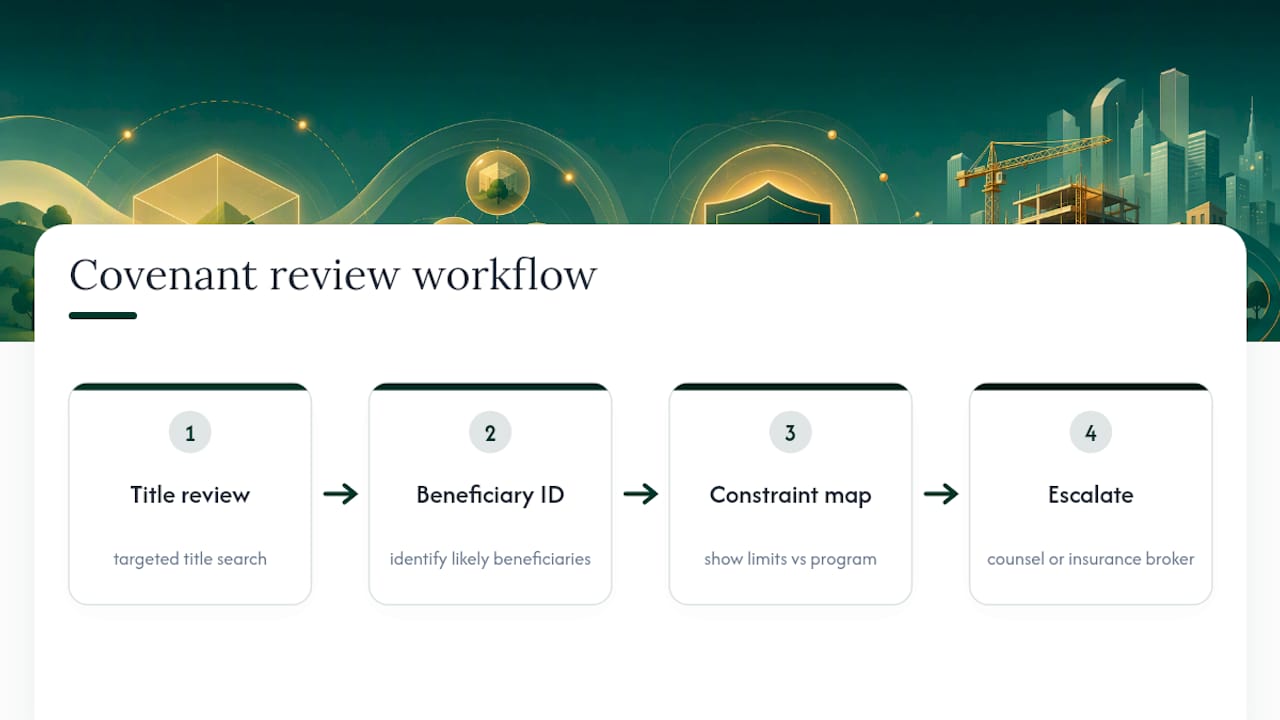
Where a genuine legal question or insurance strategy is involved, that review points toward outside counsel or an insurance broker rather than guessing at enforceability internally, which keeps the client's schedule assumptions grounded in something checkable rather than optimistic. The redevelopment work behind Detroit's Book Tower rehabilitation illustrates the kind of constraint-heavy adaptive reuse project where this sequencing matters most, since older buildings often carry title history nobody has revisited in generations.
When Covenants Protect Value and When They Block It
Not every covenant is an obstacle to fight. In stable single-family neighborhoods, a use restriction that keeps density and character consistent often supports the premium pricing surrounding it, and pushing to remove it can generate blowback that costs more in delay and reputation than the covenant itself. The calculation shifts when a covenant blocks a use the surrounding market has already moved past. Before choosing a remediation path, weigh three things: the actual yield impact of leaving the covenant in place, the realistic cost and time to resolve it, and the reputational or political cost of a contested removal in a community that's watching. Litigation might win on paper and still cost you the next three approvals in that jurisdiction.
— Jeremy Wenger
Get a Covenant Risk Assessment Before You Commit Capital
A title company can tell you a covenant exists. Few will tell you what it actually costs you in yield, schedule, or financing risk, and that gap is exactly where Urban Planning Pros works differently from a standard title review. Feasibility studies fold covenant identification, beneficiary mapping, and mitigation recommendations into the same constraint analysis used for zoning and infrastructure, so covenant risk gets priced alongside every other factor that determines whether a deal actually works.

That means a project team gets one document showing entitlement constraints, physical site limits, and title-based restrictions together, instead of piecing together a picture from three separate consultants on three separate timelines. If a covenant issue does surface, having a real estate attorney and, where relevant, an insurance broker involved early keeps a manageable problem from becoming a closing-day emergency, particularly on projects where builders risk insurance and other coverage decisions are already stacking up. If you're evaluating a parcel with any covenant history, request a feasibility study before you go further into design or entitlement spend.
Sources
For statute-specific detail, verify state marketable-title acts and local override provisions directly, and consult a licensed real estate attorney for any active enforcement matter. Explore feasibility and planning services on the Urban Planning Pros site.
- What You Need to Know About Land-Use Restrictions | Texas Real Estate Research Center
- Restrictive covenant — Cornell Law School LII / Wex
- How to Remove a Deed Restriction From Your Property - LegalClarity
- Restrictive Covenants in Development Finance | Construction Capital
FAQ
What Are the Four Types of Restrictive Covenants?
Development covenants generally fall into four categories: use restrictions (limiting the type of activity permitted), density or unit-count caps, height and setback limits, and architectural or design-approval requirements. Positive covenants, which obligate an owner to actively do something like maintain a shared fence, are less common in development contexts than negative covenants, which prohibit an action outright.
What Is an Example of a Restrictive Covenant?
A common example is a deed restriction limiting a parcel to single-family residential use, which would block a proposed multifamily or mixed-use project even if current zoning permits higher density. Another frequent example caps building height below what zoning code allows.
How Do You Get Around Restrictive Covenants on a Property?
The main paths are negotiating a release or variation with the beneficiary, purchasing restrictive-covenant indemnity insurance, relying on a statutory override where one applies, or pursuing litigation such as a changed-conditions argument. A feasibility study that maps covenant risk early helps determine which path actually fits your project's timeline and budget.
What Is the Purpose of a Restrictive Covenant?
Restrictive covenants exist to preserve a specific character, use, or value pattern on a parcel, often set up during original subdivision to guarantee open space, limit further splits, or maintain consistent architecture across a development. Municipalities sometimes require them as a condition of project approval, making them a tool for entitlement as much as a constraint on it.