Yes, most development sites in U.S. municipalities trigger local tree preservation rules, typically requiring a tree survey and a formal tree plan before permits move forward. Order a professional tree survey during early due diligence, not after your site plan is drawn. Build permit lead times and possible mitigation fees into your schedule and budget from day one.
TL;DR:
- Tree surveys should be ordered early in due diligence to incorporate preservation requirements into site design and avoid costly redesigns later.
- Local ordinances typically use diameter-at-breast-height thresholds of 12 to 20 inches DBH to determine protected trees, with exemptions for dead, hazardous, or invasive species.
- Permits for tree removal usually require documentation prepared by qualified professionals, filed well in advance, with mitigation often involving replacement planting or fees.
- Construction protection measures like root zones, fencing, and monitoring are mandatory once a tree is designated for preservation, with damage risking removal of protected status.
- Integrating tree preservation planning into feasibility studies helps optimize site layout, budgeting, and avoid permit delays or non-compliance costs.
Table of Contents
- What Are Tree Preservation Requirements and Who Enforces Them?
- What DBH and Retention Thresholds Should You Expect?
- What Permits and Documentation Does a Tree Survey Require?
- How Much Does Tree Mitigation Cost, and What Are Your Options?
- What On-Site Protection Measures Do You Need During Construction?
- How Do You Fold Tree Preservation Into Feasibility Planning?
- Why Tree Surveys Belong in the Planning Phase
- Get Ahead of Tree Preservation Before It Costs You a Redesign
- Sources
- FAQ
What Are Tree Preservation Requirements and Who Enforces Them?
Tree preservation requirements almost always originate at the local level, not the state. Your city or county planning department is the operative authority, and it should be your first call before you finalize a site layout. Some jurisdictions route enforcement through a dedicated urban forester or environmental services division rather than the general planning office, so confirm which desk actually reviews tree plans in your target jurisdiction.
Street trees and anything within the public right-of-way fall under a different chain of command entirely. Public works or transportation departments typically control that zone, and removing or working near a right-of-way tree usually requires a separate encroachment permit with its own review timeline.
The specifics vary widely by jurisdiction. Portland's municipal code ties preservation options directly to diameter-at-breast-height (DBH) thresholds and folds tree plan submission into the standard development permit process. Denton, Texas, structures its ordinance around percent-of-site retention with conservation easement offsets, detailed in the city's tree preservation guidance. Santa Clara County splits authority between administrative permits and right-of-way approvals, each with distinct notice windows. Three counties, three structures. Assume yours is unique until you confirm it.
What DBH and Retention Thresholds Should You Expect?
Diameter at breast height, measured at 4.5 feet above grade, is the standard metric almost every ordinance uses to decide which trees count as protected. Thresholds vary by jurisdiction, but 12 inches and 20 inches DBH show up repeatedly as the line between a tree you can remove without much scrutiny and one that triggers a full review. Heritage or landmark trees, usually defined by exceptional size, species rarity, or historical significance, often carry their own separate, stricter category regardless of DBH.
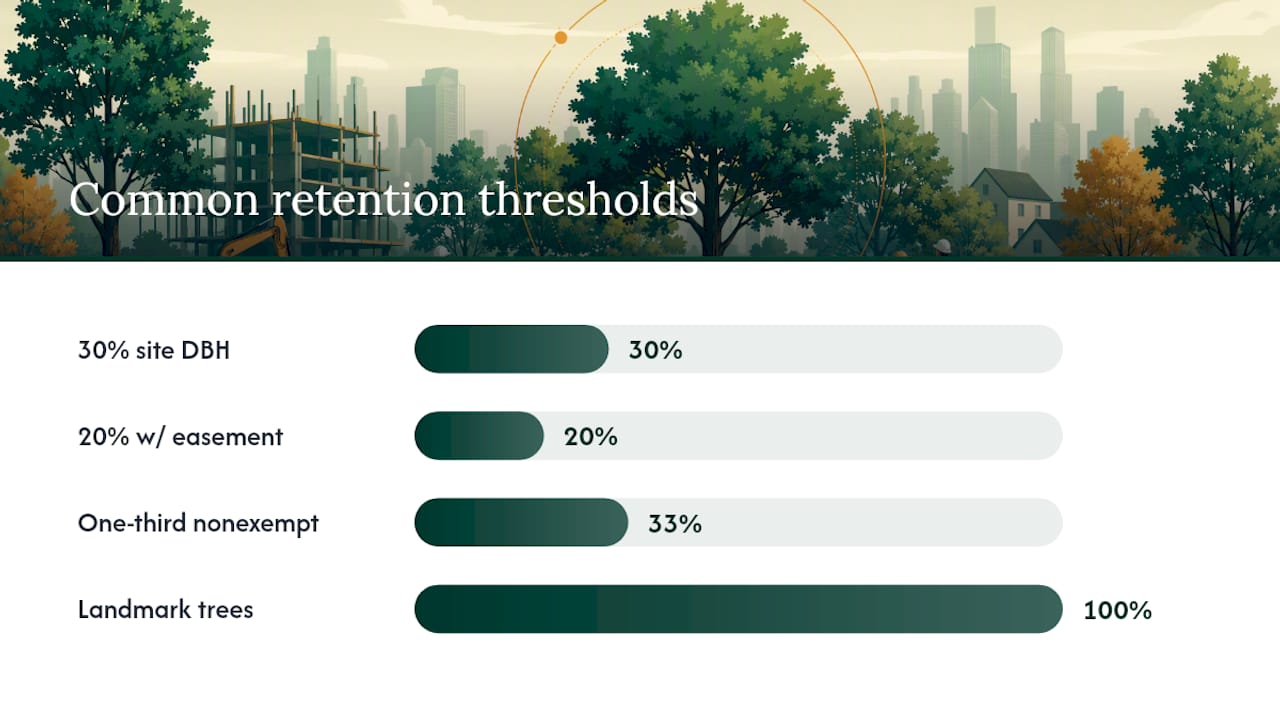
Retention math tends to work as a percentage of total site DBH rather than a simple tree count. Denton's ordinance is a useful illustration: it generally requires preserving 30% of total site DBH, but allows that figure to drop to 20% where a conservation easement protects sensitive habitat, while landmark trees require full preservation with no exceptions. Other codes frame the standard differently, such as preserving one-third of nonexempt trees on-site or offering multiple compliance paths, including preserving every tree above a certain DBH as an alternative to a percentage formula, an approach Portland's code uses explicitly.
Exemptions matter just as much as thresholds. Dead, dying, or hazardous trees are almost universally exempt, as are designated nuisance or invasive species in many jurisdictions. Trees growing too close to existing structures, within utility easements, or inside designated building envelopes sometimes qualify for exemption too, but never assume that without checking your specific code language.
What Permits and Documentation Does a Tree Survey Require?
A tree survey is the document that turns guesswork into a defensible compliance record, and it needs to be built by the right professional. Ordinances commonly require it be prepared or supervised by an ISA-certified arborist, a registered forester, or a licensed landscape architect, and a thorough survey documents species, DBH, canopy spread, health condition, and preservation classification for every qualifying tree on-site.
Timing separates smooth approvals from stalled projects. Follow this sequence:
- Order the tree survey during due diligence, before your civil engineer finalizes grading plans.
- File administrative removal permit applications at least 10 days before planned removal, per typical municipal timelines.
- Submit right-of-way or encroachment permit applications far earlier, often 60 days out, since these route through a separate public works review.
- Attach supporting documents: a site plan marking retained trees, a mitigation worksheet, dated photographs, and a replanting plan where removal is proposed.
- Expect the same tree plan requirement on every subsequent development permit for the site, since many codes carry the original preservation commitment forward through later phases.
Miss the 60 day window on a right-of-way permit and your whole construction schedule can slip by two months.
How Much Does Tree Mitigation Cost, and What Are Your Options?
Removing a protected tree rarely means walking away free of obligation. Most ordinances convert lost canopy into a mitigation formula, and the specifics differ by code but share a common logic. Some jurisdictions charge a per-inch restoration fee tied to the diameter of the removed tree. Others require planting replacement trees at a set ratio, commonly around two replacement inches of new tree diameter for every diameter inch removed. Portland's code spells out per-inch payment schedules alongside replacement-tree equivalents as alternative compliance paths.
You are not always locked into a single mechanism. In-lieu fee payments into a municipal tree fund let you satisfy the requirement without physically replanting on a tight urban lot. On-site replacement keeps canopy value local to your parcel. Preservation tracts or conservation easements can also generate credits that reduce your required retention percentage elsewhere on the site, a trade-off structure Portland's preservation credit language makes explicit.
Very large trees can trigger community notice obligations. Some codes require posting the removal permit on-site seven days before work begins, and trees above roughly 36 inches DBH may require additional notification to neighborhood associations.
What On-Site Protection Measures Do You Need During Construction?
Getting a tree through the permitting stage means nothing if it dies during grading. Protection specifications govern the construction phase, and they are typically non-negotiable once a tree is designated for preservation.
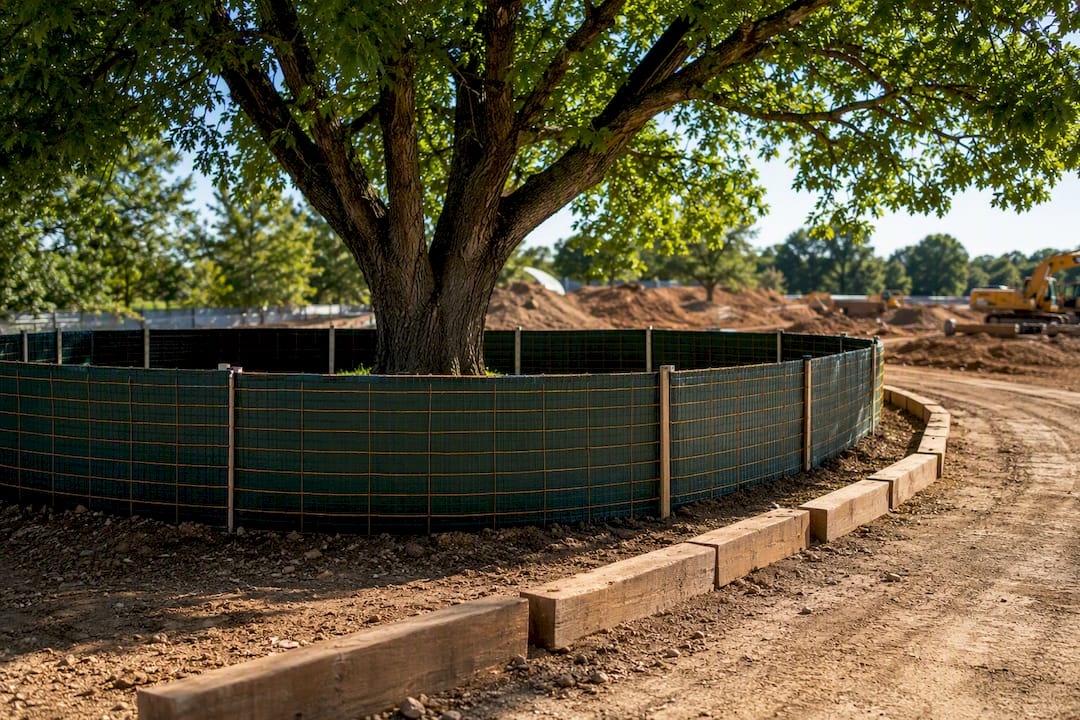
Root protection zones, generally mapped to the tree's dripline, restrict fill, excavation, and equipment staging. Denton's ordinance prohibits fill or excavation inside the dripline without prior approval and requires extra engineering measures, like tree wells or reinforced retaining walls, for grade changes of four inches or more. When a retaining wall is unavoidable near a protected root zone, it needs a licensed design, a scenario covered in detail by retaining wall permit guidance for projects where grade changes intersect protected trees.
Standard field protections include:
- Temporary fencing installed at the dripline before any grading equipment arrives on-site.
- No-staging zones that keep materials, vehicles, and spoil piles clear of the root zone.
- Monitored root pruning performed by a qualified arborist when utility trenching crosses roots.
- Posted signage identifying protected trees for every subcontractor on-site.
Pro Tip: Walk the site with your grading contractor before the first day of mobilization and physically point out every fenced tree zone. Verbal instructions get lost between subcontractors faster than you would expect.
Damage a protected tree during construction and you typically lose its preserved status entirely, triggering the same mitigation fees or replacement obligations you were trying to avoid in the first place, plus potential fines on top.
How Do You Fold Tree Preservation Into Feasibility Planning?
The developers who avoid mid-project redesigns treat the tree survey as a planning input, not a permitting afterthought. Order it during initial due diligence, alongside your title work and utility research, so no-build zones and preservation tracts get mapped into your concept plan before your engineer locks the grading design.
Build mitigation cost estimates into your financial pro forma at this stage too. If your jurisdiction offers density trade-offs or preservation credits, like the density adjustments some codes permit for retained tree tracts, that flexibility can offset the cost of lost buildable area.
Know when to bring in which specialist. An arborist handles tree health assessments and survey data collection. A land planner takes that data and translates it into a buildable site layout that satisfies both your yield targets and the retention formula. A proper feasibility study should deliver a tree plan, a mitigation strategy, and a clear permitting pathway as standard outputs, not optional add ons.
Why Tree Surveys Belong in the Planning Phase
Waiting until construction drawings are done to order a tree survey is the single most common mistake I see landowners make. Tree data arriving late forces engineers to redesign grading around trees they did not know existed, and that redesign cycle costs far more than the survey itself would have. Treat the survey as a roadmap: map the high-value specimens first, then design around them, not the other way around. That sequencing is exactly where Urban Planning Pros focuses its feasibility and constraint review work.
— Jeremy Wenger
Get Ahead of Tree Preservation Before It Costs You a Redesign
Tree preservation rules are one of the constraints that catches developers off guard late, after site plans are drawn and capital is committed. Urban Planning Pros builds tree survey coordination and mitigation strategy directly into its feasibility studies, so retention percentages, permit timing, and preservation tracts get mapped before you finalize a layout, not after.

Our master land planning work coordinates arborist input, survey data, and entitlement strategy into one deliverable, so your tree plan and your site plan get built together instead of in conflict. If your project touches undeveloped land with mature canopy anywhere in Alabama, Florida, Georgia, Kentucky, Louisiana, Mississippi, Missouri, Tennessee, Texas, North Carolina, or South Carolina, request a feasibility scoping call before you commit to a concept plan. It's the cheapest insurance you can buy against a permit-driven redesign.
Sources
- Tree Preservation (City of Denton guidance)
- Tree preservation and removal (Santa Clara County guidance)
- Portland
FAQ
Do All Development Projects Need a Tree Preservation Plan?
Most jurisdictions require a tree plan with development permit applications unless the parcel has no privately owned trees above the protected DBH threshold, per Portland's code and comparable ordinances elsewhere.
Who Is Qualified to Prepare a Tree Survey?
Ordinances typically require an ISA-certified arborist, a registered forester, or a licensed landscape architect to prepare or supervise the survey, documenting species, DBH, health, and preservation classification for each qualifying tree.
How Long Do Tree Removal Permits Take to Process?
Administrative removal permits often require about 10 days' notice, while right-of-way or encroachment permits can require up to 60 days' lead time, so file the right-of-way application well before your grading schedule assumes it.
What Happens if a Protected Tree Dies During Construction?
Most codes revoke the tree's preserved status and trigger the same mitigation fees or replacement obligations owed for a permitted removal, often with added fines for the violation.
Can Urban Planning Pros Help With Tree Preservation Compliance?
Urban Planning Pros folds tree survey coordination, mitigation strategy, and permitting pathway planning into its feasibility studies and master land planning engagements, addressing preservation requirements before a site plan is finalized rather than after.