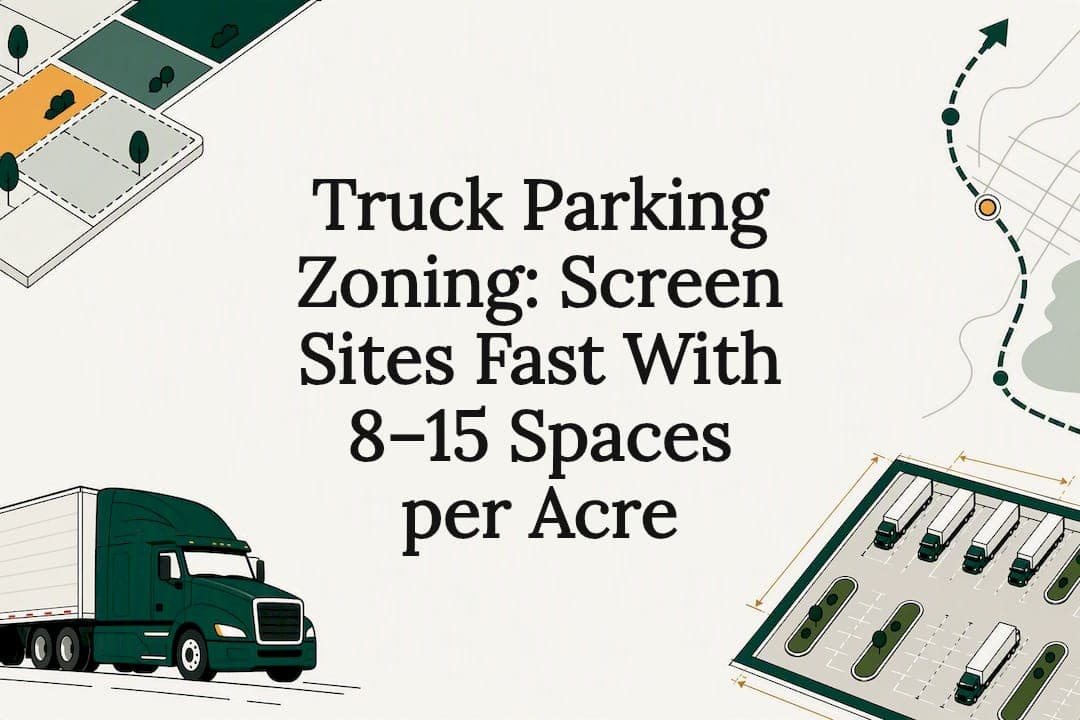
Truck parking is typically allowed in industrial and transportation zoning districts, and where it isn't a permitted use outright, most jurisdictions require a conditional use permit or site-plan approval before a single stall gets striped. Design and access requirements, particularly truck-route connectivity, usually decide whether that approval comes quickly or drags through multiple hearing cycles. Property developers and planners who screen sites against these two factors first save months of rework later.
TL;DR:
- Truck parking is primarily permitted in industrial zones like I-1, I-2, and I-3, often with minimal review, while commercial districts usually require a conditional use permit.
- Approval depends heavily on truck-route connectivity, with documented access and routing being the single most decisive factor for a smooth permit process.
- Designing for a 67-foot tractor-trailer and using asphalt or permeable pavement is essential for compliance and long-term durability, affecting capacity and costs.
- Feasibility studies should assess zoning, truck-route access, and trip generation before land acquisition to prevent costly surprises.
- Clear zoning language and early stakeholder engagement reduce conflicts and streamline permitting, especially in mixed-use or overlay districts.
Table of Contents
- What Zoning Districts Allow Truck Parking?
- How Do You Get a Conditional Use Permit for Truck Parking?
- What Design Standards Apply to Truck Parking Sites?
- Why Does Truck-Route Access Determine Approval?
- How Much Land Do You Need for Truck Parking?
- What Do Real Municipal Truck Parking Codes Look Like?
- How Should Truck Parking Be Written Into Zoning Codes?
- How Feasibility Studies Reduce Truck Parking Approval Risk
- A Planner's Take on Truck Parking and Community Friction
- How Urban Planning Pros Supports Truck Parking Projects
- Where to Verify Truck Parking Standards Directly
- Sources
- FAQ
What Zoning Districts Allow Truck Parking?
Most municipal codes route truck parking into industrial classifications: light industrial (I-1), heavy industrial (I-2), and sometimes a dedicated I-3 or transportation/port district built specifically around freight movement. These districts already anticipate the noise, traffic, and operating hours that come with commercial vehicles, so truck parking often qualifies as a permitted use with minimal review.
Commercial and mixed-use districts tell a different story. A parcel zoned C-3 or general commercial might allow truck parking, but almost always through a conditional use permit rather than as a matter of right. Pasco, Washington's code is a useful reference point: it permits truck parking outright in I-1, I-2, and I-3 zones while requiring conditional approval in C-3, tying the distinction to defined truck routes and circulation standards.
Overlay districts and corridor designations complicate the picture further. A parcel might sit in an otherwise permissive industrial zone but fall inside a residential buffer overlay that restricts hours or truck counts. Freight corridor overlays, on the other hand, can loosen requirements because the jurisdiction has already decided that stretch of road is built for trucks.
What almost never works: residential zones and neighborhood commercial districts. Cities like Chicago prohibit parking most commercial vehicles on residential streets at any time, backed by fines and impoundment authority. Before scoping any site, confirm the base district, then check for:
- Overlay zones that add hour restrictions, buffer requirements, or vehicle-count caps
- Truck-route or freight-corridor designations that expand allowable access
- Explicit residential and neighborhood-commercial prohibitions in the municipal code
- Whether the district treats truck parking as permitted, conditional, or entirely excluded
Understanding your zoning classification correctly the first time avoids a wasted application cycle, since reviewing the municipal zoning map before submitting anything reveals conflicts a site walk won't.
How Do You Get a Conditional Use Permit for Truck Parking?
A conditional use permit (CUP) gets triggered whenever truck parking isn't a permitted use by right in the base zoning district, or when a jurisdiction wants discretionary control over site-specific conditions like hours, screening, or maximum stay limits. Some codes also require a CUP for truck parking above a certain stall count, even in industrial zones, once the use crosses a scale threshold.
CUP conditions follow a predictable pattern across jurisdictions. Expect limits on overnight stays, screening and fencing requirements along adjacent property lines, minimum restroom or driver-amenity provisions, and security measures such as lighting and surveillance. The NCHRP guide for local truck parking regulations recommends that municipalities define staging, overnight, and long-term parking as distinct use categories, since blurring those definitions is what causes CUP reviews to stall.
The approval sequence generally runs through these stages:
- Pre-application meeting with planning staff to confirm zoning fit and identify likely conditions
- Technical studies, including a traffic impact analysis if trip generation warrants one
- Public notice and a hearing before a planning commission or zoning board
- Permit issuance with attached conditions of approval
- Building and site permits for grading, drainage, and paving
Timelines vary widely by jurisdiction, from a few weeks for administrative approvals to several months when a hearing calendar and appeal period are involved. Fees are set locally and should be confirmed directly with the planning department rather than assumed from a neighboring county's schedule.
Pro Tip: Ask planning staff during the pre-application meeting whether truck parking has ever been permitted in that district before. A prior approval usually means the conditions of approval are already drafted somewhere in city files, and referencing that precedent can shorten your own hearing.
What Design Standards Apply to Truck Parking Sites?
Geometric design is where good intentions run into physical reality. The FHWA Truck Parking Development Handbook recommends designing circulation around the longest legal vehicle likely to use the site, and Pasco's code makes that concrete by specifying a 67-foot tractor-trailer as the baseline for turning radii and drive-aisle width. Undersize the aisles and you'll be redesigning the site plan after the first rejected permit.
Surface and drainage decisions affect both cost and long-term maintenance. Full asphalt paving handles heavy axle loads reliably, but permeable pavement or reinforced gravel can reduce stormwater infrastructure costs on larger sites, provided the jurisdiction's engineering standards allow it. Either way, stormwater detention has to account for a fully impervious worst case, since trucks compact gravel surfaces faster than passenger vehicles.
Jurisdictions commonly require the following as part of design review:
- Stall dimensions and drive-aisle widths sized for a 67-foot tractor-trailer, not a passenger vehicle standard
- Perimeter fencing and screening, particularly where the site abuts residential or commercial neighbors
- Lighting adequate for security without spilling glare onto adjacent properties
- Driver amenities such as restrooms or designated rest areas, increasingly expected in CUP conditions
- Stormwater detention sized for the site's actual impervious coverage
Every one of these choices changes both stall capacity and construction cost, which is exactly why design should get modeled before land acquisition closes, not after.
Why Does Truck-Route Access Determine Approval?
Direct access to a designated truck route or freight corridor is often the single factor that separates an easy approval from a contested one. Planning staff want confirmation that trucks entering and leaving the site won't cut through residential streets to reach the highway network, and many codes require documented routing as a condition of approval.
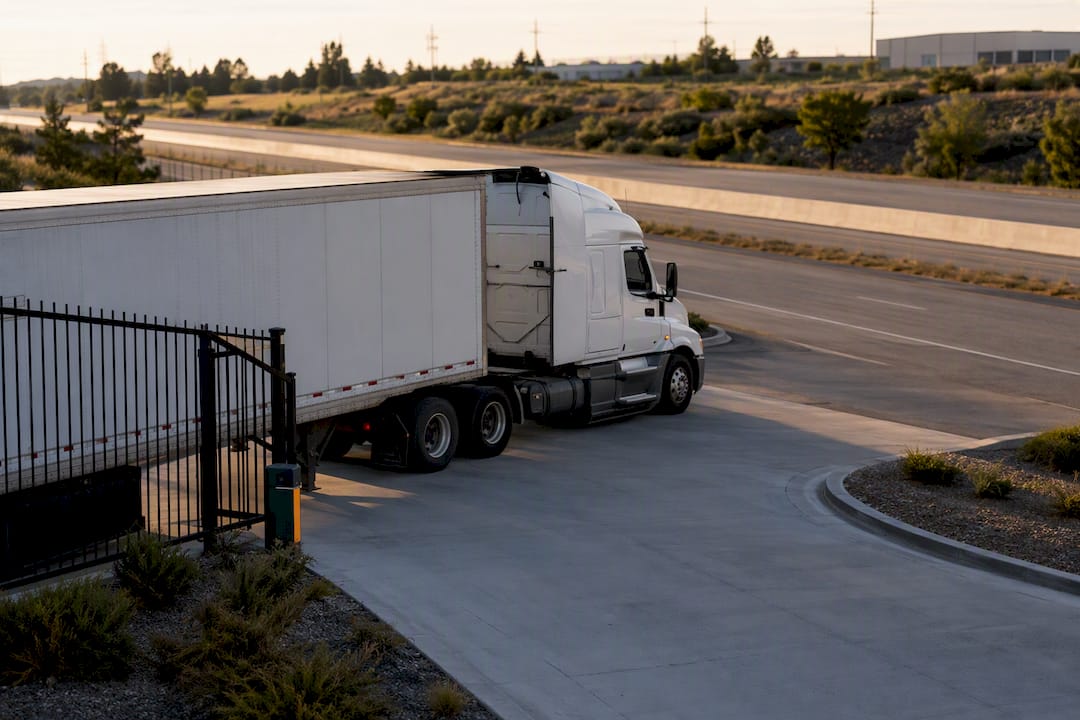
Access engineering typically covers deceleration lanes on the abutting arterial, adequate sight distance at the site driveway, and intersection turning radii sized for the same 67-foot design vehicle used on-site. When trip generation crosses a jurisdiction's threshold, usually tied to peak-hour vehicle counts or total daily trips, a Traffic Impact Analysis becomes mandatory.
A truck-focused TIA differs from a standard commercial one. It has to model truck turning movements at every affected intersection, evaluate queuing at the site entrance during peak arrival windows, and assess pavement condition on approach routes that weren't built for repeated heavy-axle loading. Planning authorities commonly respond to these findings by requesting:
- A dedicated deceleration lane or turn lane at the site entrance
- Restricted routing that keeps trucks off specific residential segments
- Pavement upgrades or a maintenance agreement for approach roads
- Signal timing adjustments at the nearest signalized intersection
How Much Land Do You Need for Truck Parking?
Capacity estimates hinge on how much of the site goes to aisles, buffers, stormwater, and amenities rather than striped stalls. A reasonable planning-level range runs from roughly eight to fifteen truck spaces per net usable acre, with the wide spread driven by drive-aisle configuration, buffer requirements, and whether the design uses back-in or pull-through stalls.
Worked examples make the trade-offs concrete:
- One acre: after access drives, a stormwater basin, and perimeter buffers, expect somewhere around 8 to 12 spaces on the remaining net area.
- Two acres: with more efficient aisle geometry possible at scale, 20 to 28 spaces is a realistic planning range, assuming no office building or scale house eats into the layout.
- Five acres: larger sites gain efficiency from consolidated stormwater and circulation, often yielding 60 to 90 spaces once security, lighting infrastructure, and driver amenities are accounted for.
Every office trailer, restroom facility, detention pond, and landscaped buffer subtracts directly from net capacity, so a site that looks generous on a plat map can shrink fast once engineering constraints are applied.
What Do Real Municipal Truck Parking Codes Look Like?
Pasco's ordinance remains one of the clearest published examples: permitted truck parking in I-1 through I-3 zones, conditional approval in C-3, and explicit circulation standards tied to a 67-foot tractor-trailer design vehicle. That level of specificity is exactly what the FHWA handbook recommends other jurisdictions adopt.
Other cities take a more restrictive posture. Carson, California, caps truck staging at 72 hours and channels vehicles onto designated truck routes to keep them off residential streets entirely, while Oakland bans truck parking on residential streets outright and defines commercial vehicle classes precisely enough that enforcement officers have clear thresholds to act on.
- Small municipal lots in Weed, California, and Elmira, New York, show that paid public parking reduces informal roadside staging.
- Stay-limit ordinances like Carson's cut down on long-term storage complaints without banning truck parking entirely.
- Clear vehicle-class definitions, as in Oakland's code, make enforcement consistent instead of discretionary.
How Should Truck Parking Be Written Into Zoning Codes?
The NCHRP guide lays out three model approaches jurisdictions mix and match depending on local freight volume: permitted use in industrial zones, conditional use in mixed-use and commercial districts, and mandatory loading or lay-by space for freight-intensive uses regardless of underlying zone.
Practical triggers determine when a project needs to address parking or staging at all. Common thresholds include building square footage above a set warehouse or distribution size, a minimum number of loading docks, or projected daily truck trips exceeding a jurisdiction's counting standard. Cross one of those thresholds and the code typically requires either on-site staging area or a demonstrated off-site arrangement.
- Permitted-use zoning in industrial districts keeps routine freight operations out of the hearing process entirely
- CUP requirements in mixed-use areas let planning boards attach site-specific conditions
- Mandatory staging or loading provisions apply once square footage, dock count, or trip generation crosses a defined threshold
- Shared parking agreements and public-private partnerships let smaller operators access capacity without owning dedicated acreage
How Feasibility Studies Reduce Truck Parking Approval Risk
A proper feasibility study for a truck parking project scans zoning and entitlement history on the parcel, evaluates truck-route access, checks whether trip generation will trigger a TIA, and produces a capacity and cost estimate before you're committed to the land. That sequence catches the deal-breakers, an access conflict, an undersized parcel, a hostile overlay district, while a purchase agreement can still be renegotiated.
An entitlement strategy built around early stakeholder outreach and specific mitigation commitments (screening, limited operating hours, defined routing) tends to move through CUP hearings with fewer appeals, since neighbors and commissioners see concrete answers instead of vague assurances.
- Zoning and entitlement scan across the parcel and adjacent overlays
- Truck-route and access analysis tied to the site's actual freight corridor connections
- TIA trigger assessment before engineering costs are committed
- Capacity and cost modeling based on realistic net usable acreage
A Planner's Take on Truck Parking and Community Friction
Truck parking conflicts almost always trace back to vague code language and reactive permitting rather than the trucks themselves. Jurisdictions that define staging, overnight, and long-term parking as separate categories, then engage freight operators before drafting CUP conditions, see far fewer contested hearings than those improvising conditions on the fly.
— Jeremy Wenger
How Urban Planning Pros Supports Truck Parking Projects
Screening a site for truck parking means answering hard questions fast: does the zoning actually allow it, will the access work, and what will the CUP process demand before you break ground? The approach involves evaluating property documents, zoning constraints, and market direction together instead of handling each in isolation, so costly conflicts surface during due diligence instead of at a public hearing.

A feasibility study scoped for truck parking checks zoning fit, truck-route access, and TIA triggers before you close on land, while master land planning coordinates site design, capacity, and phasing once the entitlement path is clear. For freight-focused projects where routing and long-term logistics strategy matter as much as zoning, pairing that work with a parcel and transportation strategy review rounds out the picture. Start with a conversation about your parcel through the Land Planning Services page, and get a scoped plan before your next zoning submission deadline.
Where to Verify Truck Parking Standards Directly
- FHWA Truck Parking Development Handbook for model ordinance text and design standards
- NCHRP Guide for Local Truck Parking Regulations for regulatory options
- WSDOT truck parking plans for state-level examples
Sources
- FHWA Truck Parking Development Handbook (2026)
- Pasco, WA municipal code excerpt (Zoneomics copy)
- Oakland municipal truck parking rules
- WSDOT: Truck parking plans
FAQ
What Zoning Is Required for Truck Parking?
Truck parking is most commonly permitted in industrial and transportation zoning districts, with commercial or mixed-use districts usually requiring a conditional use permit. Residential and neighborhood commercial zones typically prohibit it outright, so confirming the base district and any overlay restrictions is the first step.
How Much Land Do You Need for a Truck Parking Lot?
Land needs depend on stall count and design efficiency, but a rough planning range is between 8 and about a dozen spaces per net usable acre after accounting for aisles, buffers, and stormwater infrastructure. A single acre might yield 8 to 12 spaces, while a five-acre site can often support 60 to 90 once circulation and amenities are built in.
How Many Trucks Can You Park on 2 Acres of Land?
A well-designed two-acre site typically supports 20 to 28 truck spaces, assuming no office building or scale house significantly reduces the net usable area. That figure drops if the parcel needs a larger stormwater detention basin or wider perimeter buffers under local screening requirements.
Can I Park My Commercial Truck at Home?
Most residential zoning codes prohibit parking large commercial vehicles on residential streets or in residential districts, and cities like Chicago enforce this with fines and impoundment authority. Rules vary by municipality and by vehicle class, so check the local zoning code's definition of a commercial or oversized vehicle before assuming your truck qualifies for an exception.