
A utility will-serve letter is a formal written confirmation from a utility that it has the capacity to serve your project. Planning departments and lenders routinely require one before they accept an entitlement application, issue a building permit, or fund a construction loan. Utilities that typically issue these letters include:
- Water districts and municipal water departments
- Sewer or wastewater treatment authorities
- Municipal and investor-owned electric utilities
- Natural gas providers
- Fire districts and city engineering departments
Each of these agencies evaluates capacity independently, so a project rarely gets one letter. It gets a stack of them, and each one carries its own timeline, form, and conditions.
Key Takeaways
Utility will-serve letters confirm service capacity, and requesting them early in entitlement, not at permit stage, is what protects your project schedule.
| Point | Details |
|---|---|
| Identify every issuer | Water, sewer, electric, gas, and fire agencies each issue separate letters, and jurisdiction varies by parcel. |
| Request early | Submit as soon as you have a civil engineer and preliminary site plan, not at permit submittal. |
| Know the letter type | Conditional letters work for entitlement; unconditional letters are usually required for permits and lenders. |
| Plan for timelines and fees | Expect 1 to 12+ weeks depending on the utility, plus processing and possible capacity fees. |
| Watch expiration | Most letters are valid 1 to 2 years; renewing late can trigger a full re-application. |
| Get coordination support | Urban Planning Pros packages requests and coordinates engineers and utility contacts to reduce revision rounds. |
Table of Contents
- Who Issues Utility Availability Letters and How to Find Them
- When Do You Need a Will-Serve Letter During Entitlement?
- How Do You Request a Utility Will-Serve Letter?
- What Does a Will-Serve Letter Actually Say?
- What Happens If a Utility Can't Serve Your Project?
- How Long Does It Take and How Long Is It Valid?
- Your Request Checklist for a Faster Turnaround
- Frequently Asked Questions
- Sources
Who Issues Utility Availability Letters and How to Find Them
The correct issuing authority depends on how the service is delivered, not just who bills you. A city-run water department issues its own letters. A special water or sewer district, common across the Southeast and parts of Texas, operates independently of the city even when it sits inside city limits. An investor-owned utility (IOU), like many electric and gas providers, answers to a state public utility commission rather than local government, which changes both the request process and the fee structure.
- Start with the county parcel search or your local planning department's utility service map to confirm which agency actually serves your site.
- Cross-check with the utility's own service-area map, since municipal boundaries and utility boundaries rarely line up.
Pro Tip: Call the planning department before you call the utility. Staff there deal with jurisdictional overlaps daily and can usually tell you in one phone call which district actually holds your parcel.
When Do You Need a Will-Serve Letter During Entitlement?
Most jurisdictions want proof of service capacity at several distinct checkpoints, not just once at the end:
- Tentative map or subdivision application, where planners want an early signal that infrastructure exists or can be extended.
- Entitlement submission, where conditional letters are often accepted as long as they're on file.
- Environmental review, where capacity questions can trigger additional study if a utility flags constraints.
- Building permit issuance, where most agencies require a current, often unconditional, letter.
- Lender underwriting, where construction lenders frequently list a will-serve letter as a closing condition.
Conditional letters carry weight at the early stages. Unconditional letters typically become mandatory only at permit issuance. Requesting late is the single most common cause of avoidable schedule slippage. If a utility needs 8 to 12 weeks for engineering review and you request it the week before permit submittal, your entire project timeline absorbs that delay.
How Do You Request a Utility Will-Serve Letter?
Every utility has its own submission channel, but the request package looks similar everywhere. Some use dedicated developer-services portals, some ask for a plain email to a designated engineering address, and some still require a mailed form.
LADWP, for example, requires requests by email to a specific engineering address and wants the project address, Assessor's Parcel Number (APN), and contact information listed clearly. Austin Energy processes requests through its own service-availability form and returns a complete letter within a couple of weeks. SRP in Arizona runs requests through a dedicated Will Serve Center and commonly processes straightforward requests within about one to two weeks, though the letter itself doesn't guarantee service capacity stays fixed.
A solid request package includes:
- A request letter stating the APN, site address, and project description
- A site plan or vicinity map showing the parcel boundary
- Preliminary demand estimates: peak gallons per minute for water, peak kW for electric, therms for gas
- Direct contact information for the applicant and their engineer
- Fee payment, if the utility requires one upfront
Your civil engineer can usually turn around preliminary demand numbers within a few days once they have a site plan and unit count. Once submitted, most utilities send a confirmation receipt. If you haven't heard back within the stated processing window, follow up in writing so there's a paper trail if the schedule slips.
What Does a Will-Serve Letter Actually Say?
The format varies by utility, but the substance follows a predictable pattern. A usable letter includes:
- Utility letterhead and issuance date
- A service commitment statement naming the specific parcel or project
- The services covered (water only, or water and sewer, for instance)
- Conditions precedent, meaning what still has to happen before service is guaranteed
- An expiration date
- References to the utility's governing rules and tariffs
The distinction between conditional and unconditional letters matters more than most developers realize going in. A conditional letter, as LegalClarity notes, acknowledges capacity exists but ties final service to conditions like fee payment, plan approval, or completed infrastructure. An unconditional letter is the stronger document lenders and building departments want, and it's typically only issued after those conditions are satisfied. Moulton Niguel Water District illustrates this well: it issues an engineering feasibility letter during entitlement, then reserves the full will-serve letter until permit and fee requirements are met.
Watch for language about easement dedications, capacity fees, and liability disclaimers. These clauses can quietly add cost or delay if you don't catch them during entitlement.
What Happens If a Utility Can't Serve Your Project?
A denial or a heavily conditioned letter almost always points to a specific, identifiable gap rather than a dead end. The usual culprits:
- Insufficient system capacity at the treatment plant or substation level
- Water or sewer mains that don't reach the property frontage
- Transformer or substation limits on the electric side
- Treatment plant constraints that require a capacity study before approval
Mitigation paths exist for nearly all of these. Main extensions, line upsizing, pump station upgrades, and capacity reservation fees are common fixes. Reimbursement agreements let a developer front infrastructure costs and recover a share as neighboring parcels connect later. In some cases, forming or joining a special district, or securing an alternate supply source, becomes the practical path, though that route carries real regulatory complexity.
Pro Tip: IRMI's guidance on will-serve letters is worth taking seriously: don't sign a utility-drafted document without reviewing what financial obligations it locks in. Bring in a civil engineer or land use attorney once a letter includes cost-sharing or easement language you don't fully understand.
How Long Does It Take and How Long Is It Valid?
Processing time depends entirely on which utility and how complex your demand is. Simple administrative requests can turn around in 1 to 2 weeks. Water and sewer letters commonly take a few weeks to a month. Electric letters that require preliminary engineering, particularly for larger loads, can take several weeks to several months.
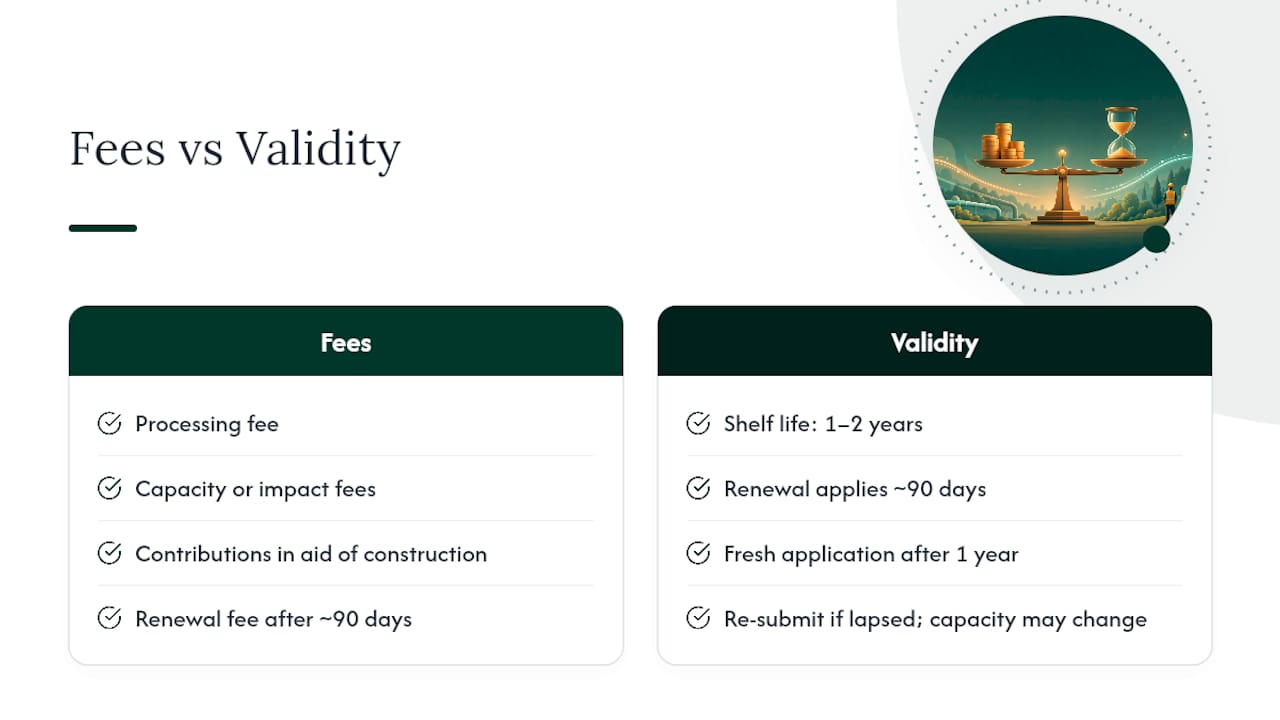
Fees vary widely by provider and typically include a processing fee plus, in some cases, capacity or impact fees and contributions in aid of construction. The City of Pasadena, Texas's utility availability application shows a common municipal pattern: a renewal fee applies once a letter passes roughly 90 days old, and a fresh application is required after a year. Most letters carry a shelf life of one to two years, and letting one lapse means re-submitting into a system that may have changed capacity since your first request.
Your Request Checklist for a Faster Turnaround
A tight request package rarely gets bounced back for missing information. Here's the sequence Urban Planning Pros uses when packaging will-serve requests for clients:
- Pull the APN and a current site or vicinity map from the county parcel search.
- Confirm every serving agency: water, sewer, electric, gas, and fire, since these are rarely all the same entity.
- Get preliminary demand estimates from your civil engineer or MEP consultant before drafting the request letter.
- Draft a request letter naming the parcel, project scope, and expected demand, and attach the site plan.
- Submit through the utility's specified channel, whether that's a portal, a dedicated email, or a mailed form.
- Log every response, confirmation number, and condition in a single tracking sheet tied to your project schedule.
Pro Tip: Request will-serve letters the same week you hire your civil engineer, not after your site plan is finalized. The engineer can generate demand estimates early enough that the utility request and the design process run in parallel instead of one waiting on the other.
Urban Planning Pros coordinates directly with engineers, surveyors, and utility contacts throughout this process, which shortens the number of revision rounds and clarifies exactly what conditions apply to a project before they become a surprise at permit submittal. Every fee, easement requirement, or infrastructure obligation gets documented as it's raised, so nothing gets lost between the utility's engineering desk and your permit set.
How we treat will-serve letters in feasibility work
Jeremy's work on feasibility studies treats a will-serve letter as an early risk signal, not paperwork. A capacity gap flagged in week two of a study is a design problem you can solve. The same gap discovered at permit submittal is a schedule and budget problem. Requesting early, even before the site plan is locked, has repeatedly turned what would have been a months-long capacity study into a manageable design condition.
Let Urban Planning Pros Handle Your Utility Coordination
Chasing down the right agency, assembling demand estimates, and tracking six different utility responses on top of your own entitlement work eats weeks you don't have. Urban Planning Pros builds utility coordination directly into its feasibility studies, which means capacity questions get flagged before you've sunk money into a site plan that a transformer limit or a treatment plant constraint could unravel later.

Our team packages the request letters, pulls demand estimates from engineering partners, and tracks every condition a utility attaches to your project, so you're not the one holding six different tracking sheets. For projects that also need survey work or MEP coordination, our engineering services and land planning services run in parallel with utility requests rather than waiting on them. If you're licensed and want to coordinate directly with our team on future projects, see how engineers partner with Urban Planning Pros. Reach out to scope a feasibility study before your next entitlement submittal and get utility capacity confirmed while there's still time to adjust the plan.
Frequently Asked Questions
Is a will-serve letter the same as a service agreement? No. A will-serve letter confirms a utility's willingness and capacity to serve a project. A formal service agreement, executed later, sets the actual terms of connection, including fees and construction obligations.
Can I get a will-serve letter before I own the property? Some utilities allow requests from an authorized applicant with a signed contract or option on the land, though policies vary. Check with the specific utility before assuming eligibility.
Do all lenders require an unconditional letter? Most construction lenders want an unconditional or near-final letter before closing, since a conditional letter still carries risk that conditions won't be met on schedule.
What if my will-serve letter expires before I break ground? You'll typically need to reapply, and the utility may reassess capacity based on current conditions rather than honoring the original terms. That's why timing your request close to your construction schedule matters.
Who prepares the engineering-level guidance behind these letters? Licensed professional engineers often review capacity and infrastructure questions tied to permits. A developer's guide to the role of PE engineers on permits covers how that coordination typically works.
Sources
- Will Serve letter process
- Will Serve Letter Request | Los Angeles Department of Water and Power
- Will-Serve Letters | Moulton Niguel Water District
- Utility Will Serve Letter Template: What to Include - LegalClarity
- Request a Service Availability Letter | Austin Energy