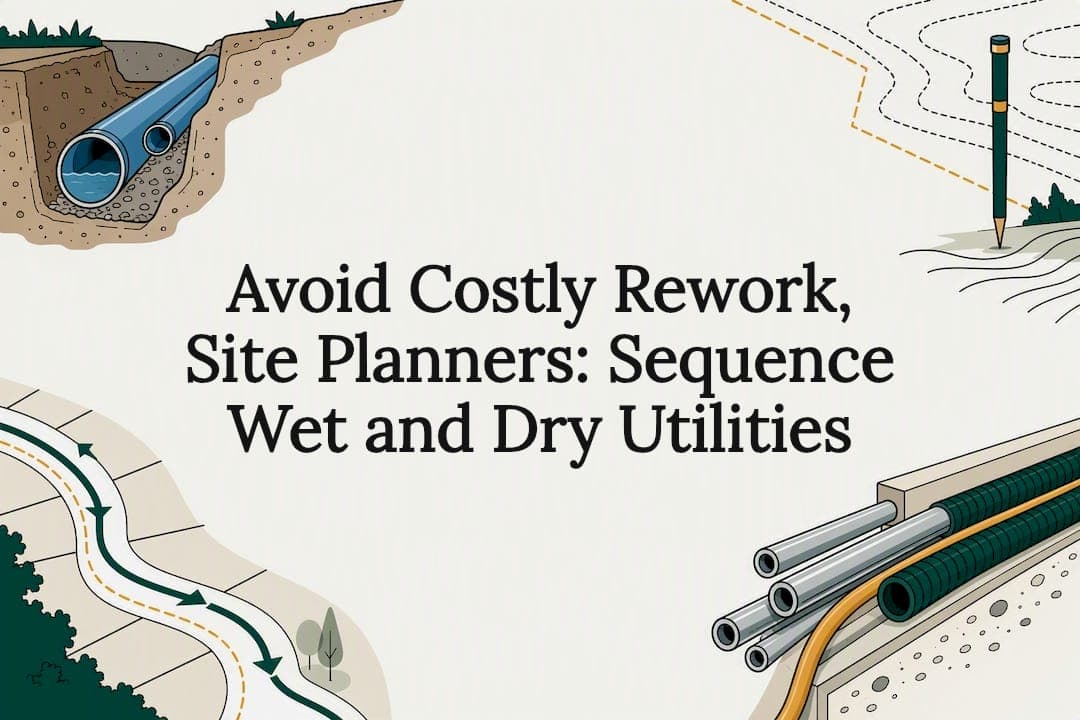
Wet utilities carry water and wastewater and require deeper trenches, pressure testing, and municipal permitting; dry utilities carry power, data, and gas and depend on early coordination with private providers. That distinction drives almost every sequencing decision on a site: wet lines typically go in first because they run deeper and rely on gravity, while dry lines follow in shallower trenches or conduits once grading settles. Get the order wrong, and you're paying for re-excavation.
TL;DR:
- Installing wet utilities first ensures protection of deeper, gravity-dependent systems and compliance with pressure testing and inspection requirements that delay construction if neglected.
- Dry utilities are more variable in scheduling due to dependent on private providers' response times and their separate permit, design, and installation processes.
- Effective coordination involves early stakeholder engagement, subsurface utility engineering, and a single point of contact to prevent conflicts and costly rework.
- Code-mandated minimum separation distances between wet and dry utilities must be confirmed early to avoid trench sharing issues and potential future damage.
- Incorporating comprehensive utility planning into feasibility studies helps prevent conflicts that could halt or delay projects during construction.
Table of Contents
- Wet Utilities vs Dry Utilities: The Core Definitions
- Dry Utilities Explained: Who Owns Them and Where They Go
- Wet vs Dry Utilities: Where the Real Differences Show Up
- How to Manage Wet Utilities and Dry Utilities on the Same Schedule
- Trenching, Testing, and Temporary Services on Site
- Safety and Code Checkpoints You Can't Skip
- Bringing Wet and Dry Utilities Into Your Feasibility Study
- Your Next Steps for Utility Planning
- A Practitioner's Note on Utility Coordination Mistakes
- Where Urban Planning Pros Fits Into Your Utility Strategy
- Sources
- FAQ
Wet Utilities vs Dry Utilities: The Core Definitions
Wet utilities are the systems that move liquid: potable water mains, sanitary sewer lines, storm drainage, and lift stations. They rely on gravity or pressure to function, which means design engineers have to calculate slope, flow rate, and depth before a single trench gets dug. That physics is why wet utilities require deeper trenches, flow management, and pressure testing before a municipal engineer will sign off on them, according to Muller's breakdown of utility differences.
A few things define wet utility work on a construction schedule:
- Gravity-fed sanitary sewer and storm systems need precise slope calculations, often requiring deep trenches that vary depending on jurisdiction.
- Potable water mains run under pressure and require hydrostatic pressure testing before backfill.
- Sanitary systems often need bacteriological testing to confirm the line is safe for service.
- Bedding and compaction standards are stricter because a failure underground is expensive to fix later.
These aren't optional steps. A municipal inspector has to witness testing before the trench gets covered, which is one reason wet utility work anchors the early schedule.
Dry Utilities Explained: Who Owns Them and Where They Go
Dry utilities move power and information instead of liquid: electric service, telecom and fiber lines, cable, gas, and often street lighting or traffic signal conduit. Unlike wet lines, these systems typically sit in shallower trenches, run through conduit, or go aerial on poles, which gives designers more flexibility in corridor placement.
The catch is ownership. Most dry utilities are installed and maintained by investor-owned providers or telecom companies, not the municipality, and each one operates on its own schedule with its own proprietary standards.
- Electric and gas lines usually require the private provider's own engineering review before installation.
- Telecom and fiber providers often work on separate timelines from the electric utility, even on the same street.
- Conduit depth is typically shallower than sanitary or water lines, varying according to the utility and local code.
- Provider responsiveness varies widely, which is why dry utility coordination is often the schedule's biggest wildcard.
That variability is exactly why dry utility management deserves attention as early as feasibility, not after grading starts.
Wet vs Dry Utilities: Where the Real Differences Show Up
The wet vs dry utilities comparison boils down to five practical variables: what's being transported, how deep it sits, who permits it, who owns it, and how that ownership affects your schedule.
| Factor | Wet utilities | Dry utilities |
|---|---|---|
| Medium transported | Water, wastewater, stormwater | Electricity, gas, data, cable |
| Typical depth | Deeper trenches, gravity-dependent | Shallower trenches or aerial |
| Permitting body | Municipal engineering department | Private provider plus municipal right-of-way permit |
| Ownership | Public/municipal utility authority | Investor-owned or private provider |
| Primary coordination need | Engineering review, testing, inspection | Provider scheduling, service agreements |
Code separation rules exist for a reason: wet and dry lines cannot share a trench, and most jurisdictions require a minimum horizontal and vertical separation between potable water and any dry utility, often measured in feet rather than inches. That's why Muller's utility comparison notes wet utilities are typically installed before dry utilities. Deeper systems have to go in first, or you risk damaging them during later excavation. The exception comes on tight urban sites where dry conduit gets sleeved through the same corridor early to avoid a second mobilization, but that still happens under separate permits and separate inspections.
How to Manage Wet Utilities and Dry Utilities on the Same Schedule
Coordination starts long before a shovel hits the ground. DFM Development's planning guidance describes wet utility planning as a three-stage process: site assessment, design, and monitoring, and each stage takes longer than most teams expect because of groundwater and environmental review.
Here's a sequence that keeps both utility types moving without stalling the schedule:
- Start at feasibility. Pull existing as-built records and confirm service capacity with the municipality before you finalize a site plan.
- Invest in subsurface utility engineering. Potholing existing lines before design prevents conflicts that only show up once excavation begins.
- Engage every stakeholder early. That means the municipal engineer for wet systems and each private provider for dry systems, on separate tracks, at the same time.
- Build in schedule contingency. Provider response times for dry utilities fluctuate, so a buffer protects your critical path.
- Document every phase. Inspection sign offs and test results become your record for final acceptance.
Pro Tip: Assign one person on your team as the single point of coordination for utility scheduling. Splitting that responsibility across multiple project managers is how conflicting timelines slip through the cracks.
GIS and GPS mapping of existing lines, paired with that single point of contact, resolves most conflicts before they reach the field.
Trenching, Testing, and Temporary Services on Site
Wet and dry installations demand different construction methods, and that difference shows up directly in cost. Wet utility trenches need deeper excavation, engineered bedding, and careful compaction to protect gravity flow. Dry utility trenches are shallower but often require more linear footage of conduit runs across a site.
- Potable water lines require hydrostatic pressure testing before backfill; sanitary lines often need bacteriological clearance.
- Electrical conduit gets inspected for depth, warning tape placement, and separation from other utilities before it's covered.
- Groundwater and rock conditions can slow wet utility trenching significantly and push traffic control costs higher.
- Temporary generators or temporary water connections can keep a site functional while permanent systems are still being tested and approved, a staging tactic worth planning into your critical path early.
Skipping any inspection point to save a day almost always costs more time later, once the municipality requires it redone.
Safety and Code Checkpoints You Can't Skip
Never assume wet and dry lines can share a trench. Most jurisdictions set minimum separation distances between potable water and any other utility, along with backflow prevention requirements at service connections. Confirm both with your local building department before design finalizes, not after.
- OSHA sets the safety standards that govern excavation, trenching, and shoring on every job site.
- NFPA standards apply directly to electrical and gas utility design and inspection.
- ANSI consensus standards often back the material and testing specifications your municipal engineer references.
- A municipal inspector has to sign off before backfill on wet systems, and most jurisdictions require the same for dry conduit depth and separation.
Document every inspection milestone. That record is what protects you at final acceptance.
Bringing Wet and Dry Utilities Into Your Feasibility Study
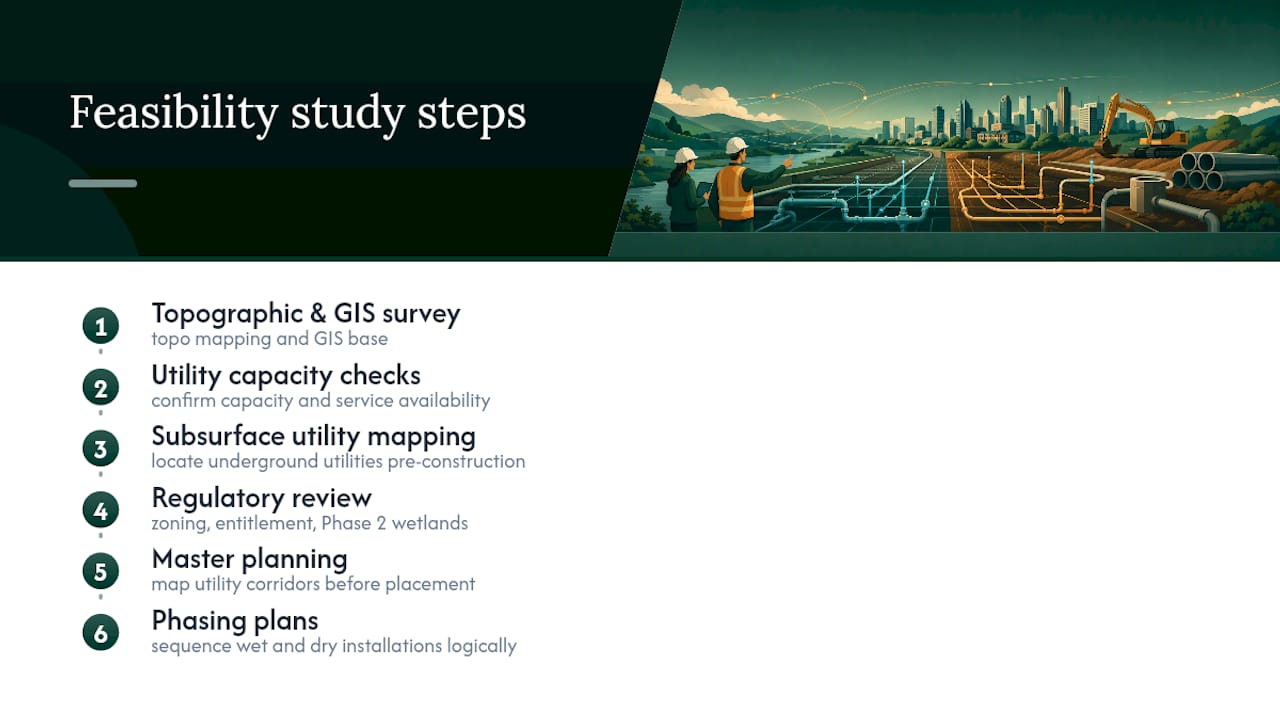
Utility conflicts that surface during construction almost always trace back to a feasibility study that skipped them. Urban Planning Pros builds utility capacity checks into every feasibility engagement, alongside topographic and GIS mapping, zoning and entitlement review, and Phase 2 wetland delineations when a site's drainage or wet utility routing touches regulated wetlands.
Master planning can include mapping utility corridors before building placement gets finalized, which helps resolve conflicts on paper instead of in the field. Typical deliverables might include service availability confirmation, topographic and subsurface utility mapping, zoning and entitlement constraint review, and phasing plans that sequence wet and dry installation logically.
That groundwork is what keeps approvals moving instead of stalling on a utility conflict nobody saw coming.
Your Next Steps for Utility Planning
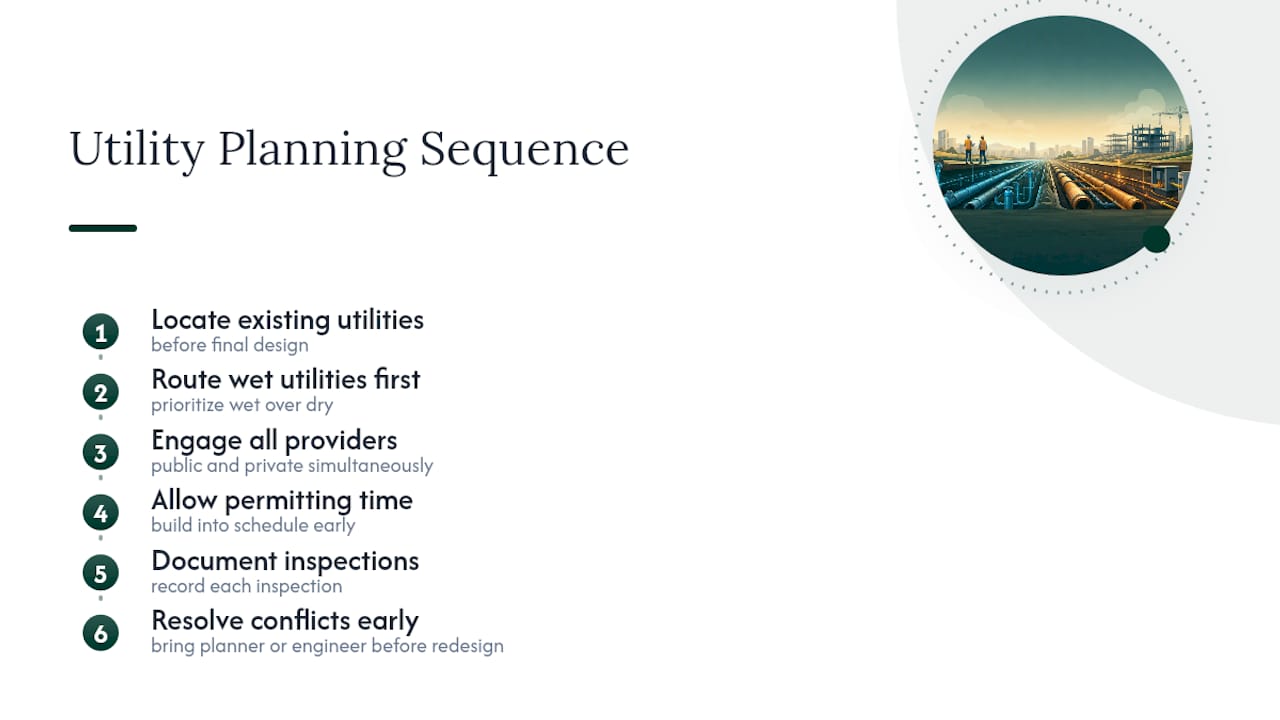
Start early, and locate every existing utility before design finalizes. Route wet utilities first, engage every provider (public and private) at the same time, and build permitting time into your schedule rather than around it. Document each inspection. When capacity or routing conflicts appear, bring in a planner or engineer before they become a redesign.
A Practitioner's Note on Utility Coordination Mistakes
The costliest mistakes rarely come from bad engineering. They come from treating wet and dry utility planning as two separate conversations that happen on two separate timelines. Sites that integrate both from the feasibility stage forward avoid the rework that sinks schedules elsewhere.
— Jeremy Wenger
Where Urban Planning Pros Fits Into Your Utility Strategy
Utility conflicts are cheaper to fix on paper than in a trench. Urban Planning Pros builds wet and dry utility coordination directly into feasibility studies and master land plans, so service capacity, corridor conflicts, and permitting sequencing get resolved before your design is locked in.

A typical engagement includes service availability checks with municipal and private providers, GPS/GIS mapping of existing infrastructure, zoning and entitlement review, and phasing recommendations that sequence wet installation ahead of dry where it matters. For sites with drainage or environmental complexity, Urban Planning Pros also coordinates wetland delineation work alongside utility planning, so one team is tracking every constraint instead of three. If you're evaluating a site or already deep into design and hitting utility conflicts, start with a feasibility study scoped to your project's specific infrastructure questions.
Sources
- Dry Utility vs. Wet Utility: Key Differences and Why It Matters for Your Project — Muller
- Wet vs Dry Utility Planning — DFM Development
- Occupational Safety and Health Administration (OSHA)
- National Fire Protection Association (NFPA)
FAQ
What are five types of utilities?
The five common utility types on a site are potable water, sanitary sewer, storm drainage, electric power, and gas, with telecom/fiber and cable often added as a sixth category.
What are some examples of wet utilities?
Wet utilities include potable water mains, sanitary sewer lines, storm drainage systems, and lift stations, all of which transport water or wastewater and require municipal permitting.
Is natural gas a dry or wet utility?
Natural gas is classed as a dry utility because it's typically installed and maintained by a private provider using shallower trenching methods, separate from municipal wet utility systems.
What is a dry utility?
A dry utility is any system that transports power or data rather than liquid, including electric, gas, telecom, fiber, and cable, usually owned and maintained by private providers rather than the municipality.