Zoning due diligence confirms whether a property can legally support your intended use and identifies the entitlements, dimensional limits, and site constraints that affect feasibility. Order a zoning report and provide it to your ALTA surveyor immediately after contract execution, since that single step preserves your leverage during the due-diligence period. The core team you need to line up early includes a land planner, a licensed surveyor, and a land-use attorney.
TL;DR:
- Confirm the property's zoning district, permitted uses, and dimensional standards before ordering reports to avoid costly surprises or limitations.
- Order a zoning verification letter, ALTA survey, and other relevant reports early within the first two weeks of the due-diligence period to ensure timely analysis and financing protection.
- Verify recorded entitlements, variances, and overlay district restrictions from official records to confirm legal compliance and identify any red flags.
- Be aware that unpermitted uses, unrecorded variances, boundary encroachments, or overlay restrictions can either kill the deal or require negotiations and fixes before closing.
- Understand that rezoning, variances, and conditional use permits involve different timelines, risks, and stakeholder approvals, requiring pre-application meetings and strategic planning.
Table of Contents
- What Does Zoning Due Diligence Actually Check?
- How Do You Verify Zoning Information Before Closing?
- What Reports and Documents Should You Order?
- Common Red Flags in Zoning Compliance Investigation
- Realistic Timelines, Costs, and Contract Protections
- When to Hire Zoning and Land-Use Experts
- How Zoning Status Affects Financing and Insurance
- How to Pursue a Rezoning, Variance, or Conditional Use Permit
- Coordinating Zoning Findings With Environmental and Building Code Reviews
- Checklist for Documenting Zoning Compliance Evidence
- Assessing Future Zoning Change Risk
- Practical Perspective From the Field
- How Urban Planning Pros Supports Your Next Deal
- Sources
- FAQ
What Does Zoning Due Diligence Actually Check?
Zoning due diligence exists to answer one question before it costs you money: does the property, as zoned today, support what you actually want to build? That means working through a specific set of items in order, not just skimming a zoning map and moving on.
Here's the sequence experienced buyers follow:
- Confirm the zoning district and permitted-use table. Match your intended use against permitted, conditional, and prohibited categories in the municipal code.
- Check dimensional standards. Setbacks, maximum height, floor area ratio (FAR), and minimum lot size all determine what you can physically build, not just what use is allowed.
- Verify parking and loading requirements. These are use-specific and frequently underestimated on tight urban parcels.
- Confirm comprehensive plan alignment and overlay districts. A property can be zoned correctly today and still sit inside a historic, flood, or corridor overlay that adds conditions.
- Pull recorded entitlements, platting status, easements, and development orders. Prior approvals run with the land, and so do their restrictions.
- Order the core reports. An ALTA survey, a Phase I environmental assessment, and a formal zoning report when the deal size or complexity warrants it.
- Classify every finding as a deal-killer or a manageable condition, and document each one for your lender or insurer.
Pro Tip: Never rely on the current tenant's use as proof of compliance. A use can look completely normal on the ground and still be operating as an unpermitted nonconforming use that a new owner cannot legally continue.
This is the backbone of any real estate zoning analysis. Skip a step here, and you're not doing due diligence. You're doing a walkthrough.
How Do You Verify Zoning Information Before Closing?
Three sources give you the real picture: the jurisdiction's GIS zoning layer, the municipal code text, and, when needed, a conversation with planning staff.
- Start with the jurisdiction's GIS zoning overlay, cross-referenced with Municode or the local code portal, to identify the district designation and pull the actual zoning text, not just a color on a map.
- Read the permitted-use table and its definitions section closely. Municipal codes often define terms like "restaurant" or "light industrial" narrowly, and ambiguous language is exactly what a land-use attorney should flag before you rely on your own reading.
- Request a zoning verification letter from the planning department, but treat it as a starting point, not a shield. These letters clarify staff interpretation, yet they aren't a definitive legal guarantee if they conflict with the actual code or recorded documents.
- Schedule a pre-application meeting with planning staff and bring a concept sketch. This is often the fastest way to learn whether your intended use will trigger a variance, a conditional use permit, or outright opposition, before you've spent real money finding out.
- Document every request, letter, and meeting date. Lenders and underwriters want a paper trail showing what you relied on and when.
Some investors now supplement this manual process with zoning intelligence platforms that aggregate parcel, overlay, and variance history for faster portfolio screening, though local staff input still matters for confirming anything these tools surface.
What Reports and Documents Should You Order?
Different deals call for different levels of documentation, and knowing which report answers which question saves both time and money.
- Zoning reports come in two tiers: a summary report confirming basic district and permitted-use status, and a standard report that adds dimensional compliance, parking analysis, and flood or overlay conditions. Lenders on larger commercial deals typically require the standard version.
- ALTA/NSPS survey, Items 6(a) and 6(b). These items require the surveyor to report client-supplied zoning information, and if you don't supply it, the surveyor must note its absence on the survey rather than guess at it. That's why ordering your zoning report before your survey matters: hand the surveyor a dated zoning letter or report so setbacks and building envelope lines actually appear on the map you're relying on for financing.
- Phase I Environmental Site Assessment. This screens for contamination risk and prior industrial use. A flagged finding triggers a Phase II investigation, which matters enormously if you're planning a rezoning or intensified redevelopment that increases exposure.
- Permit history, development orders, and recorded covenants. Pull these from the building department and the county recorder. A prior development order can lock in conditions, like a maximum unit count or a required buffer, that bind you even though nothing shows up on a current zoning map.
Commercial due-diligence handbooks consistently list these four items as the minimum standard for any transaction above a basic single-parcel purchase.
Common Red Flags in Zoning Compliance Investigation
Some zoning problems kill deals outright. Others just cost time and money to fix. Knowing the difference before you're under contract changes how you negotiate.
- Illegal or unpermitted uses. A use that looks fine can still be a violation, because most municipalities rarely conduct proactive audits and instead enforce zoning based on neighbor complaints. Check the code enforcement file, not just the current appearance of the property.
- Unrecorded variances or conditional approvals. A prior owner may have secured a variance verbally confirmed by staff but never recorded. Confirm every claimed approval against the actual permit file and title records, not a seller's assurance.
- Survey-identified encroachments and boundary conflicts. These show up on the ALTA survey and typically get resolved through a replat, a negotiated easement, or an escrowed remediation fund at closing.
- Overlay or special district constraints. Historic districts, floodplain overlays, and corridor plans can add design review, fees, or additional approval layers that a base zoning check misses entirely.
Pro Tip: When you find a fixable issue, price it, don't just flag it. A seller credit or escrow tied to a specific remediation cost moves a deal forward far faster than an open-ended "we'll figure it out."
Realistic Timelines, Costs, and Contract Protections
Most purchase agreements set a 30 to 45 day due-diligence period for zoning and title review, and that window only works if you sequence it correctly.
- Order surveys and reports on day one, not week three. An ALTA survey alone can take two to four weeks to schedule and deliver, longer if the surveyor is waiting on your zoning report to complete Item 6(a)/(b).
- Budget for entitlement timelines separately. Rezoning and platting applications commonly take several months to over a year depending on jurisdiction and hearing schedules, while conditional use permits vary widely based on public notice requirements.
- Expect report costs to scale with complexity. Zoning reports, ALTA surveys, and Phase I assessments each carry variable fees driven by parcel size, jurisdiction responsiveness, and whether a Phase II or rezoning application gets triggered.
- Negotiate explicit contingencies. Your contract should include separate zoning, financing, and environmental contingencies, each with independent termination rights, so a zoning nonconformance doesn't get bundled into a financing clause that expires first.
When to Hire Zoning and Land-Use Experts
Some findings you can resolve with a code lookup. Others need a specialist's signature before a lender or municipality will move forward.
- Surveyors deliver the ALTA/NSPS survey and depict zoning setbacks graphically when you've supplied Item 6(a)/(b) data. Required whenever a lender or title company needs a certified boundary and improvement location.
- Land-use attorneys interpret ambiguous code language, confirm vested rights, and draft the contingency language that protects you if zoning issues surface late.
- Environmental consultants run the Phase I and any follow-up Phase II work, which most lenders require before funding on commercial or industrial parcels.
- Land planners translate zoning constraints into an actual site plan, testing what density, use mix, and layout the parcel can realistically support, and this is where a feasibility study earns its cost back many times over.
Pro Tip: Don't wait for a problem to hire a planner. Bring one in during your due-diligence window, while a contingency is still open, not after you own the property and your only options are expensive ones.
As a decision rule: if in-house counsel can't cite the specific code section supporting their read of a permitted use, bring in outside land-use counsel before your contingency period closes.
How Zoning Status Affects Financing and Insurance
Lenders underwrite the zoning file almost as carefully as they underwrite the borrower. A property zoned correctly for its current use but reliant on a legal nonconforming status will often trigger a lower loan-to-value ratio, because the lender is pricing in the risk that a casualty loss or code change eliminates the right to rebuild as-is.
Title insurers price this risk too. Zoning endorsements, when available, typically require a clean zoning report and an ALTA survey with Item 6(a)/(b) completed, since the endorsement language references the specific setback and use compliance the survey depicts. Skip that survey item, and you may find the endorsement simply isn't available at any price.
Insurance carriers writing property coverage look at zoning compliance for a related but distinct reason: rebuild cost. If a structure is nonconforming and a total loss would force the owner into a smaller or differently configured replacement, that materially changes replacement-cost calculations and can affect both premium and coverage limits.
This is why the sequencing matters so much. A buyer who orders the zoning report late, after the appraisal and loan commitment are already moving, often discovers the mismatch too late to renegotiate terms. Ordering the zoning report and ALTA survey inside the first two weeks of your due-diligence period gives your lender, title company, and insurer time to flag concerns while your financing contingency is still open, not after you're contractually locked in.
How to Pursue a Rezoning, Variance, or Conditional Use Permit
When the zoning report shows your intended use doesn't fit as-of-right, you have three main paths, and each carries a different risk profile and timeline.
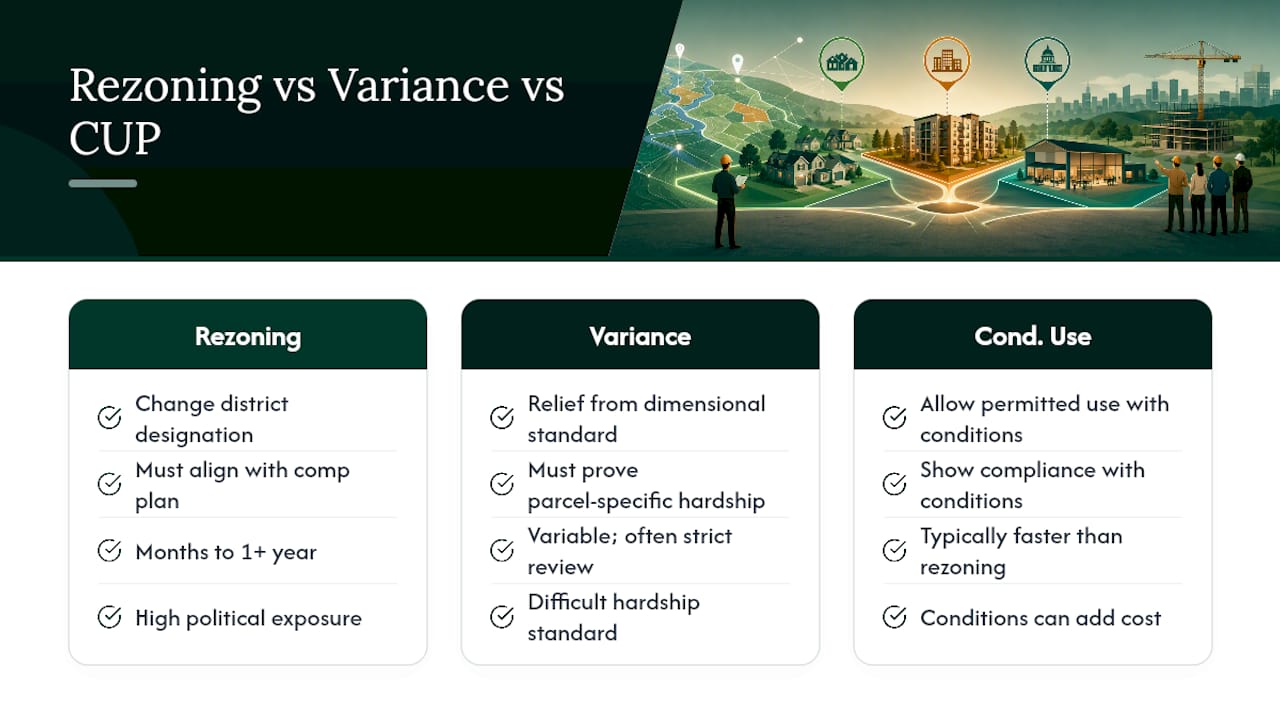
A rezoning changes the district designation itself and requires alignment with the comprehensive plan, a legislative hearing, and often the most political exposure of the three options. Expect months to over a year depending on jurisdiction, and budget for the possibility that neighboring property owners organize opposition.
A variance asks for relief from a specific dimensional standard, like a setback or height limit, without changing the underlying zoning. Variances require proving hardship unique to the parcel, not just financial inconvenience, and boards apply that standard strictly in most jurisdictions.
A conditional use permit (sometimes called a special exception) allows a use that's permitted in the district but only under specific conditions, like additional buffering or traffic mitigation. These typically move faster than a rezoning since the use is already contemplated in the code, but the review board can attach conditions that add real cost.
For any of these three, a pre-application meeting with planning staff before you file is close to essential. Staff can tell you whether your concept has a real chance or is likely dead on arrival, and that conversation is far cheaper than a denied application. Bring a concept sketch, not just a narrative description, and treat the meeting as due diligence on the approval process itself, not a formality.
Coordinating Zoning Findings With Environmental and Building Code Reviews
Zoning due diligence doesn't happen in isolation. The findings from your zoning report directly change what your environmental consultant and building code reviewer need to look for, and running these three tracks separately is how buyers miss connections that matter.
If your zoning report flags a prior industrial use permitted under the district's history, that same fact should trigger a closer Phase I environmental review, since prior industrial permits often correlate with contamination risk the environmental consultant needs to scope specifically, not generically.
Building code review works the other direction. A structure that's zoning-compliant today can still carry building code violations from unpermitted renovations, and a building code review can surface work that was never zoning-approved in the first place, like an added unit or expanded footprint that never went through site plan review.
The practical fix is simple: share each report as it comes in across your full consultant team, not just with the party who ordered it. A land planner reviewing the zoning report alongside the Phase I findings and the building code inspection can often spot a single underlying issue, like an unpermitted expansion, that shows up as three separate red flags across three separate reports. Catching that connection early is exactly the kind of coordination a feasibility study is built to deliver.
Checklist for Documenting Zoning Compliance Evidence
Every finding from your zoning due diligence needs to survive scrutiny from a lender, a title insurer, or a future buyer's own due-diligence team. That means documentation discipline from day one.
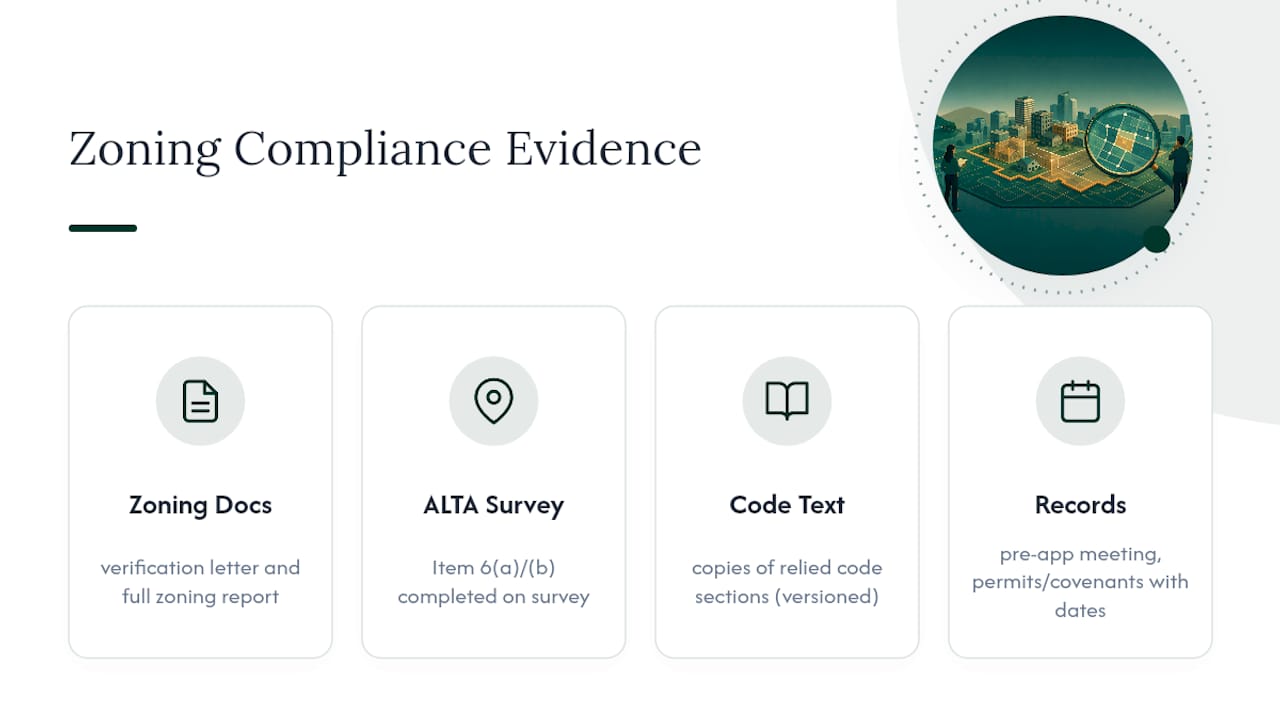
Keep a dated file containing the zoning verification letter, the full zoning report, the ALTA survey with Item 6(a)/(b) completed, and copies of the specific code sections you relied on, since code text changes and you'll want the version in effect at the time of your review. Save the written record of your pre-application meeting, including staff names and the date, because that meeting often becomes your best evidence of good-faith reliance if a dispute arises later.
Record every permit, development order, and recorded covenant you pulled from the building department and county recorder, along with the date you pulled it. If you found and resolved a red flag, whether through an escrow, a seller credit, or a negotiated remediation, keep the closing documents that show how it was resolved, not just that it was resolved.
This file isn't just paperwork. It's the evidence base your lender's underwriter, your title insurer, and any future buyer's attorney will ask for, and having it organized and dated turns a potential closing delay into a same-day confirmation.
Assessing Future Zoning Change Risk
Today's zoning district is not a permanent fact. Comprehensive plan updates, corridor studies, and neighborhood rezoning initiatives can all shift what's permitted on a parcel years after you close, and smart buyers price that risk into their decision rather than ignoring it.
Start by reading the jurisdiction's current comprehensive plan and any adopted corridor or area plans covering your parcel. Zoning maps eventually follow comprehensive plans, so a plan that designates your area for higher density or a different use category than current zoning is a signal, not a guarantee, that rezoning pressure exists in either direction.
Check for pending or recently adopted text amendments to the zoning code itself. Municipalities often telegraph future changes through study sessions and planning commission agendas months before a formal amendment reaches a vote, and those agendas are public record.
Talk to planning staff directly about known initiatives. Staff won't predict outcomes, but they will usually tell you if a corridor study or neighborhood plan update is actively underway, which is exactly the kind of forward-looking intelligence a land planner factors into an entitlement strategy built for a multi-year hold, not just the closing date.
Practical Perspective From the Field
The zoning mistakes that cost buyers the most rarely come from missing paperwork. They come from treating visible use as proof of legal use, and from ordering the survey before the zoning report exists to inform it.
If you triage anything first, triage this: confirm permitted use and pull the code section that proves it, before you spend a dollar on anything else. That single step preserves every option you have left. Treat zoning due diligence as protecting the value you're paying for, not a box to check on the way to closing.
— Jeremy Wenger
How Urban Planning Pros Supports Your Next Deal
The checklist above works. It also takes real time to execute correctly across zoning code review, survey coordination, and entitlement strategy, which is exactly where most buyers run out of due-diligence window. Feasibility studies can combine zoning constraint review, permitted-use analysis, and site capacity testing into one coordinated deliverable, so you're not piecing together findings from four separate consultants on a deadline.

The firm's feasibility study services evaluate your property's zoning constraints, entitlement path, and market direction before you're locked into a closing date. For deals that need broader coordination, from survey and engineering alignment to owner representation through entitlement approvals, the full land planning services cover the full arc from initial review to execution. If you're still in the early stage of sizing up a parcel, request a feasibility snapshot to see what your zoning district actually supports before your due-diligence clock runs out.
Sources
For standards on survey items, consult ALTA/NSPS guidance on Item 6(a)/(b). For due-diligence checklists and minimum report standards, see the NV5 commercial due diligence handbook. For land capability scoring on agricultural parcels, review USDA LESA materials and related land management practice notes.
- ALTA/NSPS FAQs — NSPS
- HANDBOOK FOR COMMERCIAL REAL ESTATE DUE DILIGENCE — NV5
- Is this letter worth the paper it’s printed on? — SOG/UNC
- Zoning due diligence: A critical step in redevelopment — Abrams Law Firm
FAQ
What Are the Three Types of Due Diligence?
Real estate deals typically involve legal due diligence (title, entitlements, contracts), physical due diligence (survey, environmental, structural condition), and financial due diligence (income, expenses, market comparables). Zoning due diligence spans both the legal and physical categories, since it covers recorded entitlements and the physical dimensional standards a survey confirms.
What Are the "Four P's" of Due Diligence?
Definitions vary by industry, but in real estate practice the concept commonly maps to property, price, permitted use, and protections, meaning what the asset physically is, what it costs, what it's legally allowed to be used for, and what contract terms shield the buyer if problems surface.
What Are Red Flags in Due Diligence?
The most common zoning red flags are unpermitted or illegal nonconforming uses, unrecorded variances or conditional approvals, survey-identified encroachments, and overlay district restrictions that add fees or approval conditions beyond base zoning.
How Much Does a Due Diligence Report Typically Cost?
Costs vary significantly by report type, parcel complexity, and jurisdiction, so there's no single reliable figure to quote. Zoning reports, ALTA surveys, and Phase I environmental assessments each carry their own fee structure, and a feasibility study that bundles zoning and site analysis together is often more cost-effective than ordering each piece separately.
How Long Does the Zoning Due Diligence Period Usually Last?
Most purchase agreements set a 30 to 45 day due-diligence window for zoning and title review, though complex entitlement questions or required rezoning applications can extend that timeline well beyond the initial contingency period.