A zoning variance is a narrow, property-specific exception to your local zoning ordinance, not a rezoning of your land. If your project violates a setback, height limit, or lot coverage rule because of something unusual about the property itself, a variance is likely your path. Start by pulling your local zoning code or calling the zoning office to confirm the exact violation and identify the hearing body that reviews variance requests.
TL;DR:
- Variances are property-specific exceptions for dimensional or use restrictions that do not reclassify the land's zoning district.
- Most applications require proof of unnecessary hardship, unique property conditions, minimal relief needed, and no substantial public harm, with self-created hardships being a common cause of denial.
- The approval process typically takes around 90 days, but delays can occur from environmental reviews, additional paperwork, or backlog, so planning ahead is essential.
- Preparing thoroughly for the hearing by gathering neighborhood support, clear documentation, and concise testimony significantly improves chances of approval.
- Engaging a land planning consultant is advisable for complex cases or use variances to strengthen application quality and reduce rejection risk.
Table of Contents
- Understanding the Zoning Variance Process: Variance vs. Rezoning vs. Conditional Use
- What Do Zoning Boards Require Before Approving a Variance?
- How Long Does the Zoning Variance Approval Process Take?
- How to Prepare for a Zoning Board Hearing
- What Happens After a Variance Decision Is Made?
- Common Zoning Variance Mistakes That Lead to Denial
- When to Bring In a Land Planning Consultant
- Why the "Just File It" Approach to Variances Usually Backfires
- Get Professional Help With Your Variance Application
- Where to Verify Your Local Variance Rules
- Sources
Understanding the Zoning Variance Process: Variance vs. Rezoning vs. Conditional Use
A variance is a single-property exception that leaves the underlying zoning designation untouched. It grants relief from one specific dimensional or use rule without reclassifying the land, which is what separates the zoning variance process from a full rezoning application.
Two categories cover almost every request:
- Area (dimensional) variances address measurable standards like setbacks, height, or lot coverage. Boards approve these more often because the impact is usually confined to the parcel itself.
- Use variances permit an activity the zoning district otherwise prohibits, such as running a small business from a residentially zoned lot. These face a steeper evidentiary bar, and some jurisdictions don't allow them at all, according to the Wisconsin Extension land use training program.
Rezoning changes the district classification permanently and affects future owners. A conditional use permit (sometimes called a special exception) authorizes a use the code already anticipates under specific conditions, unlike a use variance, which asks the board to allow something the code doesn't contemplate at all. Confusing these three paths is the fastest way to file the wrong application.
What Do Zoning Boards Require Before Approving a Variance?
Every jurisdiction phrases its standards a little differently, but most boards look for the same four findings before granting relief.
- Unnecessary hardship or practical difficulty. The property, as zoned, can't reasonably be used without the variance.
- Conditions unique to the property. Steep topography, an irregular lot shape, or a legal nonconforming structure that predates current code.
- Minimum necessary relief. The request asks for no more than what's needed to solve the problem.
- No substantial detriment to the public good. Neighbors, traffic patterns, and community character stay largely unaffected.
Self-created hardship sinks more applications than any other single issue. If a prior owner subdivided a lot into a substandard shape or built an addition without permits, and that choice created the need for relief, boards typically deny the request. The fix is documentation: title history, historical photos, and survey records that show the condition existed before your ownership, according to the UNC School of Government's analysis of variance standards.
Pro Tip: Pull your property's chain of title and any prior building permits before you write your hardship statement. If the unique condition existed before you bought the land, that timeline is your strongest evidence.
How Long Does the Zoning Variance Approval Process Take?
The application workflow follows a fairly consistent sequence across most U.S. jurisdictions, though local terminology and fees vary.
- Pre-application check. Some cities require a building permit application or preliminary zoning review before they'll accept a variance filing. New Orleans, for example, won't docket an application until this step is complete, and incomplete filings get rejected outright, according to the City of New Orleans variance request page.
- Assemble your documents. A completed application form, a stamped survey or site plan, a written hardship statement tied to each approval finding, photographs of the property, supporting exhibits, and the filing fee.
- Completeness review. Staff checks the package against a jurisdictional checklist before accepting it for processing.
- Public notice. Mailed notices to adjacent property owners and a posted sign on the site, both with fixed deadlines before the hearing.
- Staff report. Planning staff publish a written analysis, often about a week before the hearing, addressing whether the request meets each legal standard.
- Public hearing and decision. The board hears testimony, reviews the staff report, and votes.
Timeline example: Fairfax County, Virginia, lists roughly 90 days from application acceptance to the public hearing, covering agency distribution, notice periods, and staff report preparation.
That 90-day window assumes a clean application. Environmental review requirements, multiple rounds of staff corrections, or a hearing calendar backlog can push the timeline out several additional months. Building slack into your project schedule from the start avoids a construction delay you didn't plan for.
How to Prepare for a Zoning Board Hearing
Winning at the hearing starts weeks before you walk into the room. Early neighborhood outreach matters more than most applicants expect: collecting support letters and submitting them to staff before the report is published carries far more weight than presenting them cold at the hearing, since staff-vetted letters actually shape the written recommendation the board reads first.
- Photograph the property and tidy it up before any scheduled site visit; board members often see the parcel in person.
- Bring a professional site plan and elevation drawings that clearly illustrate the relief you're requesting.
- Keep your hearing testimony concise and structure it around the exact approval criteria, point by point, rather than a general narrative about the project.
- If opposition surfaces, offer a reduced version of your request rather than standing firm on the original ask. A smaller variance approved beats a larger one denied.
Pro Tip: Draft a one-page summary that maps each fact about your property directly to a required finding. Boards move faster, and vote more favorably, when you've already done the analytical work for them.
What Happens After a Variance Decision Is Made?
A board's decision generally falls into one of three outcomes, each with its own downstream steps.
- Approved with conditions. The most common result. Conditions might limit the height of an addition or require landscaping buffers, and they typically carry compliance windows, commonly 12 to 24 months to start work before the approval lapses.
- Deferred. The board asks for more information or a redesign before voting; you return to a future hearing date.
- Denied. You can pursue an administrative rehearing, a judicial appeal in court, or come back with a redesigned, reduced request that addresses the board's objections directly.
Missing an expiration deadline means starting the entire application over, so calendar every condition the moment you receive the written decision.
Common Zoning Variance Mistakes That Lead to Denial
Most denials trace back to a handful of avoidable errors.
- Self-created hardship. If you or a prior owner caused the condition needing relief, document the property's original state or expect a denial.
- Incomplete applications. Missing surveys, unpaid fees, or absent exhibits stall your filing at the completeness review stage before it ever reaches a hearing.
- Overreaching requests. Asking for more relief than the hardship justifies invites scrutiny and opposition; scale the request to the minimum necessary.
- Skipping early outreach. Waiting until the hearing to face neighbors for the first time practically guarantees pushback the board can't ignore.
When to Bring In a Land Planning Consultant
Complex topography, contested hearings, or use variance requests raise the stakes enough that professional guidance changes outcomes. Urban Planning Pros works through feasibility studies, entitlement strategy, and full application packaging, including the site documentation and hardship narratives boards expect to see.
A consultant engagement typically covers zoning and survey review, a defensible hardship statement tied to your jurisdiction's specific findings, hearing representation, and coordination with surveyors or engineers when a project needs stamped exhibits. For a use variance or a site with genuine physical constraints, that upfront analysis through Understanding Your Zoning Classification often costs far less than a rejected application and a second filing fee.
Why the "Just File It" Approach to Variances Usually Backfires
Most guidance on zoning variances treats the application form as the hard part. It isn't. The form takes an afternoon. What actually determines outcomes is whether the hardship statement was written before or after someone checked the title history, and whether neighbor letters reached the planning department weeks before the hearing instead of showing up as a surprise on hearing night.
The conventional advice, fill out the checklist, show up, answer questions, undersells how much of this process gets decided on paper before anyone speaks publicly. Staff reports shape board votes more than testimony does, and staff reports get written from whatever documentation sits in the file a week before the hearing. Applicants who treat that report as the real target, not the hearing itself, tend to fare better.
If there's one place to prioritize effort, it's proving the property's condition predates your ownership. Self-created hardship denials are almost entirely preventable with a title search and some patience, yet they remain one of the most common reasons variances fail. That's not a legal technicality. It's the single fact pattern boards are required to reject, regardless of how sympathetic the project looks otherwise.
— Jeremy Wenger
Get Professional Help With Your Variance Application
Urban Planning Pros is the alternative to filing blind and hoping the hardship statement holds up. Where a DIY application risks a self-created hardship denial or an incomplete filing bounced back at completeness review, our feasibility studies identify the property's genuine constraints and build the documentation record before you ever submit paperwork.

If you're weighing whether your project qualifies, the next step is straightforward: send us your survey and a description of the zoning conflict, and we'll scope what a full feasibility study looks like for your parcel. For projects that need broader coordination, from entitlement strategy to engineering, our land planning services cover the full path from initial evaluation to hearing representation. Book a call and get a clear read on your odds before you file anything.
Where to Verify Your Local Variance Rules
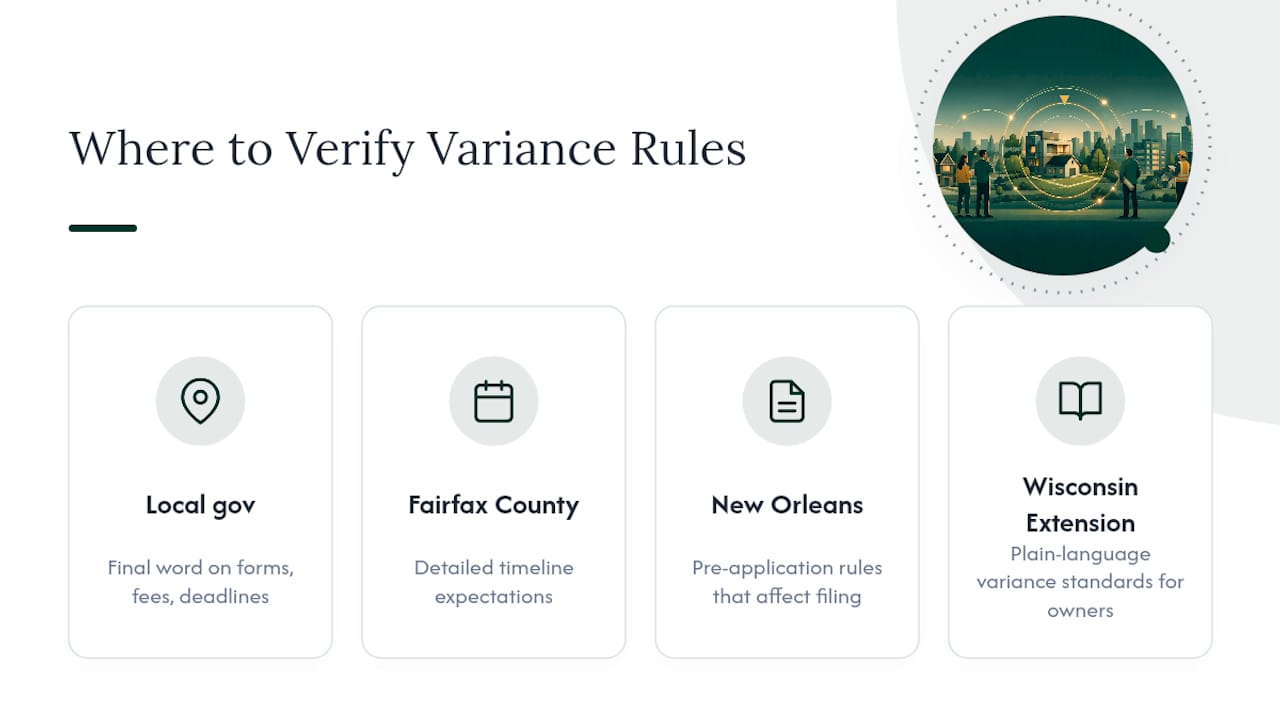
Zoning variance procedures vary by city and county, so your local government's own pages are the final word on forms, fees, and deadlines. Fairfax County's variance process page lays out timeline expectations in detail, while the City of New Orleans page shows how pre-application requirements can affect filing. The Wisconsin Extension's land use training resource explains variance standards in plain language for property owners nationwide.
Sources
- What Is a Zoning Variance? How It Works and How to Get One
- Variances – Land Use Training & Resources (UW Extension)
- Variance Process | Planning Development (Fairfax County)
- Variance Request - City of New Orleans
- Variance standards and the self-created hardship rule (UNC SOG blog)